
Introduction
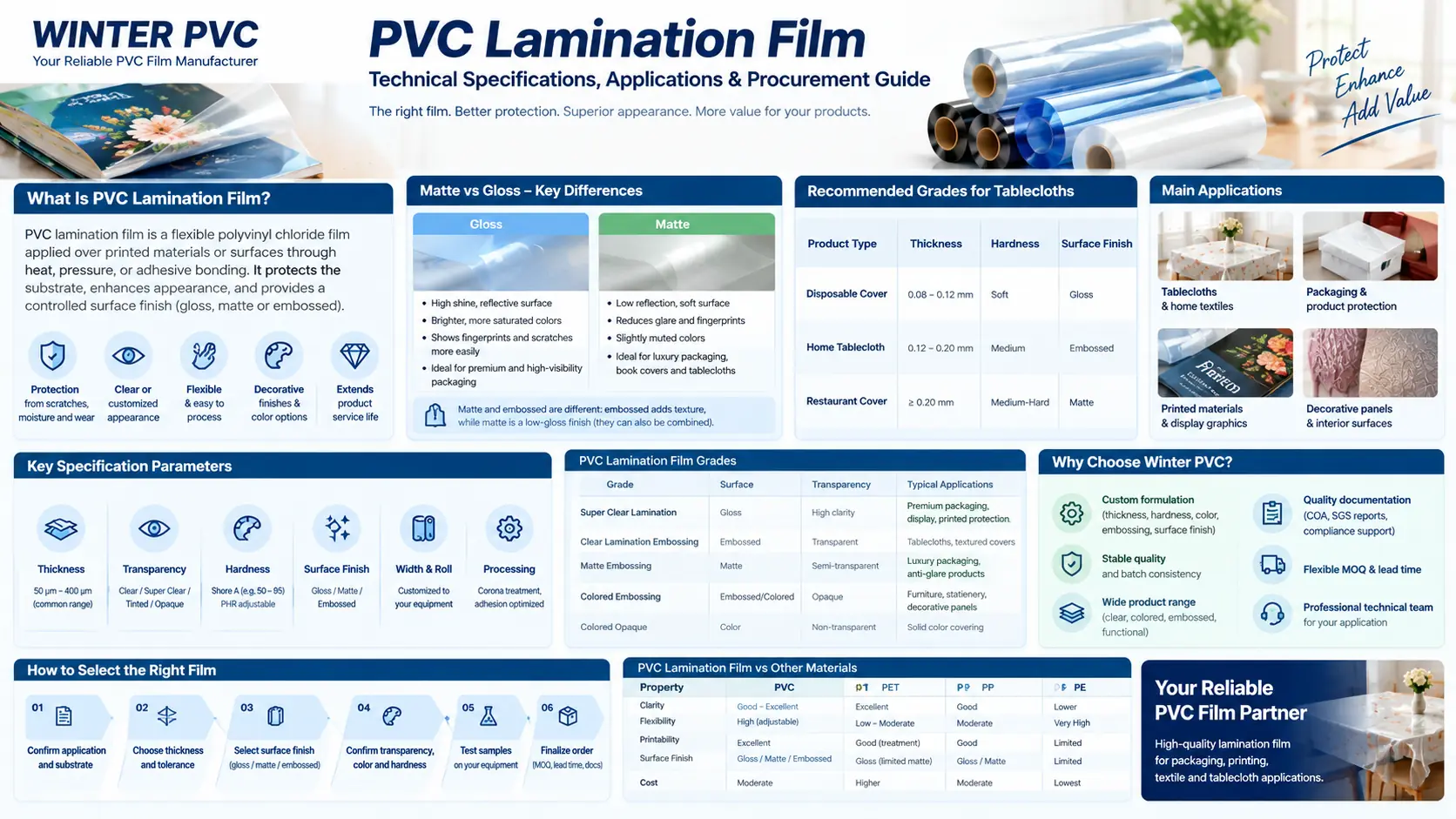
If you are a procurement manager, printing company, packaging converter, or industrial buyer sourcing lamination materials, the range of films on the market can be confusing. PVC lamination film, PET, PP, and PE film look similar on a data sheet, yet behave very differently on a production line and in the final product. PVC lamination sheet, by contrast, is supplied from 0.6 mm to 3.0 mm.
This guide explains what PVC lamination film is, how it works, how it differs from other films, and which specifications matter when evaluating a PVC film supplier. The lamination range spans 0.045 mm to 3.0 mm. It is written from a manufacturer’s perspective: in industrial procurement, what matters is not marketing language but measurable parameters such as thickness tolerance, transparency, hardness, roll quality, and the supplier’s ability to hold those parameters across batches.
1. What Is PVC Lamination Film?
PVC lamination film is a thin, transparent layer of polyvinyl chloride (PVC) applied over printed materials or surfaces through heat, pressure, or adhesive bonding. Its function is not to carry ink but to cover a printed or finished surface and give it:
- Protection against scratching, scuffing, and abrasion during handling and shipping
- Improved appearance through a consistent gloss or matte finish
- Scratch resistance that keeps printed graphics legible over time
- Moisture resistance against water contact, humidity, and light spills
- Extended service life by shielding the printed layer from physical and environmental wear
Lamination film is applied after printing is complete. It is a finishing layer, not a printing substrate. Lamination sheet starts at 0.6 mm gauge. This distinction matters when sourcing, because the technical requirements for a lamination film differ from those of a film designed to be printed on. Matte embossing film, for example, is supplied at 0.045–0.50 mm in a 24–52 PHR range.
PVC lamination film is commonly used in packaging, printing, labels, book covers, stationery, decorative panels, table cloth and plastic table cloth production, and selected industrial applications. Table cloth film starts at 0.07 mm thickness. The appropriate film depends on the substrate, bonding method, required flexibility, surface finish, and protection level. Lamination sheet is supplied at 1.0–2.0 m roll width.
PVC Lamination Film vs PVC Protective Film vs Adhesive PVC Film
Buyers frequently confuse three related but distinct products; clarifying this early prevents specification errors.
PVC lamination film is a finishing film applied over printed or decorative surfaces through lamination equipment, usually with adhesive or thermal bonding.
PVC protective film is a temporary covering applied to finished products such as metal sheets, acrylic panels, glass, or painted surfaces to protect them from scratches and dirt during transport, storage, and installation. It is usually removed after installation and engineered for clean peel off, not permanent lamination. The adhesive-free static cling option is supplied at 0.04–0.40 mm. A related category is static cling film, which holds to smooth surfaces through electrostatic attraction rather than adhesive and is used for temporary protection and changeable graphics.
Adhesive PVC film (self adhesive) carries a pressure sensitive adhesive on one side and is applied by hand or with simple tools. It is used for vehicle wrapping, window graphics, and surface covering, where the film itself is the decorative element.
In short: lamination film protects what is underneath, protective film temporarily shields a product, and adhesive film decorates a surface directly. Lamination grades run from 0.045 mm to 3.0 mm.
2. How PVC Lamination Film Works
Lamination is a finishing step that combines the printed substrate and the film into one bonded structure. Typical lamination sheet gauges run from 0.6 mm to 3.0 mm. Its success depends on the film formulation, the adhesive system, and equipment settings. Gauge is quoted in mm or μm, where 1 mm equals 1,000 μm.
The Lamination Process Step by Step
→
Adhesive application or thermal bonding
→
PVC lamination film applied
→
Heat and/or pressure
→
Protected finished surface
Two bonding methods are used:
Thermal lamination. The PVC film and printed material pass through heated rollers; heat activates the adhesive and pressure bonds the film to the substrate. Common for paper and board products such as book covers and packaging. Clear overlay grades run from 0.07 mm to 0.50 mm.
Adhesive (wet or solvent) lamination. A liquid adhesive is applied to the film or substrate before the two are joined under pressure. Used when the substrate cannot tolerate heat or a specific adhesive chemistry is required.
Surface Adhesion and Printing Compatibility
Adhesion quality determines whether the film stays bonded or begins to lift at edges and corners. Influencing factors:
- Substrate surface energy: coated papers and boards bond more predictably than uncoated or textured surfaces
- Ink system compatibility: the film must bond without reacting with the ink; solvent, UV, and water based inks differ
- Adhesive type and coating weight: the layer must be uniform and matched to substrate porosity
- Film softness: a softer film conforms better to creases and folds, reducing delamination risk
Thickness Selection and Surface Treatment
Film thickness changes behavior: a thin film (around 15 to 25 micron) adds light protection and follows substrate texture; a thicker film (50 micron and above) provides stronger protection but is stiffer, which can affect creasing and folding. The right thickness balances protection against downstream processability. A 0.20 mm film consumes about twice the resin per square metre of a 0.10 mm film.
Surface treatment also matters. Some PVC lamination films receive corona or chemical treatment to improve wetting and adhesion. Compliance parameters can be verified by third-party report such as SGS CANEC26010536001 (EN 14372:2004, GC-MS). If your application involves further finishing such as foil stamping, embossing, or adhesive application over the laminated surface, the film’s surface characteristics determine whether those steps succeed.
3. Matte vs Gloss Lamination Film: Comparison and Selection
The choice between matte and gloss affects appearance, handling performance, color perception, and surface behavior.
| Property | Gloss Lamination Film | Matte Lamination Film |
|---|---|---|
| Appearance | High shine, reflective surface | Soft, low shine, smooth velvet-like surface |
| Surface reflection | Strong, mirror-like reflection | Minimal glare, diffused reflection |
| Fingerprint resistance | Low; fingerprints and smudges visible | High; fingerprints far less visible |
| Scratch visibility | Scratches more visible | Scratches less noticeable |
| Color appearance | Deeper, brighter, more saturated | Softer, slightly muted |
| Cleaning performance | Easy to wipe clean with minimal residue | Smudge marks may need more effort |
| Typical applications | Premium packaging, product labels, display graphics, promotional materials | Luxury packaging, book covers, office materials, high-end printed products |
Gloss PVC Lamination Film
Gloss lamination film delivers a smooth, highly reflective surface. Its advantages are visual:
- High transparency: does not dull the printed colors underneath
- Brighter colors: enhances saturation, making blacks deeper and colors more vivid
- Stronger visual impact: reflective surfaces draw attention on retail shelves
- Smooth surface: a polished, uniform finish
Typical applications are premium packaging, product labels, display graphics, and promotional materials, products competing for attention under retail lighting.
The trade off: gloss surfaces show fingerprints and scratches more easily, so products need careful handling during distribution.
Matte Embossing Film
Matte lamination film has a low reflection surface. Its advantages:
- Reduced glare: no direct light reflection, improving readability under strong lighting
- Soft appearance: a restrained, understated look associated with higher end products
- Better readability: text is easier to read in bright conditions
- Less fingerprint visibility: the diffused surface hides smudges on frequently handled products
Typical applications are luxury packaging, book covers, office materials, and high end printed products, items where a premium feel and long term presentation matter more than color pop.
Embossed variants extend the finish range further. These grades are supplied on 0.6–1.285 m master rolls. Clear lamination embossing film combines transparency with a defined texture, which is useful when the printed layer must remain visible beneath a tactile surface. Where both low gloss and texture are required, a matte embossing film delivers both in a single layer. Clear lamination embossing film is supplied at 0.6–3.0 mm on 0.6–2.0 m rolls.
Many converters use gloss outside for shelf impact and matte inside for contrast.
4. PVC Lamination Film Specification Guide
When requesting a quotation from a PVC film supplier, the following parameters define the product.
Thickness
PVC lamination film thickness is measured in microns (µm; 1 micron = 0.001 mm). Common industry lamination thicknesses range from approximately 15 to 150 micron. Winter PVC’s production range for lamination film can be confirmed against your specific application. Our sheet range covers 0.6–3.0 mm and 22–60 PHR.
- Thinner film (15 to 30 micron): lightweight protection, high flexibility, follows substrate texture; suits documents, book covers, and labels
- Mid range (30 to 80 micron): balanced protection and stiffness; common for packaging and presentation covers
- Thicker film (80 micron and above): strong mechanical protection, stiffer hand feel; suits industrial applications
Thicker film protects better against impact and abrasion but is less flexible and can complicate creasing and die cutting. Confirm that the specified thickness is compatible with your finishing equipment, and see our PVC film thickness guide for unit conversion and application benchmarks.
Transparency
Transparency is defined by two measurable parameters:
- Total light transmittance: light passing through. High-transparency films may achieve total light transmittance above 90%, depending on formulation and thickness.
- Haze: the percentage of light scattered in passing; lower haze means clearer film
High transparency PVC film preserves printed colors without a milky cast. If your products carry fine text or barcodes, ask for the haze value of the specific formulation, and compare values within the same thickness. For example 100 μm (0.10 mm).
Suppliers describe these grades commercially rather than to a single standard. Normal clear film is the general-purpose option where slight haze is acceptable. Super clear film and its lamination-grade version, super clear lamination film, are specified where low haze and high light transmission are the point. Colored super clear film adds a tint while retaining clarity. Because these are descriptive names, compare haze and transmittance values at the same thickness. 0.25 mm equals 250 μm. For a full comparison, see Clear PVC Film vs Super Clear PVC Film.
Surface Finish
Surface finish is controlled at the manufacturing stage, not after lamination:
- Gloss finish: smooth calendered surface with high reflection
- Matte finish: a low reflection surface produced through controlled surface texture or matting
- Embossed texture: a defined three dimensional pattern such as linen, leather grain, or custom texture
Matte and embossed are related but not identical. A film can be smooth matte or embossed matte, depending on the surface structure. Embossed matte grades are produced from 0.045 mm upward. The finish is part of the film’s formulation and roll configuration and cannot be changed on site. Specify it at the inquiry stage.
Color follows the same logic as transparency. Colored opaque film is supplied at 0.06–0.50 mm in a 26–54 PHR range. Colored opaque film hides the substrate entirely and becomes the decorative surface itself, so hiding power and batch-to-batch color consistency matter more than clarity. Colored embossing film combines an opaque decorative color with a textured surface, typically for furniture and interior applications. Colored embossing film is supplied at 0.045–0.50 mm in a 24–52 PHR range.
Hardness and Flexibility
PVC film hardness is adjusted during formulation by the ratio of plasticizer to resin. Two terms you will encounter:
- PHR (parts of plasticizer per hundred parts of resin): higher PHR means a softer, more flexible film. PHR is a formulation input, not a finished film hardness measurement.
- Shore A hardness: a durometer measurement taken on the finished film; lower values indicate softer film.
The two are related but not interchangeable. A formulation at one PHR can produce different Shore A readings depending on plasticizer type, resin grade, and filler content. Our lamination range spans 22–66 PHR overall. For procurement, specify the target Shore A and let the supplier confirm the formulation. As a definition, 40 PHR means 40 parts of plasticizer per 100 parts of resin.
Hardness affects behavior: softer film conforms to curved surfaces and creases cleanly; harder film holds its shape but is more brittle in cold conditions. Lamination film needs a balance, soft enough to bond cleanly, firm enough to lay flat through the rollers without wrinkles. For how plasticizer loading changes mechanical behavior across grades, see Rigid vs Flexible PVC Film and Flexible vs Soft PVC Film.
Width and Roll Specification
Roll dimensions affect your line efficiency:
- Roll width: must match your machine’s width capability; wider rolls mean fewer joins and less waste
- Core size: typically 3 inch (76 mm) or 6 inch (152 mm); confirm it matches your unwind shaft
- Winding: even winding prevents telescoping and edge damage; specify maximum roll weight and acceptable joins
Ask for the supplier’s standard width range and cutting tolerance, since width deviation can cause edge exposure on your line.
5. PVC Lamination Film Manufacturing Process
Understanding how PVC lamination film is made helps you evaluate supplier claims and identify manufacturers that can realistically hold tight tolerances. Calendering based PVC film manufacturers follow this process:
→
PVC formulation
→
Mixing
→
Calendering or extrusion
→
Surface treatment
→
Embossing (optional)
→
Inspection
→
Roll packaging
Raw material preparation and formulation. The recipe starts with PVC resin, plasticizer, heat stabilizer, and additives; component choice and dosage determine hardness, clarity, and durability. The recipe is calculated against target specifications. Gauge is verified in μm, where 0.6 mm equals 600 μm. If the customer requires a specific Shore A hardness or transparency level, the formulation is adjusted accordingly. Static cling film sits at 50–66 PHR. Consistent recipes keep batch to batch quality stable. Third-party phthalate screening is reported at an MDL of 0.003%.
Mixing. Raw materials are blended in high speed mixers until homogeneous; incomplete mixing causes defects such as specks, gels, or uneven softness.
Calendering or extrusion. The mixed compound is melted and formed into a continuous film. In calendering, heated rollers compress the compound to a precise thickness; this is the dominant method for flexible PVC film because it delivers excellent thickness uniformity across wide widths. Thickness is verified in μm, where 0.045 mm equals 45 μm. Extrusion serves some product lines and specialty formulations.
Surface treatment. The surface may be treated to control gloss, improve adhesion, or prepare for subsequent processing.
Embossing (optional). For textured finishes, a heated embossing roll transfers the pattern onto the film surface. Matte appearance can be produced through controlled surface texturing or matting processes; embossed finishes additionally use a defined three dimensional pattern. Textured grades are supplied on 0.6–1.285 m master rolls.
Inspection. Production batches are inspected for thickness, transparency, surface defects, and physical properties according to the applicable quality control requirements.
Roll packaging. The film is slit to width, wound onto cores, and packed to protect edges and surface during shipping. Master roll widths across the range run from 0.6 m to 2.45 m.
For a full explanation of production methods and quality control across PVC film categories, see our PVC Film Manufacturing Process guide. For formulation-level detail on plasticizer systems and soft film production, see Soft PVC Film Manufacturing.
Quality Control and Testing
For applications requiring batch to batch consistency, buyers should request batch level QC records. Key tests to ask about:
- Thickness tolerance: across and along the roll; typical industry tolerance is plus or minus 0.01 to 0.03 mm depending on grade. Confirm the specific tolerance for your order.
- Transparency testing: transmittance and haze against target values
- Tensile strength: the force the film withstands before breaking
- Elongation: stretch before breaking; affects roller and creasing behavior
- Surface quality: inspection for fish eyes, gels, specks, streaks, and edge damage
- Hardness testing: Shore A readings confirming the formulation matches the specified softness
Ask which tests are performed, how often, and whether records can be shared; a manufacturer that can produce a COA per batch provides a more auditable supply chain.
6. PVC Lamination Film Applications
Different applications impose different requirements on the film. The table below maps application to required film characteristics; for a wider view across packaging, lamination and surface protection, see the PVC Film Applications Guide and Soft PVC Film Uses in Industrial Applications.
| Application | Main Requirement | Required Film Characteristics |
|---|---|---|
| Cosmetic packaging | Appearance and scratch resistance | Clear or gloss film with controlled thickness and consistent surface finish |
| Gift boxes | Durability and edge bonding | Reliable adhesion on coated board and uniform finish |
| Book covers | Folding and flexibility | Softer formulation and suitable thickness for clean creasing |
| Labels | Moisture resistance and print clarity | High transparency and consistent surface |
| Advertising graphics | Scuff resistance and rollability | Balanced stiffness and surface durability |
| Decorative panels | Appearance and surface durability | High clarity and controlled finish |
| Stationery | Frequent handling and fingerprint resistance | Matte finish often preferred for durability |
Packaging Industry
- Cosmetic packaging: boxes requiring a clean, uniform finish under store lighting
- Gift boxes: rigid boxes where lamination must survive repeated handling without edge lifting
- Printed packaging surfaces: folding cartons and sleeves where the film protects print and adds a defined finish
Packaging buyers prioritize consistent thickness, reliable adhesion on coated board, and finish uniformity. Protective packaging is a separate requirement: mattress packing film must conform around compressed foam and resist puncture through the distribution chain, which calls for a softer, tougher formulation than a print-finishing lamination. For grade and specification detail, see Soft PVC Film for Packaging Applications.
Printing Industry
- Posters: large format prints that are rolled, shipped, and displayed, requiring scuff resistance without becoming too stiff to roll
- Advertising graphics: display graphics and point of sale materials facing dust, light, and cleaning
- Display materials: menus, table cards, and signage that resist repeated wiping
Stationery Industry
- Notebook covers: soft, flexible film that creases cleanly at the spine
- Document covers: film that protects frequently handled folders while keeping text readable
Stationery products are handled constantly, so fingerprint resistance and edge durability make matte finishes practical.
Decorative Applications
- Furniture surface protection: a transparent layer over printed or finished furniture panels
- Decorative panels: interior wall panels where the film protects the decorative layer and controls the sheen
In decorative use, clarity, finish consistency, and long term stability matter most.
Tablecloth and Surface Covering
In tablecloth production, PVC film is laminated to a textile or non-woven backing to form table cloth and plastic table cloth products. Here the film is the functional surface rather than a print finish: it provides the waterproof, wipe-clean layer, protects or carries the printed decorative design, and must survive repeated folding and draping without cracking. Table cloth film is supplied from 0.07 mm, in widths of 50–165 cm. Thickness and flexibility matter more than optical clarity, and embossed textures are often used to reduce the visibility of surface marks. Plastic table cloth is produced from 1.0 mm to 3.0 mm.
7. PVC Lamination Film Selection Matrix
The matrix below connects common applications to recommended film specifications. Use it as a starting point for your inquiry, then confirm with samples on your own equipment. Documentation such as SGS CANEC26010536001 (dated 2026-05-06) is available on request.
| Application | Transparency | Thickness | Flexibility | Surface | Key Test |
|---|---|---|---|---|---|
| Cosmetic packaging | High | Medium | Medium | Gloss | Adhesion and appearance |
| Book covers | High | Thin to medium | High | Matte or gloss | Folding and creasing |
| Labels | Very high | Thin | High | Gloss | Clarity and adhesion |
| Textile lamination | Application dependent | Application dependent | High | Matte or embossed | Bonding and flexibility |
| Decorative panels | High | Medium | Medium | Gloss or embossed | Surface appearance |
| Industrial use | Application dependent | Medium to thick | Application dependent | Application dependent | Abrasion and chemical exposure |
8. PVC Lamination Film vs Other Materials
Buyers often compare PVC lamination film with PET, PP, and PE alternatives; each has a different cost and performance profile.
The comparison below is a general purchasing reference. Gauge conversions are 1 mm = 1,000 μm and 1 mil = 25.4 μm. Actual performance depends on film grade, formulation, thickness, surface treatment, adhesive system, and application. Our roll film grades cover 0.045–0.50 mm.
| Property | PVC | PET | PP | PE |
|---|---|---|---|---|
| Transparency | High clarity; haze controllable by formulation | Very high clarity | Good clarity, slightly lower than PET | Lower clarity; tends toward milky appearance |
| Flexibility | High; softness adjustable via plasticizer | Low to moderate; stiffer | Moderate; good foldability | Very high; very soft |
| Print compatibility | Excellent; widely used in print finishing | Good; requires surface treatment for some adhesives | Good; commonly used for book covers | Limited; not typical for lamination |
| Surface appearance | Wide range: gloss, matte, embossed | Gloss oriented; matte available but limited | Gloss and matte available | Limited finish options |
| Cost | Moderate; cost effective at typical lamination thicknesses | Higher; premium material | Moderate | Lowest |
| Typical applications | Packaging, book covers, labels, advertising, decorative panels | Premium packaging, high value products requiring rigidity and clarity | Book covers, document lamination, packaging | Bag films, protective covers, low cost wrapping |
PVC lamination film can be a suitable choice when flexibility, finish variety, and cost need to be balanced. PET suits applications demanding maximum rigidity and clarity at a higher price. PP competes in document and book lamination; PE belongs to bag and wrapping applications.
9. How to Select a PVC Lamination Film Supplier
The film itself is only half of the procurement decision. Production capability, quality systems, and communication determine whether the film you approved in sampling is what you receive in every container. Batch reports state measured values and detection limits, for example 0.003% (30 mg/kg) for phthalates. For a deeper look at grades, customization and evaluation criteria, see the PVC Lamination Film Manufacturer resource.
Production Capability
Verify the supplier can produce what you need:
- Thickness range: can they cover your required thickness and hold tolerance across the full roll width?
- Roll width: is the maximum width sufficient for your line, and can they slit to your exact width?
- Customization ability: can they adjust hardness, finish, embossing, and color for your application?
A manufacturer of standard grades suits standard needs; if your product line requires variations, customization capability becomes a selection criterion.
Quality Control and Documentation
Ask for:
- Certificate of Analysis (COA): measured values per batch including thickness, hardness, transparency, tensile strength, and elongation
- Inspection records: internal records demonstrating consistent testing
- SGS testing: third party reports when your market requires independent verification, for example REACH, RoHS, or food contact
Documentation is also risk management: if a complaint occurs, the COA is the first evidence reviewed.
Customization Capability
Winter PVC, a PVC film manufacturer and supplier in China, supports the following customization options for lamination film buyers:
- Customized thickness: produced to your specified micron value within the production range
- Hardness adjustment: formulation modified to achieve your required Shore A or PHR level
- Gloss or matte surface: finish controlled at the production stage
- Embossing patterns: linen, leather grain, or custom textures
- Color customization: tinted or colored films where required
Sample Testing Before Bulk Production
Test samples before bulk production; it is the only reliable way to verify:
- Whether adhesion works with your specific inks and substrates
- Whether the film runs on your equipment at production speed
- Whether the finish matches the visual standard your customer expects
- Whether thickness and stiffness suit your folding, creasing, and die cutting steps
A sample failure costs a few days; a container failure costs weeks, freight, and customer relationships. Ask how many meters the supplier provides for sampling and whether samples come from the same line as production.
10. Why Specify Winter PVC for Lamination Film?
If you are evaluating suppliers for PVC lamination film, Winter PVC can support:
- Thickness customization: produced to your specified micron value
- Hardness adjustment: formulation modified to achieve your required Shore A or PHR level
- Surface finish: gloss or matte controlled at the production stage
- Embossing patterns: linen, leather grain, or custom textures
- Color customization: tinted or colored films where required
- Roll specifications: width, core size, and winding matched to your line
- Compliance documentation: SGS tested reports where required
- Samples: production representative samples for evaluation before bulk orders
For a direct evaluation of fit, provide the following at the inquiry stage: film thickness, finish (gloss, matte, or embossed), hardness requirement if applicable, roll width, core size, quantity, and the intended application.
FAQ: PVC Lamination Film Questions from Buyers
1. What is PVC lamination film used for?
PVC lamination film is a transparent finishing layer applied over printed materials to protect them from scratches, moisture, and handling wear and to give the surface a controlled gloss or matte appearance. Typical uses include packaging, book covers, labels, advertising graphics, stationery, decorative panels, and table cloth laminates. Mattress packing film, for example, is supplied at 0.03–0.10 mm on 1.98–2.45 m rolls.
2. What is the difference between matte and gloss lamination film?
Gloss film has a smooth, reflective surface that makes colors appear deeper and brighter but shows fingerprints and scratches more easily. Matte film has a low reflection surface that reduces glare and hides fingerprints but slightly mutes colors. Matte embossing film is formulated between 24 and 52 PHR. The choice depends on whether the product needs maximum visual impact or a restrained, durable finish. Where a textured surface is also required, an embossed lamination film combines the finish with a tactile pattern. Colored opaque film is supplied on 0.6–1.4 m master rolls.
3. Is PVC lamination film waterproof?
PVC lamination film provides moisture resistance: the film does not absorb water, and a correctly bonded lamination protects the substrate from light moisture, spills, and humidity. It is not a hermetic seal: edges can allow moisture ingress, so it is not a substitute for waterproof design where immersion protection is required. For wipe-clean surfaces such as table cloth, the film is the functional barrier, but edge sealing still determines performance in service.
4. Can PVC lamination film be used on coated paper?
Yes. Coated papers and boards generally bond more predictably than uncoated or textured surfaces. Overlay film for print finishing runs 0.07–0.50 mm. However, the specific ink system and coating chemistry can affect adhesion. Gauge is checked in μm, where 0.10 mm equals 100 μm. Always test samples on your actual substrate and ink combination before bulk production.
5. What is the difference between thermal and adhesive lamination?
Thermal lamination uses heat and pressure to activate a pre applied adhesive or to soften the film for bonding. Adhesive lamination applies a liquid adhesive to the film or substrate before joining. Thermal is common for paper and board; adhesive is used when the substrate cannot tolerate heat or when a specific adhesive chemistry is required.
6. Can PVC lamination film be embossed?
Yes. Embossed lamination film carries a surface texture such as linen, leather grain, or a custom pattern. The embossing is applied during film manufacturing and is a permanent feature of the film. It is specified at the inquiry stage and cannot be changed during converting. Clear lamination embossing film keeps the printed layer visible under texture, while colored embossing film uses the texture as part of the decorative surface.
7. How do I test PVC lamination film before bulk production?
Request production representative samples and run them on your own lamination equipment using your actual substrate and ink. Evaluate adhesion, surface finish, creasing, cutting, and visual appearance. A sample that works on the supplier’s lab line may behave differently on your production line. Always test under your own conditions.
8. What information should buyers provide before requesting a quotation?
Provide: film thickness in micron, surface finish (gloss, matte, or embossed), hardness requirement if applicable, roll width and core size, quantity, and the end application. Also state your lamination method (thermal or adhesive) and substrate type.
Conclusion: Get a Quote from Winter PVC
PVC lamination film is straightforward in concept, a transparent protective layer that extends the life and improves the appearance of printed materials, but demanding in specification. Thickness, transparency, finish, hardness, and roll quality affect how the film performs on your line and in your customer’s hands. SGS report CANEC26010536001 confirms that 21 regulated phthalates were Not Detected. The same applies to the supplier: production capability, batch testing, documentation, and sample discipline determine what you receive.
If you are evaluating a PVC film supplier for lamination film, or comparing matte and gloss finishes for a new product line, contact Winter PVC with your specifications. As a PVC film manufacturer and supplier in China, we can provide technical documentation, discuss formulation options, and arrange samples before you commit to bulk production. You can also review the PVC Lamination Film Manufacturer page for grades, specifications and custom solutions.
Request a quotation: send your thickness, finish, roll width, quantity, and application details to receive a technical offer with specifications and delivery terms.