
Introduction
Understanding PVC Film Terminology in Industrial Procurement
When sourcing PVC film from manufacturers in China, procurement managers, importers, and converters frequently encounter two terms used across supplier catalogs, technical data sheets, and commercial quotations: flexible PVC film and soft PVC film. These terms appear in product specifications, trade inquiries, and contract documents, often without clear distinction. For a buyer evaluating suppliers, comparing quotations, or writing a purchase specification, the ambiguity between these two terms creates measurable sourcing friction.
The core question industrial buyers need answered is straightforward: are flexible PVC film and soft PVC film the same material, or do they represent distinct product categories with different cost structures, performance characteristics, and application suitability?
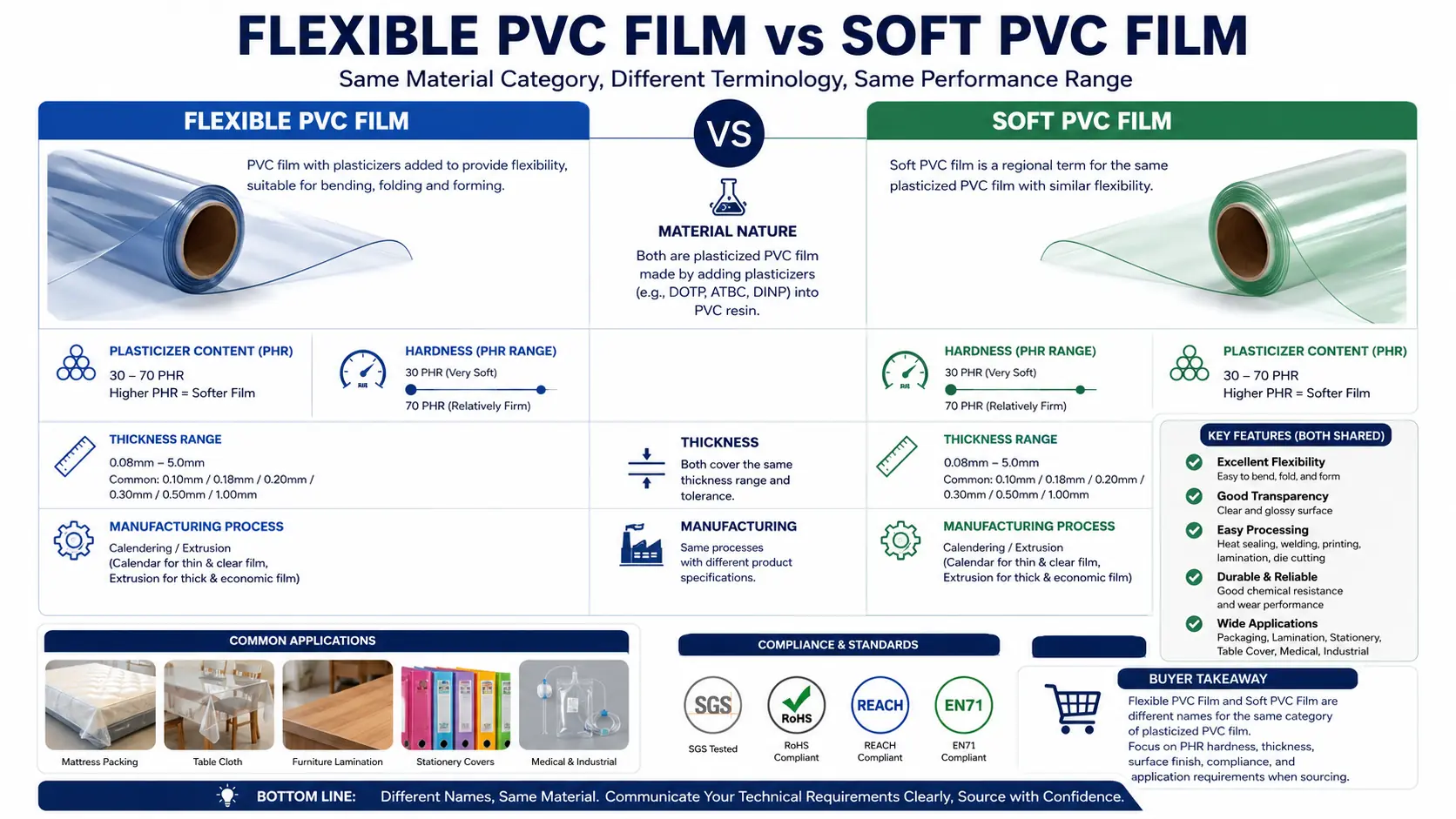
The short answer is that flexible PVC film and soft PVC film refer to the same broad material category — PVC formulations containing plasticizers that impart flexibility and reduce rigidity. However, the terminology used varies by region, industry sector, and application context. A furniture lamination converter in Southeast Asia may specify “soft PVC film,” while a packaging buyer in Europe may reference “flexible PVC film” in their RFQ. Both may be describing products within overlapping hardness ranges but with different expectations around thickness tolerance, surface finish, and processing compatibility.
This article provides a technical procurement framework for understanding the relationship between flexible PVC film and soft PVC film. It covers formulation science, hardness measurement (PHR), thickness selection, manufacturing process implications, material properties, compliance requirements, and application-specific recommendations. The objective is to equip overseas buyers with the engineering vocabulary and evaluation criteria needed to communicate precise technical requirements to suppliers and make informed sourcing decisions.
For a foundational understanding of PVC film as a material category — including its chemical structure, manufacturing methods, and general industrial applications — refer to our technical overview: What Is PVC Film? Applications, Manufacturing Process & Buying Guide.
What Is Flexible PVC Film?
Definition and Formulation
Flexible PVC film is a polyvinyl chloride-based film in which plasticizers — typically phthalate-based or non-phthalate compounds such as DOTP (dioctyl terephthalate) or ATBC (acetyl tributyl citrate) — are incorporated into the polymer matrix during compounding. Without plasticizers, rigid PVC (uPVC) is a hard, brittle material unsuitable for applications requiring bending, folding, or draping. The addition of plasticizers reduces intermolecular forces between PVC polymer chains, increasing free volume within the polymer structure and allowing chain segments to move more freely under applied stress. The result is a material that can be bent, folded, stretched, and thermoformed without fracturing.
The formulation of flexible PVC film typically includes:
- PVC resin (base polymer, typically suspension-grade or paste-grade depending on the manufacturing route)
- Primary plasticizer (determines flexibility, typically 20–60 PHR depending on target hardness)
- Stabilizers (thermal stabilizers to prevent degradation during processing; calcium-zinc, barium-zinc, or organotin systems)
- Lubricants (internal and external, to control melt rheology and prevent sticking to processing equipment)
- Fillers (calcium carbonate, to adjust cost and mechanical properties)
- Pigments and additives (for color, UV resistance, antistatic properties, or flame retardancy as required)
Plasticizer Content and Hardness Range
The defining technical characteristic of flexible PVC film is its plasticizer loading, expressed in PHR (parts per hundred resin). A higher PHR value corresponds to a higher plasticizer concentration, which produces a softer, more pliable film. Flexible PVC film typically spans a hardness range of approximately 30 PHR to 70 PHR, though formulations exist outside this range for specialized applications. At the lower end (30–40 PHR), the film is very soft and highly flexible, suitable for applications such as mattress packing film where conformability around irregular shapes is required. At the higher end (60–70 PHR), the film retains measurable rigidity while still being formable, suitable for applications such as stationery covers or light lamination.
Processing Characteristics
Flexible PVC film can be manufactured via calendering or extrusion processes, depending on the target thickness range, surface finish requirements, and production volume. Calendered flexible PVC film offers superior thickness uniformity and surface quality, making it the preferred choice for applications requiring tight thickness tolerance and optical clarity. Extruded film, typically produced via flat die or blown film extrusion, is cost-effective for thicker gauges and non-critical surface applications.
In downstream converting operations, flexible PVC film is compatible with high-frequency (RF) welding, heat sealing, solvent bonding, die cutting, slitting, and printing. These processing characteristics make it suitable for high-speed automated converting lines commonly used in packaging, stationery, and decorative lamination industries.
Key Industrial Applications
Flexible PVC film serves a broad range of industrial sectors:
- Packaging: protective wrapping, mattress packing, furniture transportation protection
- Lamination: furniture surface lamination, panel lamination, decorative film overlays
- Stationery: book covers, file folders, ring binder covers, menu covers
- Table covering: tablecloths, placemats, protective table pads
- Medical: fluid bags, tubing (subject to medical-grade formulation and regulatory compliance)
- Automotive: interior trim lamination, door panel covering
What Is Soft PVC Film?
Definition and Relationship to Flexible PVC Film
Soft PVC film is, in material science terms, identical to flexible PVC film in its fundamental composition: both are PVC formulations plasticized to achieve reduced rigidity compared to unplasticized PVC. The difference lies not in chemistry but in commercial terminology and the specific hardness ranges that different supply chains and end-use sectors associate with each term.
In Chinese manufacturing contexts — which account for a significant share of global PVC film production — the terms “soft PVC film” and “flexible PVC film” are often used interchangeably in English-language trade documentation, both translating from the Chinese industry term 软质PVC薄膜 (ruǎnzhì PVC bómó). This translation overlap is a primary source of confusion for overseas buyers reviewing supplier quotations and product specification sheets.
Commercial Usage and Regional Terminology
In practice, the distinction between the two terms is driven by application context rather than material science:
- “Flexible PVC film” is more commonly used in technical documentation, engineering specifications, and procurement documents originating from European and North American supply chains. It emphasizes the functional property (ability to flex without breaking) and is associated with industrial and engineering applications where mechanical performance specifications are detailed.
- “Soft PVC film” is more commonly used in commercial trade contexts, particularly in Asian export documentation, and in sectors such as consumer goods, stationery, and decorative products. It emphasizes the tactile property (softness to touch) and is associated with applications where haptic quality is a primary specification.
For a buyer, the practical implication is that two suppliers may use different terminology to describe products that fall within overlapping or identical specification ranges. A supplier quoting “soft PVC film 45 PHR” and another quoting “flexible PVC film 45 PHR” may be offering functionally equivalent material — but the buyer must verify the full technical specification (hardness, thickness, formulation, surface finish, and compliance certification) rather than relying on terminology alone.
When Buyers Should Specify “Soft” vs “Flexible”
To avoid miscommunication in procurement, buyers should:
- Always specify hardness in PHR alongside the descriptive term. Stating “flexible PVC film, 45–50 PHR” eliminates ambiguity about which end of the flexibility spectrum is required.
- Reference the application context in the inquiry. A buyer sourcing film for mattress packing should specify “flexible PVC film for protective packaging, 35–40 PHR” rather than “soft PVC film,” providing the supplier with application-relevant performance expectations.
- Request a technical data sheet (TDS) and physical sample before confirming bulk orders. The TDS should state hardness (PHR or Shore A), thickness tolerance, tensile strength, elongation at break, and relevant compliance certifications. Terminology differences become irrelevant once the measured specification is confirmed.
Technical Comparison: Flexible PVC Film vs Soft PVC Film
From a material engineering standpoint, flexible PVC film and soft PVC film occupy the same product category: plasticized PVC film formulations designed to provide flexibility, formability, and durability in applications where rigid PVC is unsuitable. The technical comparison must therefore focus on the specification parameters that differentiate products within this category — not on a binary distinction between two separate materials.
The key specification parameters that define where a particular PVC film sits on the flexibility spectrum are:
- Plasticizer type and loading (PHR): The primary driver of flexibility. Higher PHR = softer, more flexible film.
- Base resin molecular weight (K-value): Higher K-value resins produce films with higher tensile strength but require higher plasticizer loading to achieve equivalent softness.
- Filler content: Higher calcium carbonate loading reduces cost but increases stiffness and reduces tensile strength.
- Thickness: Independent of formulation, thicker films feel stiffer even at the same PHR due to increased bending resistance.
For a detailed discussion of how these parameters translate into measurable mechanical properties, refer to our technical reference: PVC Film Properties: Tensile Strength, PHR Hardness & Compliance.
The table below summarizes the general specification ranges for the flexibility spectrum:
| Specification | Low Flexibility (Firm) | Medium Flexibility | High Flexibility (Very Soft) |
|---|---|---|---|
| Plasticizer (PHR) | 20–30 | 35–50 | 55–70+ |
| Shore A Hardness | 85–95A | 65–85A | 40–65A |
| Tensile Strength | Higher | Moderate | Lower |
| Elongation at Break | 150–250% | 250–350% | 300–450% |
| Typical Terminology | Semi-rigid / Firm flexible | Flexible / Soft | Very soft / Ultra-flexible |
How Hardness (PHR) Affects PVC Film Performance
Understanding the PHR Scale
PHR (parts per hundred resin) is the standard unit for expressing plasticizer concentration in PVC compounding. A formulation specified at 40 PHR contains 40 parts by weight of plasticizer for every 100 parts by weight of PVC resin. This ratio directly controls the degree of plasticization and, consequently, the mechanical behavior of the finished film.
The PHR scale is not linear in its effect on material properties. The first 20–30 PHR of plasticizer produces a dramatic reduction in rigidity as the plasticizer molecules begin to separate polymer chains. Beyond approximately 50 PHR, additional plasticizer continues to soften the material but with diminishing returns, and at very high loadings (above 70–80 PHR), plasticizer migration and exudation become practical concerns that affect product shelf life and processing performance.
PHR vs Softness and Flexibility
Higher PHR values produce films with:
- Greater drapability and conformability
- Reduced stiffness and bending resistance
- Softer tactile feel
- Increased elongation at break
- Lower glass transition temperature (improved low-temperature flexibility)
For mattress packing applications, where the film must conform tightly around foam mattresses during compression packing, formulations in the 35–60 PHR range are commonly specified. For table cloth production, where the film must drape naturally over a table edge without lifting, formulations in the 40–50 PHR range provide the required balance of softness and durability.
PHR vs Tensile Strength
There is an inverse relationship between plasticizer content and tensile strength. As PHR increases, the material’s ability to resist tensile stress decreases because the plasticizer molecules reduce the intermolecular forces that give PVC its mechanical strength. A film formulated at 30 PHR will typically exhibit higher tensile strength than the same base formulation at 50 PHR. This trade-off is critical for applications where the film must withstand mechanical stress during converting or end-use: buyers specifying high-flexibility films must verify that the tensile strength at the target PHR is sufficient for the intended application.
Understanding these mechanical relationships is essential when evaluating PVC film properties, including tensile strength, hardness, elongation, and compliance requirements. For a complete breakdown, refer to: PVC Film Properties: Tensile Strength, PHR Hardness & Compliance.
PHR vs Processing Performance
Plasticizer content directly affects processing behavior during film manufacturing and downstream converting. Higher-PHR formulations:
- Process at lower melt temperatures
- Exhibit reduced melt viscosity
- Are more susceptible to thermal degradation if processing temperature is not adjusted accordingly
- May require modified stabilizer packages to maintain thermal stability during extended production runs
For buyers, this means that the hardness specification affects not only end-use performance but also the supplier’s manufacturing capability. A supplier with demonstrated experience producing films at the target PHR range is more likely to deliver consistent quality than one operating outside their normal production window.
How Thickness Influences PVC Film Selection
Thickness and Durability
Film thickness is the primary determinant of mechanical durability in flexible PVC film. Thicker films provide greater resistance to puncture, tear propagation, and abrasion. For protective packaging applications where the film must withstand handling during logistics and transportation — such as mattress packing film used to protect compressed mattresses during container shipping — thicknesses in the range of 0.06 mm to 0.12 mm are commonly specified. Thinner films in the 0.03 mm to 0.05 mm range are suitable for light-duty wrapping and temporary surface protection applications.
It is important to note that thickness and flexibility are independent variables. A thick film at high PHR can be both durable and soft, while a thin film at low PHR may be fragile despite being relatively rigid. The buyer must specify both parameters independently based on application requirements.
For a detailed thickness selection guide covering all major industrial applications, refer to: PVC Film Thickness Guide: How to Choose the Right Thickness for Industrial Applications.
Thickness and Material Cost
Film thickness has a direct, linear relationship to raw material consumption. A 0.10 mm film consumes approximately twice the raw material per square meter as a 0.05 mm film. For high-volume applications, this cost differential is significant. However, specifying minimum thickness to reduce cost without considering durability requirements can result in higher total cost due to product failure, customer returns, or increased waste during converting. The procurement decision should optimize for total cost of ownership, not unit material cost alone.
Thickness and Optical Transparency
Thickness affects the optical properties of transparent PVC film. Thicker films exhibit:
- Reduced light transmission (more material to absorb and scatter light)
- Increased haze (light scattering within the film volume)
- Potentially visible yellowing if the formulation’s thermal history during processing was not well controlled
For applications requiring high optical clarity — such as super clear lamination film or transparent table cover film — both thickness control and formulation purity are critical. A thinner film at the same formulation will typically appear clearer than a thicker one, all else being equal. For a detailed comparison of transparency grades, refer to: Clear PVC Film vs Super Clear PVC Film: Technical Comparison Guide.
Manufacturing Process and Its Impact on Film Quality
Calendering vs Extrusion
The two primary manufacturing routes for flexible PVC film — calendering and extrusion — produce films with different quality profiles that directly affect downstream converting performance.
Calendering involves passing a heated, plasticized PVC compound through a series of precision-ground counter-rotating rollers. The roller gap is progressively reduced to achieve the target thickness. Calendered film offers:
- Superior thickness uniformity (typical tolerance: ±5% of nominal thickness, or tighter depending on equipment capability)
- Excellent surface quality with controlled gloss level and minimal gel particles
- High optical clarity when produced on polished rolls
- Consistent mechanical properties across the web width
Extrusion involves melting the PVC compound and forcing it through a flat die (cast film) or an annular die (blown film). Extruded film is typically more cost-effective for thicker gauges but may exhibit:
- Wider thickness tolerance compared to calendered film
- Greater variability in surface finish across the web
- Potential orientation effects that affect mechanical properties in machine vs transverse direction
For a detailed examination of these manufacturing processes, their quality implications, and how to evaluate a supplier’s production capability during factory assessment, refer to: PVC Film Manufacturing Process: A Procurement Guide for Industrial Buyers. For the soft-grade specific route — compounding, plasticizer absorption, gelation control and in-line inspection — see our soft PVC film manufacturing process guide.
Formulation Control and Production Consistency
Production consistency in flexible PVC film manufacturing depends on precise formulation control. Variations in plasticizer dosing, stabilizer concentration, or filler content between production batches produce measurable differences in hardness, tensile strength, and surface characteristics — even if the film is produced on the same equipment to the same nominal thickness. Buyers should evaluate a supplier’s batch-to-batch consistency by reviewing historical production records, requesting retained samples from previous production runs, and conducting incoming quality control checks on initial shipments.
Surface Finish and Roll Quality
The surface finish of flexible PVC film — gloss, matte, or embossed — is determined during manufacturing. Calendered films can achieve gloss, matte, or embossed surfaces through roll surface engineering (polished, matte-finished, or engraved calender rolls). Roll quality parameters that affect downstream converting include:
- Roll tension consistency (affects unwind performance on automated converting lines)
- Edge trim quality (affects registration in printing and die-cutting)
- Splice frequency (affects converting line uptime)
- Roll length accuracy (affects production planning and material yield)
Key Material Properties for Buyer Evaluation
When evaluating flexible PVC film from different suppliers, buyers should assess the following material properties against application-specific requirements:
Tensile Strength
Tensile strength (measured in MPa or kgf/mm²) indicates the maximum stress the film can withstand before breaking. This property is critical for applications where the film is subjected to tension during converting (slitting, rewinding, printing) or end-use (stretched wrapping, tensioned lamination). Tensile strength is inversely related to plasticizer content — higher PHR formulations produce lower tensile strength values. Buyers should specify both target PHR and minimum tensile strength in procurement specifications, recognizing the trade-off between flexibility and mechanical strength.
Flexibility and Elongation
Elongation at break (expressed as a percentage of original length) measures the film’s ability to stretch before failure. High-elongation films (300–450%) are suitable for applications requiring deep-draw thermoforming, tight-radius wrapping, or conformability around complex geometries. The flexibility-elongation relationship is discussed in detail in our properties reference: PVC Film Properties: Tensile Strength, PHR Hardness & Compliance.
Transparency Levels
PVC film transparency ranges from opaque (heavily pigmented or filled formulations) through standard clear to super clear. The transparency grade required depends on the application:
- Super clear film: specified for applications where the underlying surface must be visible without perceptible distortion or color shift, such as furniture lamination over printed decorative paper or high-end table cover film. Winter PVC’s Super Clear Film and Super Clear Lamination Film are formulated for applications requiring maximum optical clarity.
- Normal clear film: suitable for general-purpose transparent applications where slight haze is acceptable. Winter PVC’s Normal Clear Film provides a cost-effective option for standard packaging and protective applications.
- Colored super clear film: pigmented formulations produce consistent, opaque color for decorative applications. Winter PVC’s Colored Super Clear Film combines pigmentation with enhanced transparency for applications requiring both color and clarity.
Chemical Resistance
PVC film exhibits good resistance to acids, alkalis, alcohols, and many organic solvents. However, plasticizer type and loading affect chemical resistance; certain plasticizers may be extracted by contact with solvents or oils, leading to embrittlement over time. Buyers should specify any chemical exposure conditions in the end-use environment so the supplier can recommend an appropriate formulation.
Moisture Resistance
PVC film is inherently resistant to water and moisture, making it suitable for applications in humid environments, outdoor exposure (with appropriate UV stabilization), and products that require wipe-clean surfaces (tablecloths, placemats, wall coverings). Moisture absorption is negligible for most industrial applications.
Surface Characteristics
Surface characteristics — including gloss level, coefficient of friction (COF), and surface energy — affect downstream processing such as printing, lamination, and heat sealing. Corona treatment can be applied to increase surface energy for improved ink adhesion in printing applications. The embossing pattern (leather grain, wood grain, matte, geometric) is imparted during calendering and must be specified at the time of order, as it is a fixed characteristic of the production run.
Application-Specific Material Selection Guide
Packaging and Protective Wrapping
For industrial packaging applications, the primary requirements are mechanical protection during transit, conformability around the packaged product, and cost efficiency.
Mattress packing film is a high-volume application in the furniture and bedding industry. The film must withstand the expansion force of compressed foam mattresses during vacuum packing, resist puncture during handling and container loading, and maintain integrity through the distribution chain. Winter PVC’s Mattress Packing Film is formulated in the 35–60 PHR range with thickness options from 0.06 mm to 0.12 mm, providing the balance of flexibility, tensile strength, and puncture resistance required for this demanding application.
Static cling film provides temporary surface protection without adhesive residue. It adheres to smooth surfaces through electrostatic attraction, making it suitable for protecting polished metal, glass, painted surfaces, and plastic panels during manufacturing, transportation, and installation. Winter PVC’s Static Cling Film is available in clear and colored variants with controlled cling levels tailored to the substrate and exposure duration.
Decorative Surface Lamination
Flexible PVC film is widely used for laminating furniture panels, interior doors, wall panels, and decorative surfaces. The film is bonded to substrates (MDF, particleboard, plywood) using adhesives and heat/pressure, providing a durable, cleanable, decorative surface.
Winter PVC’s decorative film range includes:
- Colored Embossing Film: pigmented film with textured surface patterns for furniture and interior decoration applications. Available in a wide color range with consistent batch-to-batch color matching.
- Matte Embossing Film: low-gloss textured film providing a contemporary matte finish for furniture surfaces, reducing visible fingerprints and surface scratches in high-touch applications.
- Clear Lamination Embossing Film: transparent film with embossed surface texture, applied over printed decorative paper to provide wear resistance and tactile finish while preserving the underlying printed design visibility.
Table Cover and Stationery Products
Flexible PVC film is the primary raw material for tablecloth and placemat manufacturing. The film must drape naturally, resist staining from food and beverage contact, withstand repeated folding and wiping, and maintain appearance over extended use.
Winter PVC’s Plastic Table Cloth and Table Cloth films are formulated with controlled flexibility to provide the softness, durability, and drapability required for table cover applications. As with all flexible PVC films, the material’s softness and mechanical properties are directly influenced by the plasticizer formulation. Thickness options typically range from 0.08 mm to 0.20 mm depending on the target product segment (disposable, semi-disposable, or durable table covers). For specific technical data, including PHR, tensile strength, and elongation values, buyers are encouraged to contact Winter PVC with their application requirements.
Transparent Film Applications
Applications requiring optical clarity — display packaging, transparent table covers, window films, and protective overlays — demand careful specification of transparency grade, thickness, and surface quality.
The transparency hierarchy for procurement purposes:
- Super Clear Film: highest light transmission, lowest haze. Suitable for premium table covers, display packaging, and high-end lamination where the underlying surface must be visible without perceptible quality loss.
- Normal Clear Film: standard transparency with slight haze acceptable. Cost-effective for general-purpose transparent applications.
- Colored Super Clear Film: combines pigmentation with enhanced clarity. Suitable for applications requiring both color consistency and translucency.
For a complete overview of PVC film applications across packaging, lamination, and surface protection sectors, refer to: PVC Film Applications Guide | Industrial PVC Films for Packaging, Lamination & Surface Protection.
PVC Film Product Options for Different Applications
Based on flexibility, transparency, and surface requirements, Winter PVC supplies customized PVC film solutions organized by application category:
Protective Packaging Films
- Mattress Packing Film: formulated at 35–60 PHR for high conformability and puncture resistance during compressed mattress packaging and container shipping.
- Static Cling Film: adhesive-free surface protection film for polished metal, glass, painted surfaces, and plastic panels during manufacturing and transit.
Transparent PVC Films
- Super Clear Film: maximum optical clarity for premium packaging windows, display applications, and high-end lamination where visual quality is critical.
- Super Clear Lamination Film: high-clarity film engineered for furniture surface lamination over printed decorative paper.
- Normal Clear Film: cost-effective transparent film for general-purpose packaging and protective applications where slight haze is acceptable.
- Colored Super Clear Film: combines pigmentation with enhanced transparency for applications requiring both color consistency and translucency.
Table Cover Films
-
Plastic Table Cloth: flexible PVC film with controlled surface gloss and optional embossed textures for disposable and semi-disposable table covers.
-
Table Cloth Film: durable-grade PVC film for reusable table covers requiring enhanced drape, stain resistance, and long-term appearance retention.
All product categories support customization in thickness, PHR hardness, color matching, embossing patterns, and compliance documentation for target export markets.
Compliance Requirements for PVC Film Procurement
SGS Testing and Third-Party Verification
For international trade, third-party testing through recognized laboratories such as SGS is standard practice. SGS testing provides independent verification of material composition, restricted substance content, and compliance with applicable regulations. Buyers should request SGS test reports covering:
- Heavy metal content: lead (Pb), cadmium (Cd), mercury (Hg), hexavalent chromium (Cr⁶⁺)
- Phthalate content: specific phthalates restricted under various regulations (DEHP, DBP, BBP, DINP, DIDP, DNOP)
- Formaldehyde content: relevant for applications involving indoor air quality considerations
- Organotin compounds: relevant for food-contact and toy applications
Reputable PVC film manufacturers maintain ongoing SGS testing programs covering their standard product grades. Buyers should verify that test reports correspond to the specific formulation and production period of the material being purchased, and that the testing covers all substances relevant to the target market’s regulatory requirements.
RoHS, REACH, and EN71 Standards
Three regulatory frameworks dominate compliance requirements in international PVC film trade:
RoHS (Restriction of Hazardous Substances) — applicable to electrical and electronic equipment sold in the EU, but widely referenced in procurement specifications across industries. RoHS restricts lead, mercury, cadmium, hexavalent chromium, PBBs, PBDEs, and four phthalates (DEHP, BBP, DBP, DIBP). Even for non-electronic applications, many buyers specify RoHS-compliant PVC film as a general indicator of restricted substance control.
REACH (Registration, Evaluation, Authorisation, and Restriction of Chemicals) — EU regulation covering all chemical substances manufactured or imported into the EU. REACH SVHC (Substances of Very High Concern) compliance is a common requirement in European procurement specifications. The SVHC candidate list is updated periodically; buyers should verify that their supplier’s compliance documentation references the current SVHC list at the time of order.
EN71 — European safety standard for toys. EN71 Part 3 specifies migration limits for certain elements (heavy metals) from toy materials. PVC film intended for products that may be used by children (including children’s stationery, toy packaging, inflatable products) may require EN71 compliance testing.
Application-Specific Compliance Considerations
Compliance requirements are application-specific. A PVC film used for industrial furniture lamination may have different regulatory requirements than a film used for food-contact packaging or children’s products. Buyers must:
- Identify the regulatory framework(s) applicable to the target market and product category before issuing an RFQ.
- Communicate specific compliance requirements in the purchase specification, including required test standards, acceptable limits, and documentation format.
- Verify that the supplier’s compliance documentation covers the specific formulation being purchased — not a generic product category statement.
- Consider pre-shipment inspection with compliance testing for initial orders from a new supplier to verify that production material matches the documented formulation.
Buyer Decision Guide: Flexible PVC Film vs Soft PVC Film Comparison Table
The following comparison table provides a practical reference for procurement managers evaluating whether to specify “flexible PVC film” or “soft PVC film” in their sourcing documentation, and what technical parameters to verify regardless of the terminology used.
| Parameter | Flexible PVC Film | Soft PVC Film |
|---|---|---|
| Material Definition | Plasticized PVC film characterized by its ability to flex and bend without fracturing. Term emphasizes mechanical performance. | Plasticized PVC film characterized by its soft tactile feel. Term emphasizes haptic quality. Functionally the same material category. |
| Hardness Range | Typically 30–70 PHR. Can extend to 20 PHR for semi-rigid grades. Commonly specified at 35–55 PHR for industrial applications. | Typically 40–70+ PHR. Often associated with the softer end of the range (40+ PHR). Very soft grades 60+ PHR are common in consumer goods. |
| Flexibility | Measurable by elongation at break (150–450%) and bending stiffness. Flexibility is a continuous variable controlled by PHR, not a binary category. | Functionally identical to flexible PVC film at equivalent PHR. Differences perceived by buyers are due to hardness specification, not material category. |
| Processing Methods | Calendering (preferred for thickness uniformity and surface quality). Extrusion (cost-effective for thick gauges). Compatible with HF welding, heat sealing, die cutting, printing. | Same processing methods as flexible PVC film. Higher-PHR (softer) formulations require adjusted processing temperatures and may have narrower processing windows. |
| Typical Applications | Industrial packaging, protective wrapping, furniture lamination, automotive interior trim, stationery, medical (subject to grade). | Table covers, consumer goods, toys (subject to EN71), decorative products, soft-touch applications, apparel accessories. |
| Recommended Use Cases | Specify “flexible PVC film” when: placing orders with European/North American suppliers; preparing engineering specifications; emphasizing mechanical performance requirements. | Specify “soft PVC film” when: sourcing from Asian manufacturers; buying for consumer goods; specifying tactile quality as a primary requirement. Always include PHR value regardless of term used. |
Critical Note: Regardless of terminology, the PHR value is the definitive specification parameter. Two films specified at 45 PHR with the same base formulation will have essentially identical flexibility and softness, whether the supplier labels them “flexible” or “soft.”
Common Sourcing Mistakes When Purchasing PVC Film
1. Specifying only “soft” or “flexible” without a PHR value.
This is the most frequent sourcing error. Without a PHR specification, the supplier interprets the requirement based on their own product grading system, which may not match the buyer’s expectation. The result is material that is too stiff or too soft for the intended application. Always include target PHR (or Shore A hardness) and acceptable tolerance range in the purchase specification.
2. Ignoring thickness tolerance specifications.
Quoted thickness is nominal; actual thickness varies within a tolerance band. A film specified as 0.10 mm with a ±10% tolerance could be as thin as 0.09 mm or as thick as 0.11 mm. This variation affects material consumption, mechanical performance, and optical properties. Buyers should specify thickness tolerance expectations and verify that the supplier’s production capability can meet them.
3. Assuming all flexible PVC film has the same formulation.
Plasticizer type significantly affects performance. A film formulated with DOTP has different migration resistance and low-temperature flexibility than one formulated with DOP. Phthalate-free formulations (using ATBC, DINCH, or other non-phthalate plasticizers) are required for certain markets and applications but may have different processing and performance characteristics. Buyers should understand the plasticizer system used in the supplier’s standard formulation and specify requirements accordingly.
4. Not requesting pre-production samples.
Physical samples from a production run — not lab samples — provide the most reliable basis for evaluating material suitability. Lab samples produced on small-scale equipment may not accurately represent production-scale material in terms of surface finish, thickness uniformity, and mechanical properties.
5. Overlooking compliance documentation.
Assuming that all PVC film from a particular supplier automatically meets all regulatory requirements is a high-risk assumption. Compliance must be verified against the specific formulation, production period, and target market regulations. A supplier’s general statement of “RoHS compliant” is insufficient without supporting test reports.
6. Selecting on unit price alone.
Lower-priced PVC film may achieve cost reduction through higher filler loading, which reduces tensile strength, impacts transparency, and can cause processing problems during converting. The lowest unit price often produces the highest total cost when converting waste, product failure, and customer returns are accounted for.
7. Not considering converting process compatibility.
The film specification that works for one converter’s equipment may not work for another’s. Factors such as roll weight, core size, unwind tension characteristics, coefficient of friction, and heat-seal temperature range all affect converting line performance. Buyers should communicate their converting process parameters to the supplier and request film optimized for their specific equipment.
Frequently Asked Questions (FAQ)
Q1: Is flexible PVC film the same as soft PVC film?
From a material composition standpoint, yes — both are PVC formulations containing plasticizers that reduce rigidity. The difference is primarily in commercial terminology: “flexible PVC film” is more common in technical and engineering contexts, while “soft PVC film” is more common in commercial trade and consumer goods contexts. For procurement purposes, buyers should specify hardness (PHR) alongside either term to eliminate ambiguity. A 45 PHR flexible PVC film and a 45 PHR soft PVC film from the same manufacturer using the same base formulation will be functionally identical.
Q2: Which PVC film is better for mattress packing applications?
Mattress packing requires a film that combines flexibility (to conform around compressed mattresses), puncture resistance (to withstand handling during logistics), and sufficient tensile strength (to resist the expansion force of compressed foam). A flexible PVC film formulated at 35–60 PHR with thickness of 0.06 mm to 0.12 mm is typically specified. The exact PHR and thickness should be selected based on mattress compression ratio, packaging method (manual vs automated), and distribution chain conditions. Winter PVC’s Mattress Packing Film is specifically formulated for this application.
Q3: What hardness PHR should I choose for table cloth production?
The appropriate PHR for table cloth film depends on the target product category, desired softness, and required durability. Rather than a single standard value, the PHR is selected based on the specific balance of flexibility, tensile strength, and drapability needed for the application. Disposable or economy table covers may be produced from film at the firmer end of the flexible PVC spectrum, while durable, reusable table covers intended for long-term use typically require formulations that provide enhanced drape and a softer tactile feel. Embossed surface textures — such as leather grain or linen patterns — are commonly applied to enhance the aesthetic appearance and reduce visible surface scratches. For specific PHR recommendations based on your product specifications and converting equipment, contact Winter PVC with your application details for a technical consultation.
Q4: How do I select PVC film for lamination?
Lamination film selection depends on the substrate material, lamination process parameters (temperature, pressure, line speed), and end-use requirements:
- For furniture panel lamination over MDF or particleboard: specify 0.10–0.20 mm thickness, 35–50 PHR depending on required surface durability, and appropriate embossing pattern for the target furniture style.
- For clear overlay lamination over printed decorative paper: specify super clear grade film with low haze, controlled thickness (0.06–0.12 mm typical), and corona-treated surface if adhesive compatibility requires it.
- For edge banding: specify thinner film (0.10–0.16 mm) with higher PHR (40–50) for flexibility around curved edges.
Always provide your lamination process parameters (temperature range, line speed, adhesive type) to the supplier so they can recommend or adjust the formulation for processing compatibility.
Q5: Can flexible PVC film be customized?
Yes. Flexible PVC film from a manufacturer with in-house compounding capability can be customized across multiple parameters:
- Thickness: from approximately 0.03 mm to 0.50 mm or thicker, depending on manufacturing capability
- Hardness (PHR): from approximately 20 PHR (firm flexible) to 70+ PHR (very soft)
- Color: matched to Pantone, RAL, or customer-provided color standards
- Embossing pattern: custom engraving of calender rolls for proprietary surface textures
- Surface finish: gloss, matte, or custom gloss levels
- Width: slit rolls to specified widths for direct feeding on converting lines
- Formulation: phthalate-free, UV-stabilized, antistatic, flame-retardant, or other functional additives as required
Customization typically requires minimum order quantities (MOQ) and involves a sampling and approval process. Buyers should discuss customization requirements during the supplier evaluation phase and budget for lead time associated with custom color matching or embossing roll production. Winter PVC supports full customization across all product categories, including thickness, hardness, color, embossing patterns, and surface finish.
Q6: What is the difference between Shore A hardness and PHR?
Shore A is a direct measurement of material hardness using a durometer — it measures the resistance of the material to indentation. PHR (parts per hundred resin) is a formulation parameter — it specifies the plasticizer concentration in the compound. Shore A is measured on the finished film; PHR is specified at the compounding stage. They are inversely correlated: higher PHR produces lower Shore A values (softer material). For procurement purposes, PHR is more useful because it links directly to the formulation, while Shore A is more useful for incoming quality control verification of finished film. Both can be included in a purchase specification for completeness.
Q7: How does plasticizer type affect film performance?
Different plasticizers produce different performance profiles even at the same PHR:
- DOP (dioctyl phthalate) / DEHP: traditional general-purpose plasticizer. Good plasticizing efficiency and low cost. Restricted under various regulations for certain applications.
- DOTP (dioctyl terephthalate): similar plasticizing efficiency to DOP with improved migration resistance and better low-temperature flexibility. Widely used as a phthalate alternative.
- ATBC (acetyl tributyl citrate): non-phthalate plasticizer with good compatibility. Used in food-contact and toy applications. Higher cost than DOTP.
- DINCH (diisononyl cyclohexane-1,2-dicarboxylate): non-phthalate plasticizer with excellent toxicological profile. Used in medical and sensitive applications.
Buyers should discuss plasticizer type with the supplier, particularly when specific regulatory compliance or performance characteristics (low-temperature flexibility, migration resistance, food contact) are required.
Q8: Does flexible PVC film cost more than soft PVC film?
Not on specification — the two terms describe the same plasticized material, so quotations differ because of formulation and gauge, not terminology. A wide price spread between two suppliers usually reflects a different plasticizer system (DOP versus DOTP or a citrate ester), a different filler level, or a wider thickness tolerance rather than a genuinely different material category. Compare quotations line by line: nominal thickness with tolerance, plasticizer type, Shore A target, and the documentation package. That comparison, not the product name, is what determines the real cost per square meter of usable film.
Conclusion: Making the Right Sourcing Decision
Flexible PVC film and soft PVC film are not two distinct materials competing for different applications. They are two commercial descriptions of the same material category — plasticized PVC film — where the appropriate specification is determined by application requirements, not by which term appears on the supplier’s quotation.
The procurement decision should be driven by technical specification, not terminology:
- Define the application requirements first: What mechanical properties does the film need? What converting processes will it undergo? What regulatory standards must it meet? What is the target cost structure for the finished product?
- Specify PHR, thickness, and formulation parameters: These are the variables that determine whether the film performs as required. The term “flexible” or “soft” is secondary — the numbers define the material.
- Evaluate suppliers on production capability, not catalog descriptions: A supplier’s ability to produce film at your target PHR with consistent thickness tolerance, surface quality, and batch-to-batch repeatability matters more than which terminology they use in their marketing materials.
- Verify through documentation and physical samples: Technical data sheets, SGS test reports, compliance certifications, and pre-production samples provide objective evidence. A procurement decision based on verified data outperforms one based on supplier claims.
Winter PVC manufactures flexible PVC film across the full hardness spectrum — from firm flexible grades for structural lamination to ultra-soft grades for tactile consumer products — with in-house compounding capability that enables formulation customization to specific application requirements. Our product range covers transparent, colored, embossed, and functional films in thicknesses from 0.03 mm to 0.50 mm, with full support for custom color matching, embossing pattern development, and compliance documentation for target markets.
To discuss your specific flexible PVC film requirements — including PHR specification, thickness selection, and application compatibility — contact Winter PVC with your technical specifications for a detailed quotation and sample request.
Need a Quotation or Technical Recommendation?
Send your specification to the Winter PVC export sales team — thickness, width, hardness (PHR), color, surface finish and estimated annual volume. Our engineers will confirm the suitable formulation, production route and documentation package, and arrange samples for evaluation on your own converting equipment.
This technical procurement guide is published by Winter PVC, a China-based manufacturer of PVC film products for industrial, packaging, decorative, and converting applications. For product specifications, technical consultation, or to request samples, contact our export sales team with your application details and target specifications.