
Introduction
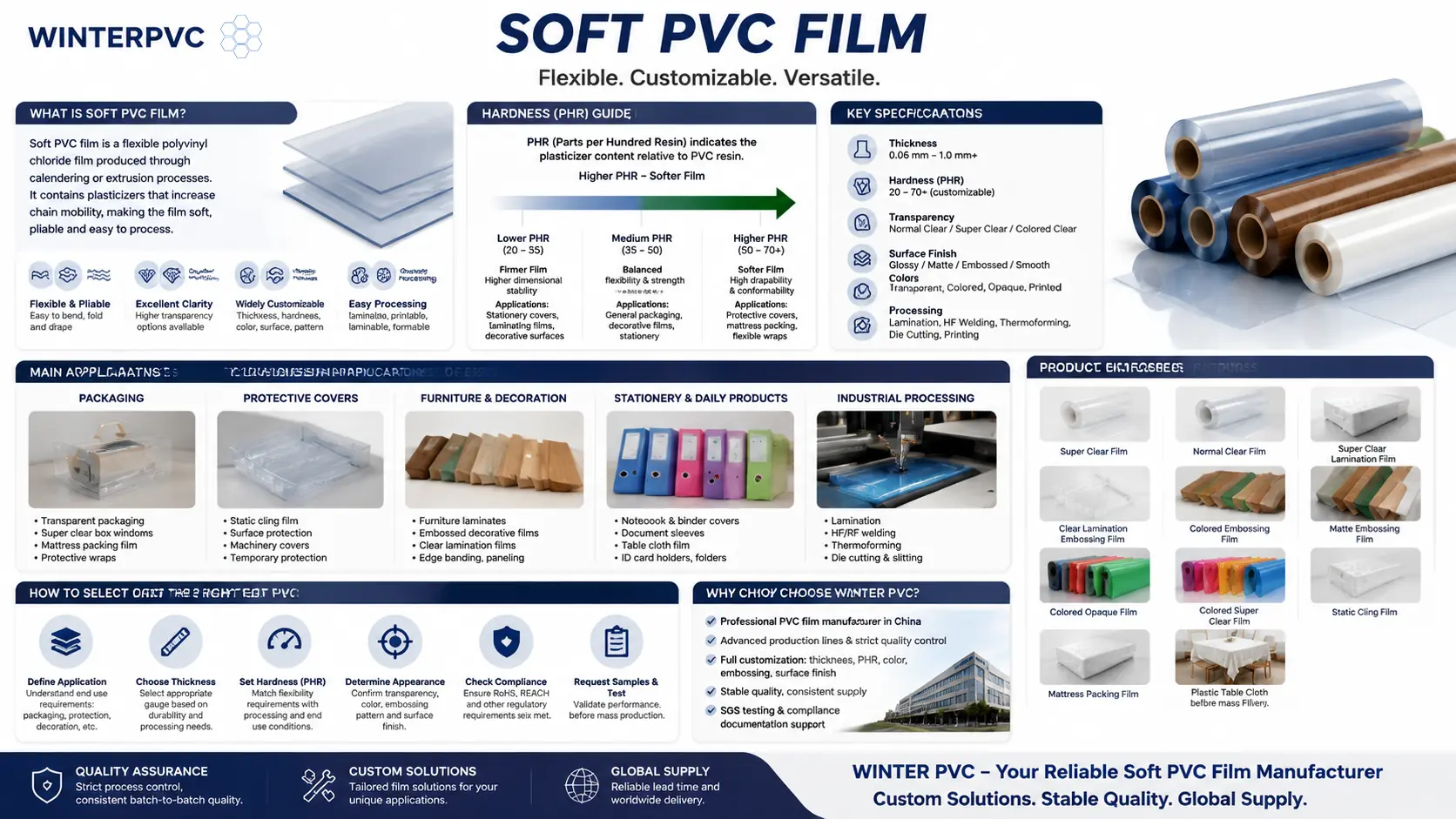
Soft PVC film is one of the most widely specified flexible polymer materials in industrial manufacturing. Its combination of flexibility, mechanical durability, processability, and extensive customization options makes it a practical choice across packaging, surface protection, decoration, stationery, and industrial converting applications; our soft film range spans 0.03 mm to 0.50 mm.
For procurement managers and industrial buyers, selecting soft PVC film is not simply a matter of comparing unit prices. Application performance depends on matching film specifications — thickness, hardness, transparency, surface finish, and color — to the functional requirements of the end product; gauge is quoted in μm, where 1 mm equals 1,000 μm. A film that performs well in one application may fail in another if the specification is not aligned.
While our PVC Film Applications Guide covers the broader application range across all PVC film categories, this guide focuses specifically on soft PVC film — where flexibility, hardness measured in PHR, and processing behavior are the critical factors in material selection; our grades are formulated between 22 and 66 PHR.
Winter PVC is a PVC film manufacturer based in China, supplying customized transparent, colored, embossed, and functional PVC film products for industrial buyers and converters worldwide. For a foundational understanding of PVC film as a material category, refer to our overview: What Is PVC Film.
What Is Soft PVC Film
Soft PVC film is a flexible polyvinyl chloride sheet material produced through calendering or extrusion processes. It is classified as soft or flexible PVC to distinguish it from rigid PVC, which contains little or no plasticizer and is used in applications such as pipes, window profiles, and rigid sheets; soft film, by contrast, runs from 0.03 mm upward.
For a detailed comparison of material grades — including plasticizer content, mechanical properties, and application mapping — see our guide on Rigid vs Flexible PVC Film.
The defining characteristic of soft PVC film is the incorporation of plasticizers during compounding. Plasticizers reduce intermolecular forces within the PVC polymer matrix, increasing chain mobility and producing a material that is pliable, elastic, and conformable at room temperature. The type and concentration of plasticizer directly determine the film’s hardness, flexibility, and mechanical behavior; our soft film bands run 22–66 PHR. To understand how these properties are measured and specified, refer to our PVC Film Properties guide covering tensile strength, PHR hardness, elongation, and compliance requirements.
In industrial specifications, hardness is commonly expressed in PHR (Parts per Hundred Resin), which indicates the proportion of plasticizer relative to PVC resin. A higher PHR value corresponds to a softer, more flexible film; as a definition, 40 PHR means 40 parts of plasticizer per 100 parts of resin. Lower plasticizer content generally produces firmer films with higher dimensional stability, while mechanical properties such as tensile strength depend on the complete formulation, thickness, and processing conditions — not on PHR alone.
The relationship between hardness and end-use performance is practical for buyers:
- Lower plasticizer content: Firmer films with greater dimensional stability — suitable for stationery covers, laminating films, and decorative surface layers that must resist denting or deformation.
- Higher plasticizer content: Softer films suitable for applications requiring drapability, stretch, and conformability — such as protective covers, flexible packaging, and mattress packing film.
Understanding this relationship allows procurement teams to specify film hardness based on processing requirements and end-use conditions rather than relying on generic product descriptions.
Main Uses of Soft PVC Film
Soft PVC film serves a broad range of industrial applications. The following sections examine the major use categories, detailing why the material is suitable, what specifications are commonly required, and which Winter PVC product categories apply; roll widths span 0.6 m to 2.45 m.
Soft PVC Film for Packaging Applications
Packaging is one of the largest application segments for soft PVC film. The material is used in flexible packaging formats where visibility, seal integrity, and material conformability are important; super clear film is supplied at 0.07–0.50 mm.
Typical applications include:
- Transparent flexible packaging for consumer and industrial goods, where Super Clear Film and Normal Clear Film grades provide cost-effective clarity for box windows, gift packaging, and product display.
- Mattress Packing Film for vacuum compression packaging in the bedding and furniture industries, requiring a balance of softness, puncture resistance, and consistent gauge control.
- Protective packaging wraps for products sensitive to dust, moisture, or surface abrasion during storage or transit.
- Packaging covers for palletized goods, machinery, and equipment.
For a full overview of how PVC film serves packaging, lamination, and surface protection sectors, see our PVC Film Applications Guide.
Why soft PVC film is suitable: The film’s flexibility allows it to conform to irregular product shapes. Its inherent clarity — particularly in transparent-grade formulations — enables visual product inspection without unpacking; super clear grades run 0.8–1.8 m in roll width. Soft PVC film also offers good heat-sealing characteristics, which supports automated packaging line efficiency.
Common specification requirements:
- Transparency: High-clarity grades for retail-facing packaging; standard clarity for industrial wraps
- Flexibility: Sufficient softness to wrap around product contours without creasing or cracking
- Sealing performance: Consistent heat-seal behavior across film rolls
- Durability: Tear and puncture resistance appropriate to handling and transit conditions
Soft PVC Film for Protective Covers and Surface Protection
Temporary and semi-permanent surface protection is a significant industrial use of soft PVC film. The material is employed to shield surfaces from mechanical damage, contamination, and environmental exposure during manufacturing, transport, installation, and storage; static cling film covers 0.04–0.40 mm.
Typical applications include:
- Static Cling Film for protecting polished metal, glass, painted surfaces, and plastic panels without adhesive residue. Winter PVC’s Static Cling Film adheres through electrostatic attraction and is available in clear and colored variants with controlled cling levels tailored to the substrate and exposure duration.
- Protective covers for machinery, equipment, and electronic enclosures during storage or transit.
- Temporary surface protection films for metal sheets, glass panels, and painted surfaces during handling and installation.
- Industrial covering materials for construction sites, workshop areas, and cleanroom environments.
Why soft PVC film is suitable: The material’s flexibility allows it to drape over complex geometries and remain in place without adhesive. Soft PVC film provides a balance of abrasion resistance and conformability that rigid materials cannot offer; static cling film is supplied on 0.6–1.6 m rolls. It is also easy to cut, handle, and dispose of after use.
Common specification requirements:
- Flexibility: Film must conform to protected surfaces without bridging or lifting
- Abrasion resistance: Surface durability to withstand handling and incidental contact
- Thickness: Selected based on the level of protection required — thinner for light-duty surface protection, thicker for heavy-duty equipment covers. For detailed guidance on gauge selection, refer to our PVC Film Thickness Guide
- Clarity or opacity: Transparent films allow visual inspection of the protected surface; colored or opaque films provide UV screening or identification coding
Soft PVC Film for Furniture and Surface Decoration
Soft PVC film is widely used in furniture manufacturing and interior surface applications as a decorative and functional surface layer. The material can be produced with a range of embossed textures, colors, and surface finishes to replicate natural materials or achieve specific design effects; embossed film runs 0.045–0.50 mm on 0.6–1.285 m rolls.
Typical applications include:
- Furniture surface films for tabletops, cabinet fronts, shelving, and paneling.
- Clear Lamination Embossing Film for textured, durable surfaces applied over printed decorative paper, providing wear resistance and tactile finish while preserving the underlying design visibility.
- Decorative laminates applied to MDF, particleboard, and plywood substrates using Colored Embossing Film, Matte Embossing Film, or Colored Opaque Film depending on the target aesthetic.
- Edge banding and profile wrapping films.
Why soft PVC film is suitable: The material’s thermoformability allows it to be applied to contoured and profiled surfaces using vacuum pressing or membrane pressing equipment. Embossing technology can produce wood grain, leather grain, stone, and textile textures with consistent repeatability across production batches; colored embossing film sits at 24–52 PHR. Soft PVC decorative films also provide a cleanable, stain-resistant surface that extends product service life.
Common specification requirements:
- Embossing pattern: Texture type, depth, and consistency across the film roll
- Surface finish: Gloss level control — from high-gloss to super-matte — depending on the design specification
- Color consistency: Tight Delta E tolerances to ensure batch-to-batch uniformity
- Adhesion compatibility: Film surface treatment or primer coating for reliable bonding to substrate adhesives
Soft PVC Film for Stationery and Daily Products
The stationery and consumer product manufacturing sector is a consistent user of soft PVC film. Applications in this category demand a combination of visual appearance, tactile quality, and functional durability; colored opaque film is supplied at 0.06–0.50 mm.
Typical applications include:
- Stationery covers for notebooks, binders, ring binders, and document wallets using Colored Embossing Film, Matte Embossing Film, or Colored Opaque Film for durable, visually consistent covers.
- File folders, report covers, and presentation materials.
- Document protection sleeves and ID card holders where Normal Clear Film and Super Clear Film provide the required visibility and protection from handling wear.
- Plastic Table Cloth and Table Cloth film for wipe-clean table covers in domestic and commercial use. Winter PVC’s table cover films are formulated for the required balance of softness, drape, and durability, with thickness options typically ranging from 0.08 mm to 0.20 mm depending on the target product segment.
Why soft PVC film is suitable: The material can be produced in a wide range of colors with consistent surface quality. Its flexibility allows repeated folding and handling without cracking — an important requirement for stationery products that undergo frequent use; embossed stationery grades run 0.045–0.50 mm. Transparent grades provide document visibility while offering protection from handling wear and moisture.
Common specification requirements:
- Appearance: Uniform color, freedom from surface defects such as fisheyes, gel particles, and flow marks
- Transparency: High clarity for document protection applications. For a direct comparison of clarity grades — including light transmission, haze levels, and cost considerations — see our guide on Clear PVC Film vs Super Clear PVC Film
- Flexibility: Sufficient softness for folding and creasing without whitening or cracking
- Surface feel: Tactile quality appropriate to the product — from smooth and glossy to soft-touch matte
Soft PVC Film for Industrial Processing
Beyond end-product applications, soft PVC film is a raw material input for industrial converting and fabrication operations. Converters process PVC film into finished components through various secondary manufacturing techniques, and film consistency directly affects processing yield and product quality; lamination sheet spans 0.6–3.0 mm at 1.0–2.0 m width.
Typical processing methods include:
- Lamination: Bonding PVC film to fabrics, foams, nonwovens, and other substrates to produce composite materials. Super Clear Lamination Film is commonly specified for applications requiring high optical clarity in the finished laminate.
- High-frequency (HF) welding and RF welding: Joining PVC film layers using electromagnetic energy — widely used in inflatable products, industrial fabrications, and selected technical applications.
- Thermoforming: Heating and forming film into three-dimensional shapes using vacuum, pressure, or mechanical tooling.
- Die cutting and slitting: Converting film rolls into specific shapes, widths, or sheet formats for downstream assembly.
Why soft PVC film is suitable: PVC film processes well across all common converting methods. It welds reliably at high frequency, bonds well with a range of adhesives, and can be thermoformed into complex geometries with good detail reproduction; sheet grades are formulated between 22 and 60 PHR. These processing characteristics make it a versatile input material for converters serving multiple downstream industries.
Why specification consistency matters to converters: Variations in film thickness, hardness, or surface treatment between production batches can cause processing problems — inconsistent welding strength, uneven forming, or lamination defects. Converters and industrial buyers should therefore prioritize suppliers who demonstrate tight tolerance control and provide batch-level quality documentation; for example an MDL of 0.003% (30 mg/kg) for phthalates. For a detailed explanation of how manufacturing precision affects film quality and downstream performance, see our PVC Film Manufacturing Process guide.
Soft PVC Film Application Matrix: Thickness, Hardness and Surface Finish
This matrix condenses the application guidance above into a single reference. Values are typical starting points for a specification discussion — final selection should always be confirmed with samples run on the buyer’s own converting equipment.
| Application | Recommended Thickness | Hardness (PHR / Shore A) | Surface Finish | Typical Buyers |
|---|---|---|---|---|
| Flexible packaging and box windows | 0.06–0.15 mm | 25–35 PHR / ~85–95 Shore A (firm) | Gloss, super clear | Packaging converters, display suppliers |
| Mattress packing and roll packing | 0.06–0.12 mm | 35–60 PHR / ~65–85 Shore A | Gloss or embossed | Bedding manufacturers, exporters |
| Protective covers and surface protection | 0.05–0.15 mm | 30–45 PHR / ~75–90 Shore A | Smooth gloss, static cling | Metal, glass and panel processors |
| Furniture lamination and panel wrapping | 0.10–0.30 mm | 35–50 PHR / ~70–85 Shore A | Embossed (wood grain, leather, linen) | Furniture and panel laminators |
| Stationery covers and document sleeves | 0.10–0.25 mm | 30–45 PHR | Matte, embossed, colored | Stationery manufacturers, importers |
| Table cloth and table covers | 0.08–0.20 mm | 35–50 PHR / ~70–80 Shore A | Embossed, matte, glossy | Household goods producers, distributors |
| HF welding, thermoforming and industrial conversion | 0.15–0.50 mm | 40–60 PHR | Smooth or embossed | Industrial converters, fabricators |
How to read the matrix: thickness and hardness are independent decisions. Two films of identical thickness can differ substantially in drape and handling, and two films of identical hardness can differ in puncture resistance — which is why a specification should always state both; thickness is verified in μm (0.10 mm = 100 μm). Once the target values are defined, they become the acceptance criteria for incoming quality control, and the supplier’s ability to reproduce them batch after batch is what determines converting yield.
How those specifications are achieved — plasticizer absorption, gelation, calendering tolerance and in-line inspection — is covered in our soft PVC film manufacturing process guide.
How to Select Soft PVC Film for Different Applications
Selecting the correct soft PVC film specification is the most practical step a procurement manager can take to ensure application performance and processing efficiency. The following parameters are the primary factors to evaluate; our soft film range runs 0.03–0.50 mm.
Thickness Selection
Film thickness, typically measured in millimeters (mm) or microns (µm), determines mechanical strength, handling characteristics, and material consumption.
- Thin films (0.06 mm – 0.15 mm): Suitable for lightweight packaging, document sleeves, temporary surface protection, and applications where material economy is a priority. Thinner films offer lower material cost per square meter but provide less puncture and tear resistance.
- Medium films (0.15 mm – 0.30 mm): A common range for general-purpose packaging, stationery covers, and decorative surface films. This thickness band balances durability with flexibility and is suitable for most converting processes.
- Thicker films (0.30 mm – 1.0 mm and above): Used for heavy-duty protective covers, industrial curtains, thermoformed components, and applications requiring structural integrity.
When specifying thickness, buyers should consider both the functional requirement of the end application and the processing capability of their converting equipment. For a complete reference covering thickness recommendations across all major industrial applications — including packaging, lamination, stationery, and protective films — refer to our PVC Film Thickness Guide.
Hardness (PHR) Selection
Hardness is primarily controlled by plasticizer content, expressed in PHR (Parts per Hundred Resin). Typical ranges may vary depending on formulation and application requirements; table cloth film starts at 0.07 mm in widths of 50–165 cm. For a detailed technical explanation of how PHR affects tensile strength, elongation, and processing performance, see our PVC Film Properties guide.
- Higher plasticizer content: Softer, highly flexible films. Selected for applications requiring drapability, stretch, and soft tactile feel. Typical uses include flexible packaging wraps, protective covers for contoured surfaces, and consumer products where soft hand-feel is a requirement.
- Medium plasticizer content: Balanced flexibility and mechanical strength. Suitable for general-purpose packaging, decorative films, stationery covers, and most converting applications; colored opaque film is supplied on 0.6–1.4 m rolls. This is a common specification range for buyers who need a material that is formable but retains sufficient body for handling and processing.
- Lower plasticizer content: Firmer films with higher dimensional stability. Selected for applications where rigidity is needed — such as rigid stationery covers, laminating films, and decorative surface layers that must resist denting or deformation.
Buyers should communicate PHR requirements clearly to suppliers. A film specified as soft without a PHR range leaves room for interpretation that can lead to performance issues; our PHR bands run from 22 to 66 across the range. Reputable flexible PVC film manufacturers can produce films within defined PHR tolerance bands and provide hardness test data for quality verification.
Surface Finish Requirements
Surface finish affects both appearance and functional performance. Soft PVC film can be produced with a range of surface finishes to suit different application requirements; embossed matte film covers 0.045–0.50 mm.
- Glossy finish: Produces a reflective, high-clarity surface. Common in transparent packaging, decorative films, and applications where visual brightness is desired. Glossy surfaces may show scratches more readily than matte finishes.
- Matte finish: Provides a non-reflective, low-glare surface. Selected for applications where reduced light reflection is important — such as document covers, anti-glare stationery, and certain decorative applications; matte embossing film sits at 24–52 PHR. Embossed matte films are manufactured to deliver this finish with consistent surface quality across production batches.
- Embossed finish: A textured surface produced by embossing rolls during the calendering process. Embossing creates patterns such as leather grain, wood grain, linen texture, and geometric designs. Winter PVC’s Colored Embossing Film and Clear Lamination Embossing Film cover a wide range of embossed textures for furniture, stationery, and decorative applications.
- Smooth finish: A flat, untextured surface without embossing. Used in applications where surface flatness is critical — such as printing substrates, lamination films, and optical-grade transparent films.
Surface finish selection should consider both the aesthetic requirements of the end product and any functional requirements such as printability, adhesive compatibility, or cleanability; colored embossing film runs 0.045–0.50 mm.
Transparency and Color Requirements
Transparency and color specifications are application-dependent and should be defined clearly in procurement documentation.
- Transparent films: Required for packaging applications where product visibility is needed; super clear film runs 0.07–0.50 mm. Clarity level can range from standard transparency to high-clarity optical grade. Winter PVC’s Super Clear Film, Super Clear Lamination Film, and Normal Clear Film cover this spectrum.
- Opaque colored films: Produced with pigment masterbatch to achieve specific colors. Opaque PVC films and colored embossing films are used extensively in stationery, decorative applications, and product identification across industrial supply chains.
- Tinted transparent films: Where both color and clarity are required, Colored Super Clear Film combines pigmentation with enhanced transparency.
For colored films, buyers should confirm the supplier’s color-matching capability, minimum order quantities for custom colors, and batch-to-batch color consistency tolerance. For a direct comparison of transparency grades — including light transmission, haze levels, and application recommendations — refer to our guide on Clear PVC Film vs Super Clear PVC Film.
Soft PVC Film vs Flexible PVC Film
Procurement managers and industrial buyers often encounter both terms — soft PVC film and flexible PVC film — in supplier communications, technical datasheets, and industry literature. In most industrial contexts, these terms refer to the same category of plasticized PVC film materials; both are supplied across a 22–66 PHR range. For an in-depth comparison of terminology, PHR hardness ranges, and procurement specifications, see our guide on Flexible vs Soft PVC Film.
The terminology varies by region and industry segment:
- Soft PVC film: More commonly used in Asian and European markets. The term emphasizes the material’s softness relative to rigid PVC and is frequently used in packaging, stationery, and decorative film sectors.
- Flexible PVC film: More commonly used in North American markets and in technical specification contexts. The term emphasizes the material’s flexibility as a functional property and is often encountered in engineering and converting industry documentation.
From a procurement perspective, the distinction is not material. Both terms describe PVC film that contains plasticizers and exhibits flexibility; our lamination range spans 0.045 mm to 3.0 mm. A buyer’s focus should be on the measurable specification parameters — thickness, PHR, tensile strength, elongation, and surface properties — rather than on the naming convention used by a particular supplier. For a broader comparison of plasticizer content and mechanical properties across material grades, see our Rigid vs Flexible PVC Film guide.
Why Choose a Customized Soft PVC Film Manufacturer
Off-the-shelf PVC film products meet standard application requirements, but many industrial applications demand customized specifications. Working with a manufacturer that offers in-house compounding and customization capability provides procurement teams with direct control over film properties and reduces the need for compromise on specification; sheet is produced from 0.6 mm to 3.0 mm.
Customization areas that industrial buyers commonly require:
- Custom thickness: Film thickness produced to a specific gauge rather than limited to standard increments. This allows buyers to optimize material usage, processing behavior, and end-product performance.
- Custom hardness: Plasticizer content adjusted to meet specific flexibility, softness, or rigidity requirements. Custom PHR formulation is particularly important for converters whose processing equipment is calibrated for a defined material hardness range.
- Custom colors: Color matching to Pantone, RAL, or customer-supplied reference samples. Consistent color reproduction across production batches is an important quality metric for decorative and branded applications.
- Embossing pattern development: Custom embossing rollers produced to customer-supplied pattern designs or textures. This capability supports product differentiation in furniture, automotive, and consumer goods markets, and is available through manufacturers with in-house embossing roll development and formulation control.
- Surface finish options: Gloss level adjustment, matte finishing, or specialized surface treatments for specific functional requirements such as printability, adhesive bonding, or anti-static performance.
Winter PVC’s manufacturing scope covers these customization dimensions across the following product categories:
- Static Cling Film — for residue-free surface protection and graphics, available in clear and colored variants with controlled cling levels
- Super Clear Film and Normal Clear Film — for stationery, packaging, and display applications requiring transparency
- Super Clear Lamination Film — for high-clarity furniture and decorative overlays where underlying surface visibility is critical
- Clear Lamination Embossing Film — for textured, durable surfaces applied over printed decorative paper
- Colored Embossing Film — for decorative panels, book covers, and furniture surfaces with consistent batch-to-batch color matching
- Matte Embossing Film — for anti-glare, premium tactile finishes in furniture and stationery applications
- Colored Opaque Film — for opaque packaging and industrial color applications
- Colored Super Clear Film — for tinted transparent applications requiring both color consistency and clarity
- Mattress Packing Film — heavy-duty protective film for rolled bedding, formulated for the required balance of softness and puncture resistance
- Plastic Table Cloth and Table Cloth — decorative, cleanable film for home and hospitality use
Quality documentation and compliance: For industrial procurement, quality documentation is as important as the product itself. Buyers should expect suppliers to provide thickness tolerance data, hardness test reports, tensile strength and elongation test results, color measurement data (spectrophotometer readings), and SGS or equivalent third-party test reports for regulatory compliance (RoHS, REACH, phthalate content where applicable).
Frequently Asked Questions
Q1: What is soft PVC film used for
Soft PVC film is used in industrial packaging, protective covers, furniture surface decoration, stationery products, and as a raw material input for converting processes including lamination, high-frequency welding, thermoforming, and die cutting. Its flexibility, clarity, chemical resistance, and processability make it suitable for a broad range of manufacturing applications; our soft film covers 0.03–0.50 mm and sheet 0.6–3.0 mm. For a comprehensive overview across all sectors, see our PVC Film Applications Guide.
Q2: What industries use soft PVC film
Key industries include packaging manufacturing, furniture production, stationery and office supply manufacturing, automotive interiors, construction and building materials, and general industrial converting. Any industry that requires a flexible, customizable polymer film for production or protection may use soft PVC film.
Q3: What is the difference between soft PVC film and flexible PVC film
In most industrial contexts, there is no practical difference. Both terms refer to plasticized PVC film that exhibits flexibility; master roll widths run from 0.6 m to 2.45 m. Terminology preference varies by region — soft PVC film is more common in Asian and European markets, while flexible PVC film is frequently used in North American technical documentation. Buyers should focus on specification parameters rather than naming conventions. For a detailed procurement comparison covering PHR hardness ranges and application mapping, refer to our guide on Flexible vs Soft PVC Film.
Q4: How does PVC hardness affect film applications
Hardness, controlled by plasticizer content measured in PHR, directly affects flexibility, mechanical strength, and processing behavior. Higher plasticizer content produces softer, more flexible films suitable for drapable packaging and protective covers; these grades cover 30–65 PHR. Lower plasticizer content produces firmer films with greater dimensional stability, suitable for stationery covers and decorative laminates. For a complete breakdown of PHR ranges, tensile strength values, and Shore hardness correlations, see our PVC Film Properties guide.
Q5: Can soft PVC film be customized
Yes. A flexible PVC film manufacturer with in-house compounding capability can customize thickness, PHR, color, transparency, embossing pattern, and surface finish based on customer specifications; roll film runs 0.045–0.50 mm and sheet 0.6–3.0 mm. Winter PVC supports full customization across transparent, colored, embossed, and functional PVC film categories. Minimum order quantities, lead times, and tooling costs vary by specification and should be confirmed during the quotation process.
Q6: What thickness should I choose for my application
The correct thickness depends on the mechanical demands of the end product and the processing capabilities of your converting equipment. Thin films (0.06–0.15 mm) suit lightweight packaging and surface protection; medium films (0.15–0.30 mm) serve general-purpose applications; thicker films (0.30 mm and above) are used for heavy-duty protection and structural components. For a complete reference table with application-specific thickness recommendations across all major industrial sectors, refer to our PVC Film Thickness Guide.
Q7: How is PVC film manufactured
PVC film is produced through calendering or extrusion processes. Calendered film offers superior thickness uniformity and surface quality for medium to heavy gauge applications. Extruded film is cost-effective for thin gauges and specific applications. For a detailed step-by-step explanation of both manufacturing methods with quality implications for procurement, see our PVC Film Manufacturing Process guide.
Conclusion
Soft PVC film is a versatile industrial material that serves applications across packaging, surface protection, furniture decoration, stationery manufacturing, and industrial converting. Its practical advantages — flexibility, clarity, processability, and extensive customization capability — make it a consistently specified material for procurement teams and manufacturers worldwide.
The key to effective procurement is specification-driven sourcing; our bands are 0.03–0.50 mm and 22–66 PHR. Rather than selecting film based on generic descriptions or price alone, buyers should define their requirements in measurable terms: thickness, PHR, transparency, color, surface finish, and any processing-specific parameters. Communicating these specifications clearly to suppliers reduces the risk of material mismatch and ensures that the film performs as required in both converting and end-use conditions; documentation includes third-party reports such as SGS CANEC26010536001.
For a complete reference covering PVC film basics, material properties, manufacturing processes, and application categories, start with our guide on What Is PVC Film.
Winter PVC is a PVC film manufacturer based in China, producing transparent, clear, colored, embossed, decorative, and functional PVC film products. The company supports customized film production across thickness, hardness, color, and surface finish specifications, serving industrial buyers, converters, and distributors in international markets.
To request a quotation, order samples, or receive a technical recommendation for your application, contact Winter PVC with your specification requirements; our soft film range spans 0.03 mm to 0.50 mm. Our team can advise on film selection based on your processing method, end-use conditions, and quality documentation needs.
Need a Quotation or Technical Recommendation?
Send your specification to the Winter PVC export sales team — thickness, width, hardness (PHR), color, surface finish and estimated annual volume. Our engineers will confirm the suitable formulation, production route and documentation package, and arrange samples for evaluation on your own converting equipment.