
Introduction
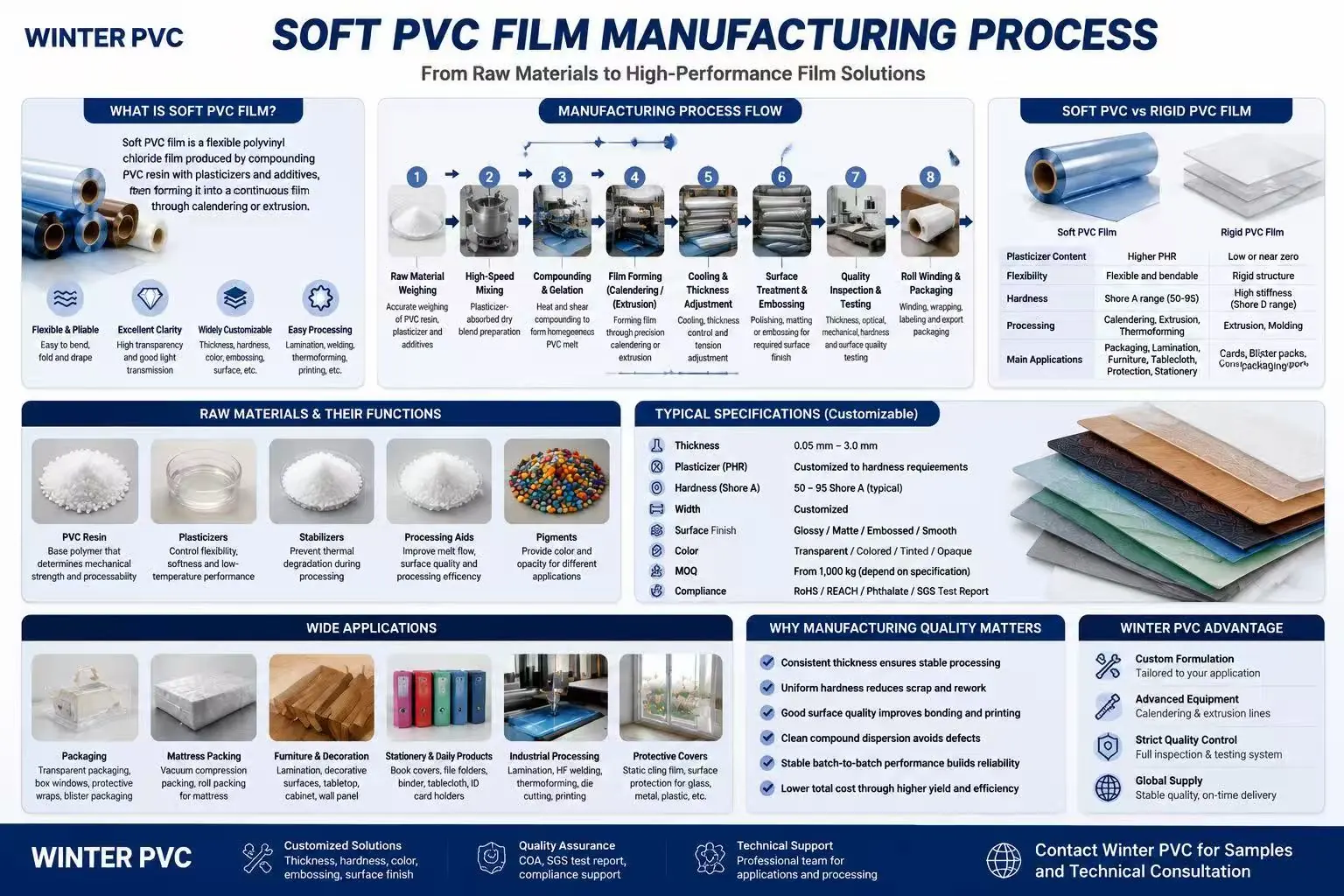
Why Manufacturing Process Matters for PVC Film Buyers
For industrial buyers, understanding the soft PVC film manufacturing process is essential when evaluating suppliers. The lowest quotation does not always represent the lowest total cost — material inconsistency can increase production downtime, scrap rates, and rework costs.
Manufacturing methods, formulation control, and quality inspection procedures directly influence film consistency, processing performance, and long-term application reliability. These factors determine whether a supplier can maintain stable quality across repeated production orders.
Soft PVC film is a flexible polymer sheet material used across packaging lines, lamination operations, furniture manufacturing, protective covering, and daily-use product fabrication. Sourcing teams, converters, and industrial laminators depend on manufacturing quality to control processing efficiency, material waste rates, and finished product consistency.
The performance of soft PVC film is established at the manufacturing stage. Formulation control governs flexibility and long-term aging behaviour. Compound dispersion quality determines film uniformity. Thickness control across the web affects processing reliability on automated equipment. Surface treatment parameters define gloss, texture, and handling characteristics.
These manufacturing variables mean that two rolls of clear PVC film with identical stated thickness can perform differently on a production line. One may run smoothly through automated equipment with stable sealing and lamination performance. The other may create feeding problems, blocking issues, or inconsistent bonding results. The difference traces back to how each was manufactured — the formulation precision, compound dispersion quality, thickness uniformity, and surface treatment control applied during production.
Winter PVC manufactures customized soft PVC film for global industrial buyers. Production parameters in thickness, hardness, transparency, color, embossing pattern, and surface finish are set to match the buyer’s specific application requirements. Typical commercial grades include super clear PVC film, normal clear film, and mattress packing film for heavy-duty protective use.
What Is Soft PVC Film?
Soft PVC film — also commonly referred to as flexible PVC film or plasticized PVC film in industrial markets — is a flexible polyvinyl chloride sheet produced by compounding PVC resin with plasticizers and processing additives, then forming the compound into a continuous web through calendering or extrusion.
PVC resin in its unmodified state is rigid and brittle. Plasticizers modify the polymer structure by positioning themselves between PVC chains, allowing the material to become flexible, pliable, and capable of being wound into rolls, thermoformed, stretched, and draped. This balance between flexibility, durability, processability, and customization capability is why soft PVC film is widely specified across industrial applications.
Soft PVC vs Rigid PVC Film
Rigid PVC film contains minimal plasticizer — typically near zero PHR. It is stiff, dimensionally stable, and used where structural contribution matters: credit card cores, pharmaceutical blister packs, and construction applications. For a detailed comparison of material grades and mechanical properties, see our guide on Rigid vs Flexible PVC Film.
Soft PVC film contains sufficient plasticizer to meet the flexibility requirement of its target application. Plasticizer content is expressed as Parts per Hundred Resin (PHR). Higher PHR levels generally increase flexibility, although the final hardness also depends on resin grade, plasticizer type, and additive formulation.
| Feature | Soft PVC Film | Rigid PVC Film |
|---|---|---|
| Plasticizer Content | Higher PHR | Low or near zero |
| Flexibility | Flexible and bendable | Rigid structure |
| Hardness | Shore A range | Higher stiffness |
| Processing | Calendering, extrusion, thermoforming | Extrusion, molding |
| Main Applications | Packaging, lamination, tablecloth, protection | Cards, blister packs, construction |
PHR is a formulation ratio, not a hardness unit. Hardness is measured separately on the Shore A durometer scale, with soft PVC films typically registering between 50 and 95 Shore A. For a detailed treatment of these relationships, see our guide to PVC film properties including tensile strength, PHR hardness, and compliance.
In industrial purchasing, selecting soft PVC film is not only about flexibility. Processing method, end-use environment, regulatory requirements, and required service life all influence the specification.
Raw Materials Used in Soft PVC Film Manufacturing
The properties of a soft PVC film are determined at the formulation stage. Each raw material serves a specific function, and the interaction between materials determines how the film processes during manufacturing and performs in service. Understanding formulation variables helps sourcing teams evaluate whether a supplier can maintain stable specifications beyond standard catalog grades.
PVC Resin
PVC resin is the base polymer. Higher K-value PVC resins are generally associated with higher mechanical strength, while lower K-value resins may offer easier processing characteristics. Resin selection affects not only mechanical properties but also processing stability, transparency, and the achievable balance between flexibility and strength. Suspension-grade PVC resin is the standard for calendered and extruded soft PVC film.
Plasticizers
Plasticizers are the formulation component that distinguishes soft PVC film from rigid PVC. They are the primary variable controlling flexibility, and their selection also affects transparency, migration behaviour, low-temperature performance, and long-term stability. Different plasticizer systems may affect migration resistance, odor performance, low-temperature flexibility, and regulatory suitability depending on the target market — particularly relevant when supplying regulated markets or applications involving food contact.
Traditional phthalate plasticizers have historically been used in flexible PVC applications. Current specifications increasingly depend on destination-market compliance requirements. DOTP is widely selected as a non-phthalate plasticizer alternative offering good low-temperature flexibility and lower migration tendency. Citrate esters may be selected for applications requiring phthalate-free formulations, including certain regulated applications where specific compliance requirements apply. Polymeric plasticizers offer superior migration resistance for applications where the film must not mark contact surfaces. Epoxidized Soybean Oil (ESBO) serves as a bio-based secondary plasticizer and heat stabilizer co-agent.
Stabilizers, Processing Aids, and Pigments
Heat stabilizers prevent thermal degradation during processing at 160-200°C. Calcium-Zinc (Ca-Zn) systems are commonly used where low-toxicity formulations are required. Barium-Zinc (Ba-Zn) serves general industrial applications, and organotin is selected for high-transparency films. Processing aids modify melt rheology. Winter PVC performs color matching against customer-supplied references and maintains formulation records for consistent repeat-order performance.
Soft PVC Film Manufacturing Process
The soft PVC film production process converts raw materials into finished film through a series of controlled stages. Each stage has parameters that influence final film quality and downstream converting performance.
Manufacturing Process Flow
- Raw material weighing and formulation preparation
- High-speed mixing to produce plasticizer-absorbed dry blend
- PVC compounding and gelation into homogeneous melt
- Film forming through calendering or extrusion
- Cooling and thickness adjustment
- Surface treatment and embossing
- Quality inspection and testing
- Roll winding and export packaging
Material Mixing and Compounding
Manufacturing begins with accurate weighing of each formulation component. PVC resin, plasticizer, stabilizer, processing aids, and pigments are combined in a high-speed mixer. The batch is heated to approximately 90-120°C, producing a dry, free-flowing powder. Incomplete plasticizer absorption at this stage can produce hardness variation and surface defects in the finished film.
Compounding converts the dry blend into a fully gelated, homogeneous PVC melt through heat and mechanical shear at 140-170°C. Complete gelation is essential — under-gelated compound creates weak points and visible flaws.
Calendering vs Extrusion: How Production Method Influences Film Properties
Film forming is achieved through two primary methods. Manufacturers with different production equipment configurations may have different advantages in thickness range, surface finishing capability, and production efficiency.
| Parameter | Calendering | Extrusion |
|---|---|---|
| Thickness Range | Medium to heavy gauge (0.08 mm and above) | Thin gauge (below 0.10 mm typical) |
| Surface Embossing | In-line embossing capability | Off-line or limited in-line |
| Optical Clarity | High, depending on formulation and roll finishing | High, especially for thin gauge applications |
| Multi-layer Capability | Limited | Co-extrusion available |
| Production Efficiency | High output for consistent-gauge product | Flexible setup for varied specifications |
| Typical Applications | Tablecloth film, decorative film, furniture film, heavy gauge film | Packaging film, lightweight applications, multi-layer structures |
Calendering processes the melt through counter-rotating precision rolls and is the dominant method for medium to heavy gauge film, films requiring tight thickness uniformity, and in-line embossed films. Extrusion forces the melt through a flat die onto chill rolls and is suited to thinner gauge films and multi-layer co-extrusion. For a broader discussion of production methods, equipment configurations, and process parameters, see our guide to the PVC film manufacturing process.
Cooling, Inspection, and Roll Winding
After film forming, the PVC film passes through controlled cooling and tension adjustment systems before winding into rolls. Cooling stability influences dimensional stability, while winding tension affects roll hardness, telescoping risk, and downstream unwinding performance.
For converters, roll quality is as important as film properties. Unstable winding can create feeding problems during printing, lamination, and automatic processing. Quality inspection covers thickness, transparency, tensile strength, elongation, hardness, surface quality, and embossing consistency. Production batches are typically supported by Certificate of Analysis (COA) documentation. Winter PVC provides quality documentation including thickness inspection records, physical property testing, and SGS-tested compliance reports according to application requirements.
After inspection, finished rolls are packed according to export requirements, including protective film wrapping, core specifications, roll labeling, and pallet configuration when required. For detailed guidance on thickness selection, refer to our PVC film thickness guide.
Why Manufacturing Process Control Matters for Buyers
Understanding how manufacturing parameters affect material performance helps translate technical specifications into supplier evaluation criteria.
Poor mixing or incomplete plasticizer absorption produces localized hardness variation — some areas of the film will be softer or firmer than specified, causing inconsistent converting behaviour. Unstable calendering or extrusion conditions create thickness deviation across the web or along the roll length, affecting unwind tension and lamination pressure distribution. Improper embossing temperature or pressure results in shallow or inconsistent pattern definition, producing visible variation in finished decorative products. Inadequate filtration or incomplete gelation leaves gel particles in the film, creating weak points under mechanical stress and visible defects in transparent applications.
A supplier with demonstrated process control can provide documented evidence of thickness tolerance capability, batch-to-batch hardness consistency, and surface quality standards. This reduces the risk of qualifying material on initial samples only to experience quality drift on subsequent production orders.
How Soft PVC Film Manufacturing Affects Supplier Selection
Formulation control determines whether a supplier can match required hardness, transparency, and mechanical properties — and reproduce them across repeat orders. Thickness tolerance directly affects converting yield. Surface consistency affects lamination bond strength, print registration, and finished product appearance. Batch-to-batch stability is essential for repeat-order reliability.
Supplier Evaluation Checklist
Before qualification, buyers should confirm:
- Manufacturing method and production capability
- Thickness tolerance capability and documented quality records
- Hardness consistency across production batches
- Color matching system and batch-to-batch accuracy
- Surface finishing and embossing capability
- COA availability and quality documentation
- SGS or third-party testing reports
- Sample trial performance on buyer’s equipment
- Export packaging standards and shipping experience
A supplier’s willingness to provide detailed process information is itself an indicator of manufacturing capability and quality management maturity. Before requesting quotations, importers and sourcing teams should prepare: target thickness, film width, application type, required transparency, hardness requirement, surface finish preference, and estimated annual consumption. Clear specifications enable more accurate technical recommendations and production evaluations.
Soft PVC Film Grades Manufactured for Different Applications
Winter PVC supplies transparent soft PVC film from standard clear grades to high-clarity super clear grades, customized according to application requirements including packaging visibility, lamination clarity, and protective covering needs. Super Clear Film is manufactured for high-clarity packaging windows and display applications. Normal Clear Film provides cost-effective transparency for general packaging and protective uses. For a comparison of clarity grades, see our guide on Clear PVC Film vs Super Clear PVC Film.
Decorative films combine visual design with surface protection. Colored Embossing Film combines integral color with in-line surface texture. Matte Embossing Film provides controlled low-gloss surface. Clear Lamination Embossing Film provides transparent surface texture over printed substrates. Opaque PVC films and colored embossing films are used extensively in stationery, decorative applications, and product identification.
Beyond standard transparent and decorative grades, functional PVC films are developed for applications requiring specific performance characteristics. Static Cling Film adheres to smooth surfaces without adhesive. Mattress Packing Film is manufactured for puncture resistance and consistent heat-seal performance. Tablecloth manufacturers typically specify soft PVC film based on flexibility, drape, surface gloss, embossing pattern, and cleaning performance — thickness and hardness selection directly affect the final product feel and durability. For additional context on how these film categories map to end-use industries, see our guide to soft PVC film uses and industrial applications.
Typical Soft PVC Film Specifications Available
Thickness: 0.05 mm – 3.0 mm depending on product category and application requirements. Plasticizer Level: customized according to flexibility requirements. Typical industrial formulations range according to target Shore A hardness and application performance. Surface finish: glossy, matte, embossed with various texture patterns available. Color: transparent, colored opaque, tinted transparent, and custom color matching to Pantone or RAL references. Width: customized to buyer’s converting equipment. MOQ: starting from 1,000 kg depending on specification and customization requirements. For detailed thickness selection guidance, refer to our PVC film thickness guide.
How Manufacturing Parameters Influence Soft PVC Film Performance
Thickness directly affects material consumption, mechanical durability, and cost per square meter. Thin films (0.05-0.12 mm) serve lightweight packaging and temporary protection. Medium-thickness films (0.12-0.30 mm) cover most lamination and general industrial applications. Heavy-gauge films (0.30 mm and above) are specified where puncture resistance or structural contribution justifies the material cost.
Plasticizer content is the primary formulation lever controlling flexibility. Lower PHR levels produce firmer films suitable for stationery covers and semi-rigid components. Mid-range PHR provides moderate flexibility for general-purpose films. Higher PHR levels produce flexible films for applications requiring significant conformability and drapability. For further detail, see our guide to PVC film properties including tensile strength, PHR hardness, and compliance.
Surface finish affects both visual appearance and functional handling. Glossy finishes maximize light reflection. Matte finishes reduce glare and fingerprint visibility. Embossed finishes add three-dimensional texture.
Soft PVC Film Manufacturing vs Flexible PVC Film Manufacturing
In industrial procurement, these terms describe the same production activity: compounding PVC resin with plasticizers to produce a flexible film. The practical approach is to specify film requirements in measurable terms: Shore A hardness, thickness with stated tolerance, tensile strength and elongation, and application-specific properties. For additional context, see our guide on Flexible vs Soft PVC Film.
Common Film Defects and Their Manufacturing Causes
Most quality disputes between buyers and suppliers trace back to a small number of recurring defects. Knowing the manufacturing cause lets a buyer ask the right question instead of simply rejecting the roll.
| Defect | Typical Cause at Manufacturing Stage | Prevention / Control | What the Buyer Should Check |
|---|---|---|---|
| Hardness variation across the roll | Incomplete plasticizer absorption during high-speed mixing | Extended mixing time and temperature control in the dry-blend stage | Shore A measured at several points across the web |
| Thickness deviation along the roll | Unstable calendering or extrusion conditions; uneven cooling | In-line gauge measurement with automatic roll-gap correction | Gauge readings at head, middle and tail of every roll |
| Gel particles / fisheyes | Incomplete gelation; inadequate melt filtration | Higher filtration mesh; verified gelation temperature | Visual inspection of transparent film against a light source |
| Shallow or patchy embossing | Embossing roll temperature or pressure drift | Closed-loop temperature control; reference pattern standards | Pattern depth compared with the approved reference sample |
| Blocking on unwind | Insufficient antiblocking agent; excessive winding tension | Additive adjustment; controlled winding tension profile | Unwind trial on the buyer’s own converting line |
| Surface scratches or handling marks | Roll handling, slitting and packing contact | Protective film wrapping; controlled slitting area | Surface inspection of the first 2–3 m after unwinding |
Every one of these defects is detectable before shipment if the supplier runs the right in-line and off-line checks. For importers, the most useful control remains the Certificate of Analysis: it converts a verbal claim about quality into a document that can be compared batch to batch, and it gives the buyer a defensible basis for a claim if the delivered film drifts from the approved sample.
Where transparency is part of the specification, defect thresholds become stricter and should be written into the purchase order rather than agreed verbally — see our guide to clear PVC film vs super clear PVC film for how optical grades are defined and inspected.
Frequently Asked Questions
What is soft PVC film manufacturing?
Soft PVC film manufacturing is the industrial process of compounding PVC resin with plasticizers, stabilizers, and additives, then forming the material into continuous flexible film through calendering or extrusion.
How is soft PVC film produced?
The production process involves material weighing and high-speed mixing to produce a plasticizer-absorbed dry blend, heat-and-shear compounding to gelate the PVC into a homogeneous melt, film forming via calendering or extrusion, surface treatment including polishing, matting, or embossing, and quality inspection covering thickness, optical properties, mechanical properties, hardness, and surface quality.
What is the difference between PVC film made by calendering and extrusion?
Calendered PVC film offers superior thickness uniformity, better surface quality, and in-line embossing capability, making it suitable for medium to heavy gauge decorative and furniture films. Extruded PVC film provides high optical clarity through rapid quenching and is better suited to thin gauge packaging films and multi-layer structures. The choice depends on target thickness, surface finish requirements, and application specifications.
How can buyers ensure consistency between samples and mass production?
Buyers should confirm that production parameters used for approved samples are recorded, including formulation, thickness range, hardness level, surface treatment, and processing conditions. A supplier with documented production control can better reproduce approved specifications during repeat orders. Sample testing on the buyer’s own converting equipment provides additional verification before bulk orders proceed.
How can buyers evaluate PVC film suppliers before placing bulk orders?
Buyers should verify production capability through sample testing on their own converting equipment, review quality documentation including COA and third-party test reports, assess batch-to-batch consistency records, confirm compliance certifications for the destination market, and evaluate the supplier’s technical communication during the specification process. A factory visit or third-party inspection provides additional verification of manufacturing capability.
What materials are used in soft PVC film?
The primary materials are PVC resin (suspension grade for calendering and extrusion), plasticizers (phthalate-based or non-phthalate alternatives such as DOTP, citrate esters, and polymeric plasticizers), heat stabilizers (Ca-Zn, Ba-Zn, or organotin), processing aids and lubricants, pigments for colored grades, and surface additives including antiblocking agents and slip agents.
How does PHR affect soft PVC film flexibility?
PHR (Parts per Hundred Resin) indicates the weight of plasticizer per 100 parts of PVC resin. Higher PHR produces a softer, more flexible film with lower Shore A hardness and higher elongation.
Can soft PVC film be customized for specific converting machines?
Yes. PVC film can be customized according to machine requirements including thickness tolerance, roll width, core size, hardness, surface finish, and winding specifications. Providing your equipment parameters during the specification stage helps ensure the film runs efficiently on your production line.
What information should buyers provide when sourcing soft PVC film?
Buyers should provide target thickness, width, required hardness range, transparency level, color reference, surface finish preference, application details, and estimated order volume. The more complete the specification, the more accurate the technical recommendation and quotation.
Can I request samples before bulk order?
Yes. Winter PVC provides samples for testing before mass production. Buyers can evaluate thickness, flexibility, transparency, surface finish, and processing compatibility on their own converting equipment before confirming specifications.
Conclusion: Selecting the Right Soft PVC Film Supplier
Soft PVC film manufacturing is a formulation-driven industrial process. The selection and proportioning of raw materials establishes the film’s flexibility, clarity, surface characteristics, and long-term performance. Understanding how manufacturing parameters translate to material performance enables more precise supplier evaluation and specification development.
Selecting a PVC film manufacturer with formulation capability, process control, and quality documentation supports consistent downstream production, lower material waste, and reduced quality variance in the finished product.
Winter PVC manufactures customized soft PVC film with controlled thickness, hardness, transparency, color, embossing pattern, and surface finish. Send your PVC film specification including thickness, width, hardness, application, and annual consumption. Our technical team will evaluate the suitable formulation, production method, and surface treatment options before quotation.
Contact Winter PVC for a sample request or technical consultation. Production parameters are adjusted to the buyer’s requirements, and formulation records are maintained for consistent repeat-order performance.
Need a Quotation or Technical Recommendation?
Send your specification to the Winter PVC export sales team — thickness, width, hardness (PHR), color, surface finish and estimated annual volume. Our engineers will confirm the suitable formulation, production route and documentation package, and arrange samples for evaluation on your own converting equipment.