
Introduction
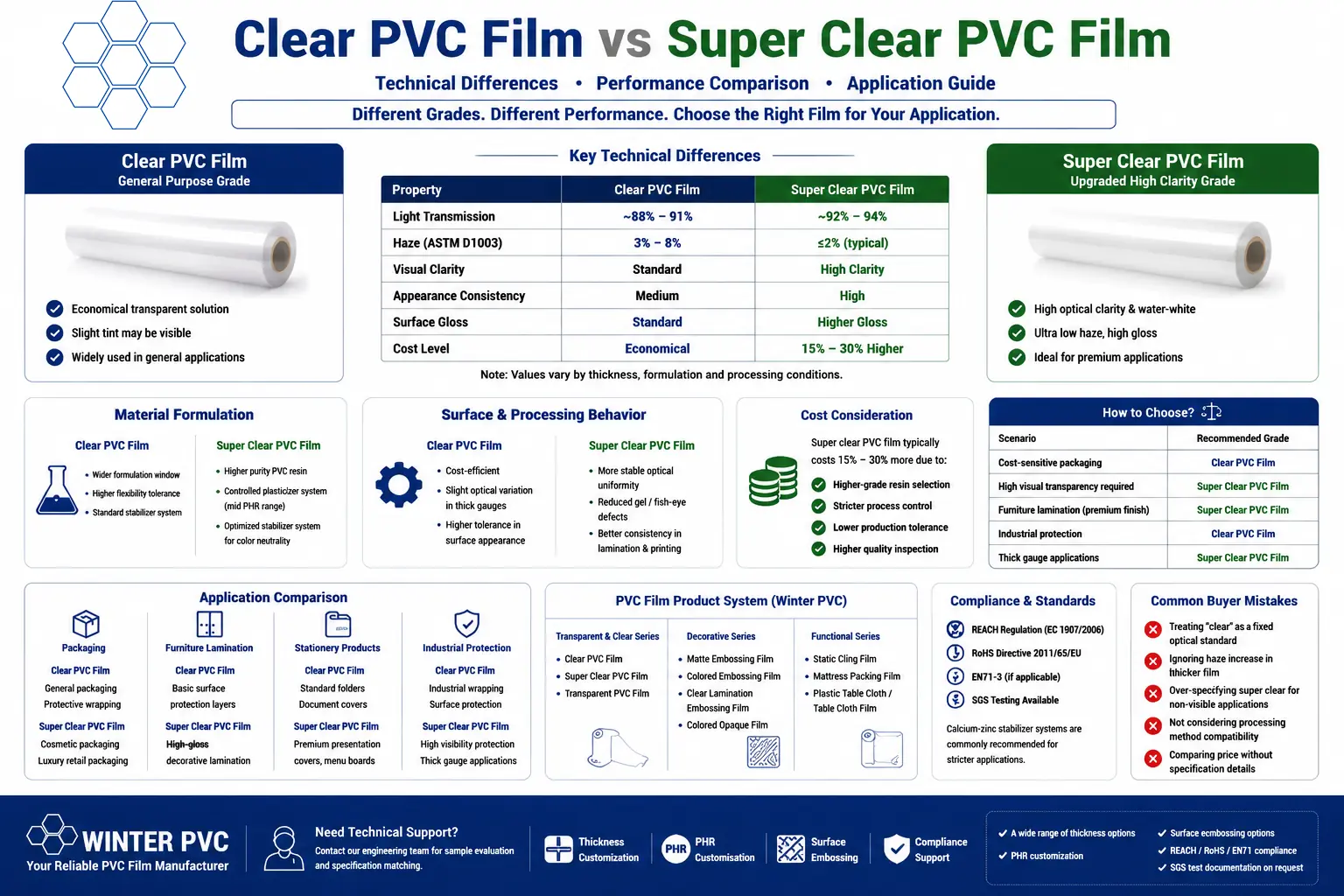
When sourcing transparent PVC film for packaging, furniture lamination, stationery, or industrial protection applications, buyers often evaluate two primary options:
The difference between them is not cosmetic. It directly affects optical clarity, haze level, processing stability, and final product perception.
This guide explains the technical differences from a manufacturing perspective — including measured optical values, cost conversion, and process compatibility — so procurement teams can specify the correct grade instead of paying for clarity the finished product will never show.
What is Clear PVC Film?
Clear PVC film is a general-purpose transparent film manufactured from PVC resin combined with plasticizers and stabilizers. It is the workhorse transparency grade: it delivers dependable see-through performance at the lowest cost per square meter, and it tolerates a wider formulation window than premium optical grades.
Typical Industry Characteristics
- Light transmission: ~88%–91% (depending on thickness and formulation)
- Haze: 3%–8%
- Appearance: slight tint may be visible depending on stabilizer system
- Cost level: economical transparent film solution
It is widely used in:
- Packaging protection
- Stationery covers
- Document sleeves
- General industrial wrapping
Related: PVC Film Properties Guide
What is Super Clear PVC Film?
Super clear PVC film is an upgraded transparent grade designed to improve optical performance by reducing internal light scattering. It typically uses higher purity raw materials and tighter process control, which is why it is also referred to as a water-white or optical grade film.
Typical Industry Performance Range
- Light transmission: ~92%–94%
- Haze: ≤2% (under standard ASTM D1003 conditions)
- Appearance: water-white, high clarity
- Surface: higher gloss and improved optical uniformity
It is commonly used in:
- High-end packaging windows
- Furniture surface lamination
- Premium stationery products
- Retail display materials
Related: PVC Film Manufacturing Process
Key Technical Differences
1. Optical Performance
| Property | Clear PVC Film | Super Clear PVC Film |
|---|---|---|
| Light transmission | ~88%–91% | ~92%–94% |
| Haze | 3%–8% | ≤2% (typical) |
| Visual clarity | Standard | High clarity |
| Appearance consistency | Medium | High |
Note: Optical values may vary depending on thickness, processing conditions, and formulation system.
2. Material Formulation
Clear PVC Film (General Grade)
- Wider formulation window
- Higher flexibility tolerance (PHR range varies by application)
- Standard stabilizer systems
Super Clear PVC Film (Upgraded Grade)
- Higher purity PVC resin
- Controlled plasticizer system (typically mid PHR range)
- Optimized stabilizer system for color neutrality
Because both grades are defined by plasticizer content (PHR) as well as transparency, the same transparency level can be produced in very different hardness ranges. If your decision also depends on stiffness, tensile strength or elongation, review the rigid vs flexible PVC film comparison before locking the specification.
Related: PVC Film Thickness Guide
3. Surface and Processing Behavior
Super clear film generally provides:
- More stable optical uniformity
- Reduced gel/fish-eye defects
- Better consistency in lamination and printing processes
Clear film is more cost-efficient but may show:
- Slight optical variation in thicker gauges
- Higher tolerance range in surface appearance
4. Cost Consideration
Super clear PVC film typically carries a 15%–30% higher cost level due to:
- higher-grade resin selection
- stricter process control
- lower production tolerance
- higher quality inspection requirements
5. Haze, Light Transmittance and Yellowness Index: Measured Comparison
Brochure values are usually quoted on a single thickness, which makes two suppliers look identical on paper. The table below shows how the two grades typically behave across the parameters that decide whether a buyer will accept or reject the delivered roll.
| Optical Parameter | Test Method | Clear PVC Film | Super Clear PVC Film | Why It Matters to Buyers |
|---|---|---|---|---|
| Light transmittance | ASTM D1003 | 88%–91% | 92%–94% | Brightness of backlit displays and packaging windows |
| Haze | ASTM D1003 | 3%–8% | ≤2% | Sharpness of printed graphics seen through the film |
| Yellowness index (YI) | ASTM E313 | 3.5–6.0 | 1.5–2.5 | Neutral white appearance; avoids a yellow cast in laminated panels |
| Gloss (60°) | ASTM D523 | 85–100 GU | 100–120 GU | Perceived premium finish in retail and furniture use |
| Haze at 0.30 mm gauge | ASTM D1003 | 8%–12% | ≤3% | Thick-gauge transparent applications |
All figures above are typical ranges for 0.20 mm film unless stated otherwise. Always request a batch-specific test report rather than accepting catalogue values, because haze in the general grade rises noticeably with thickness while the super clear grade stays comparatively flat.
6. Calendering vs Coating: Why the Process Decides Clarity
Transparency is not only a raw material property — it is a process outcome. Two production routes dominate transparent PVC film manufacturing:
- Calendering: the compound is passed through a series of heated rolls. It is the most cost-efficient route and is used for the majority of general clear film. Roll temperature uniformity and calendering speed determine surface waviness and gel level.
- Coating / casting: the formulation is deposited onto a carrier and cured with controlled heat and tension. It yields lower internal stress and therefore lower haze, which is why optical-grade film is frequently produced this way.
Practically, this means an optical-grade formulation produced on a poorly controlled line can be hazier than a well-run general grade. When comparing quotations, ask which route will be used, what in-line haze inspection is performed, and how often rolls are sampled. These controls are described in more detail in our soft PVC film manufacturing process guide.
7. Converting the Price Gap: Cost per Square Meter vs Cost per Ton
The 15%–30% premium is quoted per ton, but the end product is costed per square meter or per finished unit. Because super clear film can usually be run thinner for the same visual result, the effective gap is often smaller than the quotation suggests. Using an indexed comparison (general clear film = 100):
| Cost Basis | Clear PVC Film | Super Clear PVC Film | Comment |
|---|---|---|---|
| Index per ton | 100 | 115–130 | Quotation basis used by most suppliers |
| Usable thickness | 0.15–0.20 mm | 0.10–0.15 mm | Lower haze allows a thinner downgauge |
| Index per m² (equivalent clarity) | 100 | 105–120 | Real gap is usually narrower than the per-ton gap |
| Rejection / rework cost | Higher | Lower | Fewer gel defects and more consistent lamination |
For cost-sensitive protective packaging, the general grade almost always wins. For visible retail packaging, furniture lamination and backlit display work, the premium is normally recovered through fewer rejects and a better shelf appearance. If you are undecided, request matched samples of both grades in the same thickness from the super clear PVC film product range and compare them under your own lighting conditions.
Application Comparison: Where Each Grade Performs Best
Packaging Applications
- Clear PVC: general packaging and protective wrapping
- Super Clear PVC: cosmetic packaging, luxury retail packaging
Furniture Lamination
- Clear PVC: basic surface protection layers
- Super Clear PVC: high-gloss decorative lamination
Stationery Products
- Clear PVC: standard folders and document covers
- Super Clear PVC: premium presentation covers and menu boards
Related: PVC Film Applications Guide
PVC Film Product System (Winter PVC)
Both materials belong to a broader PVC film product portfolio:
Transparent & Clear Series
- Clear PVC Film
- Super Clear PVC Film
- Transparent PVC Film
Decorative Series
- Matte Embossing Film
- Colored Embossing Film
- Clear Lamination Embossing Film
- Colored Opaque Film
Functional Series
- Static Cling Film
- Mattress Packing Film
- Plastic Table Cloth / Table Cloth Film
Compliance & Industrial Standards
Winter PVC film products can be manufactured under international compliance frameworks:
- REACH Regulation (EC 1907/2006)
- RoHS Directive 2011/65/EU
- EN71-3 (if applicable for regulated end-use)
- SGS third-party testing available upon request
For stricter applications (stationery, furniture, export packaging), calcium-zinc stabilizer systems are commonly recommended — they support color neutrality and are compatible with food-contact and toy-safety requirements when the full formulation is reviewed.
How to Choose Between Clear and Super Clear PVC Film
| Scenario | Recommended Grade |
|---|---|
| Cost-sensitive packaging | Clear PVC Film |
| High visual transparency required | Super Clear PVC Film |
| Furniture lamination (premium finish) | Super Clear PVC Film |
| Industrial protection | Clear PVC Film |
| Thick gauge applications | Super Clear preferred |
Common Procurement Mistakes
- Treating “clear” as a fixed optical standard instead of a range
- Ignoring haze increase in thicker film
- Over-specifying super clear for non-visible applications
- Not considering processing method compatibility
- Comparing price without specification details
- Quoting a super clear grade against a general clear quotation — and then discovering the price gap after the order is placed. Always confirm the grade in writing on the quotation
- Confusing transparency grade with hardness grade: clear/super clear describes optics, while PHR describes flexibility. The two decisions are independent — see the flexible vs soft PVC film guide for how PHR is specified
Frequently Asked Questions
Q1: Is super clear PVC film always better?
Not necessarily. It depends on whether optical clarity is required in the final product. If the film sits behind a printed label or wraps a hidden component, the premium buys nothing.
Q2: When does the difference become visually noticeable?
Typically in thicker gauges or backlit applications where haze becomes more visible. Below 0.10 mm the two grades look very similar under normal indoor lighting.
Q3: Can both grades meet REACH and RoHS standards?
Yes, depending on formulation and stabilizer system. Confirm the stabilizer type and request the compliance documents for the exact batch.
Q4: Does thickness affect transparency?
Yes. Higher thickness generally increases haze level — noticeably in the general grade, only marginally in the super clear grade.
Q5: Can PVC film be customized?
Yes. Thickness, PHR, color, surface finish, and additives can all be customized.
Q6: Does the yellowness index change over time?
A properly stabilized film keeps a stable YI under normal indoor conditions. Yellowing usually indicates an unsuitable stabilizer system or prolonged UV exposure, which is worth specifying in advance for outdoor or sunlit installations.
Q7: How many samples should I compare before ordering?
Request at least two thicknesses of each grade so you can evaluate clarity, stiffness and lamination behavior together. Sample evaluation is the cheapest way to avoid an expensive grade mismatch.
Conclusion
Clear PVC film and super clear PVC film serve different industrial purposes.
- Clear PVC: cost-efficient, general applications
- Super Clear PVC: high optical performance applications
The correct selection depends on balancing:
- optical requirements
- processing conditions
- cost structure
- end-use visibility
Need Technical Support?
Winter PVC provides customized PVC film solutions including:
- A wide range of thickness options tailored to your specific application needs
- PHR customization
- Surface embossing options
- REACH / RoHS / EN71 compliance support
- SGS test documentation on request
Contact our engineering team for sample evaluation and specification matching, or send your target thickness, PHR and clarity requirement directly to our sales team.