
Introduction
What Is PVC Film Thickness?
PVC film thickness is the measured distance between the two surfaces of the film — typically expressed in millimeters (mm), microns (μm), or gauge (GA). In industrial procurement, this single dimension determines converting behavior, mechanical strength, optical clarity, and material cost per square meter.
Units of Measurement
| Unit | Relationship | Common Usage |
|---|---|---|
| Millimeter (mm) | 1 mm = 1,000 μm | Global industrial standard |
| Micron (μm) | 1 μm = 0.001 mm | Thin-film specifications |
| Gauge (GA) | 1 gauge = 0.01 mil = 0.254 μm | North American legacy usage |
| Mil | 1 mil = 0.001 inch = 25.4 μm | Mils are commonly used in North American industrial manufacturing. |
> Example: 0.25 mm = 250 μm ≈ 984 gauge.
During production, film gauge is continuously monitored using laser micrometers, beta gauges, or contact calipers. For procurement teams, nominal thickness directly connects to both part quality and total cost, making it one of the most tightly controlled variables in any PVC film specification.
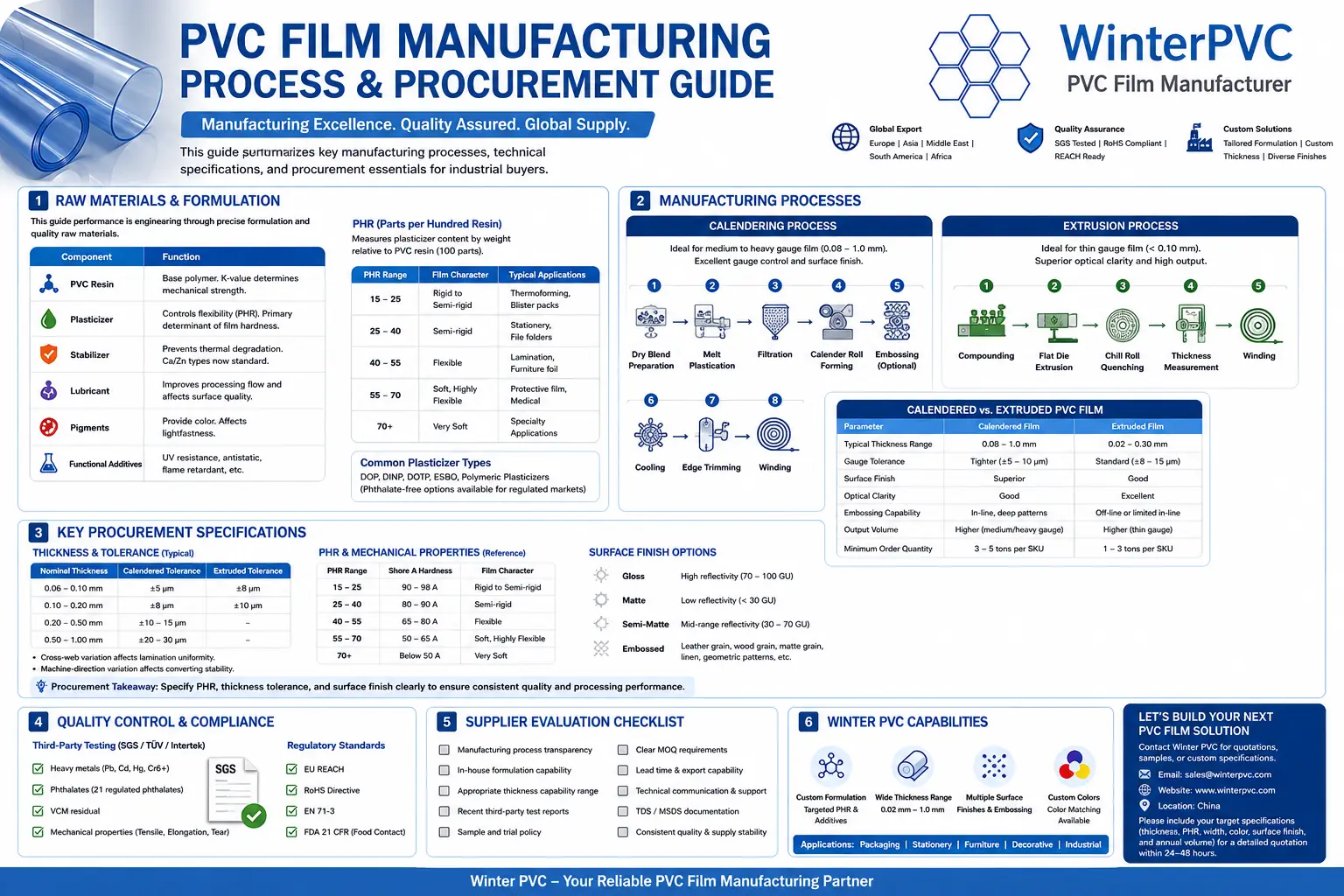
To understand how thickness is engineered and controlled during production, refer to our guide on how PVC film is manufactured, from raw material compounding through calendering and extrusion to final quality inspection
Standard PVC Film Thickness Range
Industrial PVC film is commercially available in various thicknesses, from approximately 0.05 mm to 3.0 mm, spanning ultra-thin flexible roll stock to rigid heavy-gauge sheet.
| Category | Thickness Range | Typical Form |
|---|---|---|
| Ultra-Thin Film | 0.05 – 0.10 mm | Flexible roll stock |
| Thin Film | 0.10 – 0.30 mm | Flexible roll stock |
| Medium Film | 0.30 – 0.60 mm | Semi-rigid roll/sheet |
| Thick Film | 0.60 – 1.00 mm | Rigid sheet |
| Heavy-Gauge | 1.00 – 3.00 mm | Rigid sheet |
Many industrial manufacturers today can produce across this entire spectrum, with core capability typically spanning 0.06 mm to 0.80 mm on calender and extrusion lines. Buyers can source everything from ultra-thin surface protection film to sturdy decorative laminates from a single supplier.
PVC Film Thickness Chart (Comprehensive)
The following reference table maps specified thickness in millimeters, microns, and gauge to typical industrial applications and recommended processing methods.
| mm | Micron (μm) | Gauge (GA) | Common Applications | Recommended Processing |
|---|---|---|---|---|
| 0.05 | 50 | 200 | Light stationery overlay, document lamination | Calendering, cold lamination |
| 0.08 | 80 | 315 | Surface protection film, temporary masking | Calendering, self-adhesive coating |
| 0.10 | 100 | 400 | Light packaging, envelope windows, book covers | Calendering, high-frequency welding |
| 0.12 | 120 | 472 | Stationery film, report covers, menu lamination | Calendering, thermal lamination |
| 0.15 | 150 | 591 | General packaging, gift box film, lamination film | Calendering, high-frequency welding |
| 0.20 | 200 | 787 | Heavy stationery, ID card overlay, opaque film | Calendering, shallow vacuum forming |
| 0.25 | 250 | 984 | Furniture edge banding, decorative laminates, lamination embossing film | Calendering/extrusion, hot-press lamination |
| 0.30 | 300 | 1,181 | 3D membrane pressing, vacuum forming, embossing film | Calendering/extrusion, vacuum thermoforming |
| 0.40 | 400 | 1,575 | Heavy packaging, technical blister, matte embossing film | Extrusion, deep-draw thermoforming |
| 0.50 | 500 | 1,969 | Rigid blister packaging, medical trays, heavy-duty protective film | Extrusion, thermoforming |
| 0.60 | 600 | 2,362 | Construction profiles, door panels, furniture fronts | Extrusion, flat-bed lamination |
| 0.80 | 800 | 3,150 | Rigid industrial panels, machine housing lamination | Extrusion, hot-press lamination |
| 1.00 | 1,000 | 3,937 | Heavy industrial cladding, structural panels | Extrusion, CNC cutting |
| 1.50+ | 1,500+ | 5,906+ | Industrial-grade rigid sheets, chemical containment | Extrusion, die cutting |
Because flexibility depends on both film thickness and plasticizer content, buyers should evaluate PHR alongside gauge selection. Our PVC film properties guide explains how tensile strength, Shore hardness, elongation, and PHR interact during material selection.
PVC Film Thickness Selection Matrix
Use this quick-reference matrix to narrow down gauge options based on your primary requirement.
| If you need… | Recommended Thickness | Suggested Film Category |
|---|---|---|
| Maximum optical clarity | 0.10 – 0.20 mm | Clear PVC film |
| Furniture lamination | 0.20 – 0.35 mm | Embossed PVC film |
| Surface protection (removable) | 0.05 – 0.10 mm | Static cling film |
| Blister packaging | 0.25 – 0.50 mm | Rigid PVC film |
| Heavy-duty mattress packing | 0.20 – 0.50 mm | Heavy-gauge flexible film |
| Decorative table covering | 0.12 – 0.25 mm | Colored decorative film |
| Deep-draw thermoforming | 0.40 – 0.80 mm | Thermoforming-grade film |
Recommended Thickness by Industry
Packaging Materials
| Application | Recommended Thickness | Notes / Key Criteria |
|---|---|---|
| Flexible overwrap | 0.08 – 0.15 mm | Thin-gauge flexible packaging |
| Box windows | 0.10 – 0.20 mm | Clear PVC film, high transparency |
| Blister packs | 0.25 – 0.50 mm | Rigid, thermoformed |
| Clamshell packaging | 0.30 – 0.50 mm | Rigid packaging |
| Key selection criteria | Product weight, seal strength, clarity | |
Furniture Lamination
| Application | Recommended Thickness | Notes / Key Criteria |
|---|---|---|
| Flat-panel lamination | 0.15 – 0.30 mm | Clear lamination film, premium finish |
| Edge banding | 0.20 – 0.40 mm | Durable edge finishing |
| 3D membrane pressing (MDF doors) | 0.25 – 0.40 mm | Embossed PVC film, grain retention |
| Key selection criteria | Deep-draw ratio, heat resistance, grain retention | |
Furniture Lamination
| Application | Recommended Thickness | Notes / Key Criteria |
|---|---|---|
| Flat-panel lamination | 0.15 – 0.30 mm | Clear lamination film, premium finish |
| Edge banding | 0.20 – 0.40 mm | Durable edge finishing |
| 3D membrane pressing (MDF doors) | 0.25 – 0.40 mm | Embossed PVC film, grain retention |
| Key selection criteria | Deep-draw ratio, heat resistance, grain retention | |
Surface Protection
| Application | Recommended Thickness | Notes / Key Criteria |
|---|---|---|
| Typical range | 0.03 – 0.10 mm | — |
| Low-tack temporary protection | 0.05 – 0.08 mm | Static cling film, residue-free removal |
| Medium-duty protection | 0.08 – 0.10 mm | General surface protection |
| Key selection criteria | Easy release, no residue, UV resistance | |
Thermoforming / Vacuum Forming
| Application | Recommended Thickness | Notes / Key Criteria |
|---|---|---|
| Typical range | 0.20 – 1.00 mm | — |
| Shallow draw | 0.20 – 0.40 mm | Basic thermoforming |
| Deep draw | 0.40 – 0.80 mm | Matte embossing film, textured finishes |
| Heavy-gauge forming | 0.80 – 3.00 mm | Thick-gauge forming |
| Key selection criteria | Elongation at break, uniform heating, sag resistance | |
Static Cling Film
| Application | Recommended Thickness | Notes / Key Criteria |
|---|---|---|
| Typical range | 0.08 – 0.20 mm | — |
| Window graphics | 0.10 – 0.15 mm | Static cling application |
| Shelf liners | 0.12 – 0.20 mm | Protective liners |
| Key selection criteria | Surface smoothness, plasticizer control, cling force | |
Decorative Film
| Application | Recommended Thickness | Notes / Key Criteria |
|---|---|---|
| Typical range | 0.12 – 0.40 mm | — |
| Woodgrain / stone patterns | 0.15 – 0.30 mm | Decorative overlays |
| Metallic finish | 0.12 – 0.25 mm | Premium decorative effect |
| Colored opaque film / embossed film | — | Common choices for decorative overlays |
| Table cloth film | 0.12 – 0.25 mm | Flexible, cleanable surfaces |
| Key selection criteria | Print quality, embossing depth, color consistency | |
For a broader overview of end-use sectors, read our PVC film applications guide, which covers packaging, lamination, surface protection, and more.
How Thickness Affects Performance
Flexibility vs. Rigidity
- < 0.20 mm: Highly flexible; suitable for roll-fed processes and tight-radius bends.
- 0.20 – 0.50 mm:Semi-rigid; often supplied in both roll and sheet form.
- > 0.50 mm: Rigid; sheet-fed only; requires different handling and converting equipment.
Plasticizer content (PHR) modulates this relationship — a 0.20 mm film with 45 PHR can feel more flexible than a 0.15 mm film with 25 PHR. Always evaluate film dimension alongside PHR.
Transparency and Optical Clarity
- Thinner films (0.05 – 0.30 mm) typically achieve >90% light transmission, per ASTM D1003, making clear PVC film the go-to for high-clarity applications.
- As gauge increases beyond 0.50 mm, slight haze may appear due to internal light scattering.
- Calendered film generally delivers better clarity than extruded film at equivalent specified thickness.
Tensile Strength and Mechanical Properties
- Absolute tensile strength rises with thickness, per ASTM D882 / ISO 527-3, but elongation at break remains formulation-dependent.
- Typical tensile range for flexible PVC: 15 – 60 MPa.
- Heavy-duty protective films demand both high nominal thickness and optimized elongation to prevent tearing during handling.
Processing Stability
- Thin films (< 0.15 mm) are heat-sensitive and require precise tension control.
- Thicker films (> 0.50 mm) are more thermally forgiving but slower to heat uniformly in thermoforming.
- Always align film thickness specification with the processing window of your converting equipment.
Cost Implications
Although thicker PVC film generally increases material cost, selecting the thinnest film that still satisfies performance requirements often reduces total procurement cost without compromising product quality. Experienced converters typically evaluate gauge selection together with PHR, processing method, and expected service life before finalizing specifications.
Shipping and Logistics
- Thinner films yield more square meters per roll, reducing freight cost per unit area.
- Thicker films produce heavier rolls; verify that container weight limits and handling equipment can accommodate them.
- To substantially mitigate international ocean and air freight costs per square meter for our global buyers, we routinely engineer specific roll diameters and optimized master roll weights. WinterPVC provides tailored, high-density pallet configurations and localized bundling solutions upon request to maximize container utilization ratios while guaranteeing zero-deflect transit protection during long-distance export shipping.
> Procurement Tip: Avoid over-specification. Many buyers default to thicker film “to be safe,” but a properly specified 0.25 mm film often performs identically to a 0.30 mm film at 15–20% lower cost. Always request a thickness recommendation based on your actual converting conditions.
Common Thickness Selection Mistakes
1. Choosing thicker film to “improve quality”
Thicker film adds cost, not necessarily performance. A 0.25 mm film with proper formulation often outperforms a 0.30 mm film with inconsistent PHR. Quality is about formulation control and gauge uniformity, not film dimension alone.
2. Ignoring processing compatibility
A film that performs well in one converting process may fail in another. Thermoforming requires uniform heating and sag resistance; HF welding requires specific dielectric properties. Specify your processing method upfront.
3. Neglecting tolerance in cost calculations
A film quoted at 0.20 mm ±8% can arrive at 0.184 mm. If your application requires minimum 0.19 mm, specify ±5% tolerance to avoid production issues.
4. Specifying thickness without PHR
Film gauge and PHR work together to determine flexibility. A 0.20 mm film at 25 PHR is rigid; the same 0.20 mm at 50 PHR is flexible. Always specify both parameters.
Thickness Tolerance and Manufacturing Quality
Thickness tolerance is the allowable deviation from nominal thickness. It is one of the strongest indicators of a supplier’s production capability. Poor uniformity leads directly to:
- Wrinkling and bubbles in lamination
- Uneven wall thickness in thermoformed parts
- Inconsistent weld strength in HF welding
- Print registration errors in decorated films
Industry Tolerance Grades
| Nominal Thickness | Premium (±5%) | Standard (±8%) | Economy (±10%) |
|---|---|---|---|
| 0.10 mm | 0.095–0.105 mm | 0.092–0.108 mm | 0.090–0.110 mm |
| 0.20 mm | 0.190–0.210 mm | 0.184–0.216 mm | 0.180–0.220 mm |
| 0.30 mm | 0.285–0.315 mm | 0.276–0.324 mm | 0.270–0.330 mm |
| 0.50 mm | 0.475–0.525 mm | 0.460–0.540 mm | 0.450–0.550 mm |
To ensure seamless downstream converting, our precision production lines operate under a strict ±5% thickness tolerance baseline for all bespoke OEM runs, fully backed by verifiable digital inspection logs. Every batch undergoes comprehensive traceability logging, with real-time Statistical Process Control (SPC) data readily accessible for enterprise buyers requiring documented process capability and premium quality assurance.
Quality Control Framework
- Incoming raw material inspection — resin K-value, plasticizer purity
- In-line thickness measurement — continuous cross-web profiling
- Off-line laboratory verification — tensile (ASTM D882), elongation, haze (ASTM D1003), and color (CIELAB ΔE)
- Third-party certification — SGS, REACH, RoHS compliance
- Batch traceability — from resin lot to finished roll number
For buyers sourcing tinted transparent films, colored opaque films, or any application where visual consistency is critical, tight gauge control is as important as color matching. A 5 μm variation in film dimension can shift color perception in transparent tinted films.
Supplier Evaluation Checklist for Thickness Specification
When requesting quotations from PVC film manufacturers, ask suppliers to provide:
– ✓ Nominal thickness capability range
– ✓ Thickness tolerance (±5%, ±8%, or wider)
– ✓ PHR range and standard formulations
– ✓ Available roll width and core size
– ✓ Minimum order quantity (MOQ) per SKU
– ✓ Third-party test reports (SGS or equivalent, dated within 12 months)
– ✓ Production lead time and export documentation capability
– ✓ Sample and trial roll policy
A supplier that cannot or will not provide these details may not be manufacturing the film themselves.
Information Buyers Should Confirm Before Ordering
Beyond the supplier evaluation checklist, procurement teams should also confirm the following application-specific details to ensure the specified film gauge will perform as expected:
Application type — packaging, lamination, thermoforming, surface protection, etc.
Operating temperature range — both during converting and in end-use
Printing or coating method — if post-processing is required
Lamination process — hot press, membrane press, or flat-bed
Vacuum forming depth — shallow or deep draw
Required certifications — REACH, RoHS, FDA, EN 71-3, etc.
Expected service life — indoor, outdoor, or limited-use
Storage environment — temperature, humidity, UV exposure
Clarifying these points with your manufacturer before production helps avoid mismatches between material specification and real-world performance.
How Winter PVC Customizes Film Thickness
Winter PVC is a specialized PVC film manufacturer that offers OEM-caliber thickness customization for industrial buyers. Rather than forcing your process to fit an off-the-shelf gauge, we engineer film to your exact specification.
Custom Thickness Manufacturing
- Available range: Spanning a comprehensive range from ultra-thin flexible roll stock to heavy-gauge rigid sheets to meet diverse industrial demands.
- Specification increment: Fully tailorable gauge specifications engineered to match your exact application requirements and processing tolerances.
- Calendered lines: Optimized for high-precision flexible films, delivering superior surface uniformity and exceptional aesthetic clarity.
- Extrusion lines: Formulated for medium to heavy-gauge products, offering outstanding structural integrity for semi-rigid and rigid applications.
Custom PHR Optimization (Flexible PVC Matrix)
- High Flexibility / Ultra-Soft (40 – 50 PHR): Engineered for maximum elasticity, elongation, and surface tack. Ideal for static cling films, high-stretch protective masking, and premium medical-grade overlays.
- Standard Industrial Flexibility (30 – 40 PHR): Optimized for a flawless balance of tensile strength and pliability. Widely utilized in super clear films, general-purpose technical packaging, and consumer goods.
- Firm Flexibility (20 – 30 PHR): Formulated for applications requiring a subtle structural hand and crease resistance while remaining fully flexible. Perfect for lamination overlays, stationery windows, and industrial liners.
Tailored PHR adjustment within our specialized flexible spectrum allows the exact same gauge to deliver vastly different tactile and mechanical performance—a critical capability when matching the film’s behavior to your specific high-speed converting machinery and environmental demands.
Tailored PHR allows the same base thickness to serve completely different flexibility requirements — a critical capability when converting between, for example, static cling film (soft, high PHR) and lamination embossing film (semi-rigid, medium PHR).
Product Range
Our factory manufactures the following film categories, all available in custom gauge:
Static cling film— for residue-free surface protection and graphics
Super clear film and normal clear film — for stationery, packaging, and display
Super clear lamination film — for high-clarity furniture and decorative overlays
Clear lamination embossing film — for textured, durable surfaces
Colored embossing film — for decorative panels and book covers
Matte embossing film — for anti-glare, premium tactile finishes
Colored opaque film — for opaque packaging and industrial color applications
Colored super clear film — for tinted transparent applications
Mattress packing film — heavy-duty protective film for rolled bedding
Plastic table cloth and table cloth — decorative, cleanable film for home and hospitality
Additional Customization Options
- Advanced Color Matching: Precise compliance with Pantone, RAL, or physical client samples via our in-house masterbatch formulation system.
- Premium Embossing Patterns: Extensive roll library including natural woodgrain, leather textures, technical mattes, linen, and custom geometric textures.
- Engineered Surface Finishes: Available in high-gloss, premium matte, anti-glare, textured, and soft-touch tactile finishes.
- Flexible Roll Dimensions: Slitting widths customizable up to 1,600 mm, tailorable to your converting machinery.
- Industrial Core Standards: Accommodating 1″, 2″, 3″, and 6″ heavy-duty paper or plastic cores based on winding tension needs.
- Functional Performance Treatments: Integrated anti-static coatings, enhanced UV stabilization, flame retardancy (FR), and anti-mildew additives.
Enterprise OEM Workflow
- Strategic Technical Consultation — Thorough application environment review and meticulous specification alignment.
- Custom Prototyping & Sampling — Lab-scale trial production and rigorous benchmarking for client qualification and approval.
- Quality Assurance Blueprint — Binding agreement on mechanical tolerances, localized PHR formulation, and CIELAB color standards.
- Rigorous Pre-Shipment Inspection — Comprehensive internal QC reporting combined with SGS, TÜV, or third-party laboratory verification upon request.
- Lifecycle Technical Support — Ongoing batch-to-batch consistency tracking, retention sample archiving, and continuous post-sale engineering support.
Typical PVC Film Thickness Benchmark by Product Type
The table below provides a quick reference for standard commercial thickness ranges. Please note that all specifications can be fully engineered outside these benchmarks to satisfy your specific OEM requirements.
| Product Category | Typical Thickness Range | Core Industrial Applications |
|---|---|---|
| Static Cling Film | 0.08 – 0.20 mm+ | Surface protection masking, high-end window graphics, protective overlays |
| Super Clear PVC Film | 0.10 – 1.00 mm+ | Stationery envelopes, industrial packaging windows, strip curtains, clear displays |
| Colored Opaque Film | 0.12 – 0.60 mm+ | Office file folders, heavy-duty packaging, decorative panel overlays, signage |
| Matte Embossing Film | 0.15 – 0.55 mm+ | 3D membrane furniture lamination, premium book covers, interior profiles |
| Clear Lamination Film | 0.08 – 0.40 mm+ | Furniture face veneers, ID card security overlays, protective composite lamination |
Formulation Note: Because final performance depends on both gauge and mechanical compound, our engineering team can adjust plasticizer levels (PHR) to achieve the exact flexibility, tensile strength, or elongation required for your converting machinery.
PVC Film Thickness Selection Process
- Define Application
- Choose Flexibility
Flexible / Semi-Rigid / Rigid - Select Thickness Range
0.05–0.20 mm / 0.20–0.50 mm / 0.50–3.00 mm - Confirm PHR Target
- Confirm Tolerance
±5% / ±8% / ±10% - Request Samples
- Mass Production
Frequently Asked Questions
Q1: What is the standard PVC film thickness for packaging?
Flexible packaging and surface protection applications typically utilize 0.08–0.50 mm+ PVC film. High-stretch overwrap films and descriptive labeling typically use thinner gauges (0.08–0.15 mm), while heavy-duty industrial wraps and container linings require thicker dimensions. Super Clear PVC film is frequently specified for premium box windows requiring crystal clarity.
Q2: How do I convert PVC film gauge to millimeters?
1 gauge (GA) = 0.01 mil = 0.254 micron = 0.000254 mm. To convert gauge to mm, simply multiply by 0.000254. For example, 1,000 gauge is approximately 0.254 mm. Most international industrial procurement specifications now standardized on millimeters (mm) or microns (μm).
Q3: What thickness of PVC film is best for furniture and interior lamination?
For flat-panel lamination and decorative profile wrapping, a thickness range of 0.15–0.30 mm is highly standard. Clear lamination film within this spectrum provides excellent wear resistance, while our customized flexible embossing films deliver superior woodgrain or matte texture retention without cracking during processing.
Q4: Is thicker PVC film always stronger?
Not necessarily. Mechanical strength, tensile durability, and tear resistance depend far more on the core polymer formulation, precise plasticizer (PHR) control, and calendering quality than on the physical gauge alone. A precisely engineered 0.25 mm flexible film can easily outperform a poorly formulated 0.30 mm film. We recommend specifying thickness based strictly on your converting machinery and application needs.
Q5: How much thickness tolerance is acceptable for industrial PVC film?
For high-speed automated converting, a ±5% thickness tolerance is considered premium grade and is highly recommended to prevent machine jamming. A ±8% tolerance is acceptable for standard commercial applications. Consistent gauge across the entire roll web ensures uniform tension and winding performance.
Q6: What thickness is recommended for heavy-duty industrial barriers and strip curtains?
For industrial environmental control, thermal barriers, and flexible strip curtains, heavier gauges ranging from 0.50 mm to 1.00 mm+ are standard. Our dedicated flexible formulations ensure that even at these higher thicknesses, the film maintains optimal pliability, roll flatter memory, and outstanding durability.
Q7: Can PVC film thickness variations affect printing quality?
Yes, significantly. Minor deviations in film gauge can alter roll tension, leading to multi-color print registration errors and uneven ink absorption. Maintaining a tight thickness tolerance (±5% or premium grade) is critical for consistent graphics replication in gravure or flexographic printing.
Q8: Does PVC film thickness influence international shipping costs?
Yes. Thicker films yield heavier rolls with fewer linear meters per kilogram, which increases the ocean or air freight cost per square meter. Our logistics team routinely optimizes roll diameters, master roll weights, and pallet configurations to maximize container yield and minimize landed costs for our global OEM buyers.
Q9: How should I specify PVC film thickness when requesting a factory quotation?
To receive an accurate commercial proposal, please provide: (1) target nominal thickness (in mm or micron), (2) preferred tolerance (e.g., ±5%), (3) visual finish (super clear, opaque colored, or matte embossed), (4) desired flexibility or PHR level (20–50 PHR), (5) roll width and paper core size, and (6) your target application so our engineering team can review compliance.
Q10: Can PVC film thickness be fully customized for custom OEM orders?
Yes. We specialize in bespoke gauge engineering for tailored OEM runs, with minimum order quantities (MOQs) starting from 1,000 kg per custom specification. Rather than locking you into rigid stock intervals, our advanced production machinery allows for fully customizable, high-precision thickness adjustments to perfectly align with your high-speed converting equipment and tension controls. Contact our technical sales team to discuss specific MOQ layouts for your target product category.
Q11: How does PVC film thickness affect transparency?
While standard films can develop haze as gauge increases, our proprietary Super Clear Formulation incorporates premium optical-grade resins. This ensures that our flexible films maintain excellent light transmission and low-haze visibility across our entire clear catalog, even when stepping up to heavier flexible gauges.
Conclusion
Whether you are sourcing clear PVC film for packaging, embossed film for furniture lamination, or static cling film for surface protection, defining film thickness together with tolerance, PHR, and processing requirements will help reduce production risks and avoid unnecessary material costs. Rather than defaulting to a thicker gauge “for safety,” experienced buyers identify the minimum functional thickness that meets all performance requirements — a practice that improves both product quality and procurement efficiency.
Before placing an order, confirm:
– ✓ Thickness and tolerance
– ✓ PHR or Shore hardness
– ✓ Roll width and core size
– ✓ Surface finish and embossing pattern
– ✓ Compliance documentation required
These specifications help reduce production risk and minimize unnecessary procurement costs. If additional engineering support is required, our technical team can assist in reviewing application requirements before production begins.
Winter PVC supplies custom-thickness PVC film from 0.05 mm to 3.00 mm across calender and extrusion lines. Contact us with your target gauge, application, and volume for a technical recommendation and quotation within 24–48 hours.