
Introduction
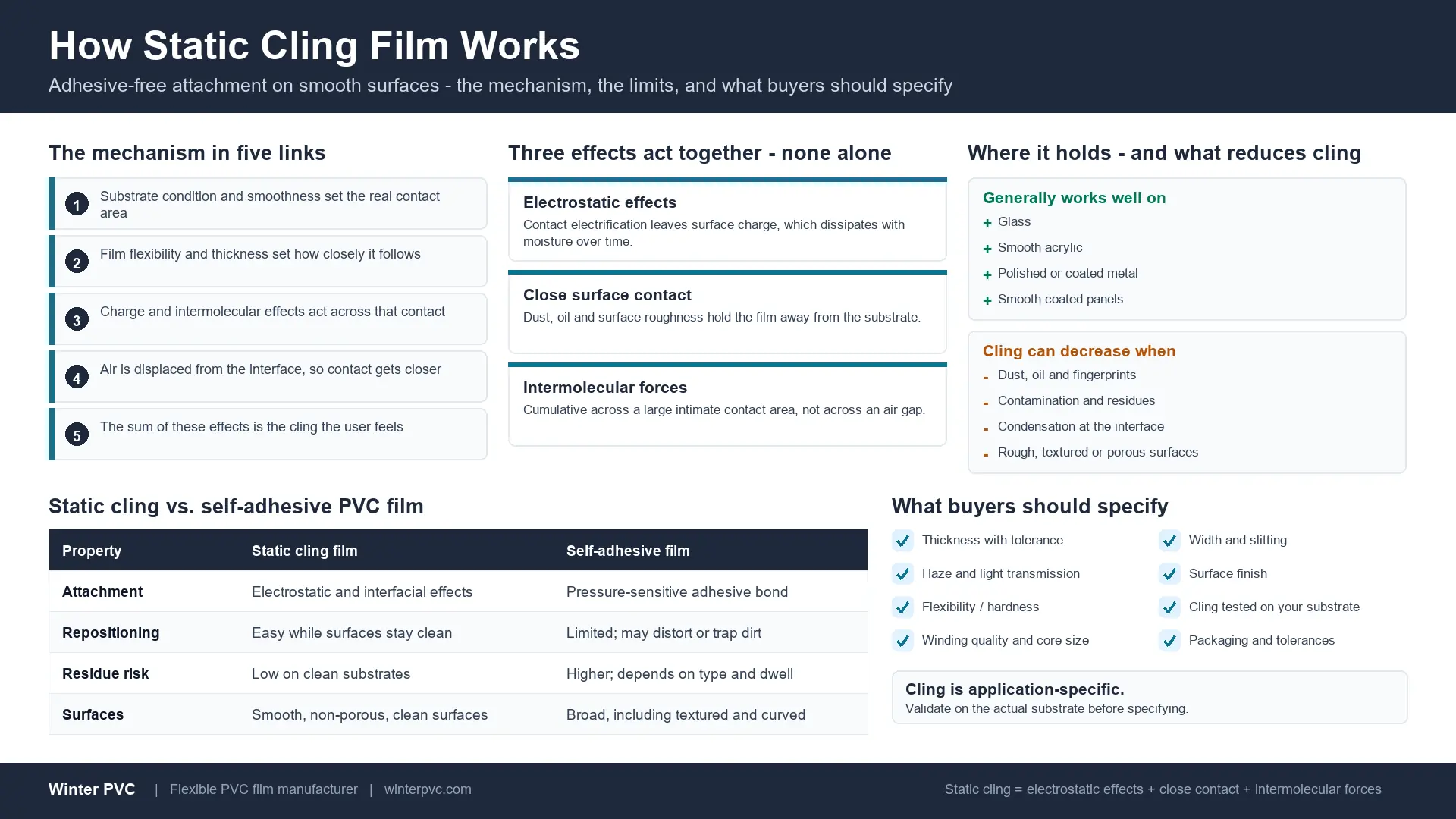
Static cling film is a flexible PVC film that attaches to smooth surfaces without a pressure-sensitive adhesive layer. Static cling results from a combination of electrostatic effects, close surface contact and intermolecular forces acting at the interface – not from any single mechanism. Cling is therefore not a fixed property that can be certified once for all substrates: it is the result of a film formulation, a surface condition and an environment working together, and it should be validated on the actual substrate before a specification is fixed.
That matters commercially. A converter who knows why cling varies with contact area tests samples on its own glass rather than trusting a generic data point, and a distributor who understands charge retention does not treat ordinary transparent PVC film and static cling PVC film as interchangeable line items.
This guide explains the mechanism step by step, separates static cling film from adhesive and other PVC film types, and sets out a specification and sampling framework for B2B purchasing.
What Is Static Cling Film?
Static cling film is a thin, flexible plastic film engineered to attach to suitable substrates by surface interaction rather than an applied adhesive. The most common material is flexible PVC, because PVC formulations can be tuned across a wide range of softness, clarity and surface behaviour while remaining economical to produce in continuous rolls. For the broader material picture, see what is PVC film.
Typical Construction
Static cling PVC film is usually a single-layer calendered or extruded film with no adhesive coating, no liner and no carrier paper: PVC resin, plasticizer to set flexibility, stabilizers for processing and service life, and processing aids, colourants or opacifiers as required, over a controlled surface finish. Common formats are clear, translucent, frosted, coloured and gloss, matte or embossed.
Static Cling Film Is Not Self-Adhesive Film
Self-adhesive PVC film carries a coated pressure-sensitive adhesive protected by a release liner, and attachment depends on the adhesive’s tack and the bond it forms. Static cling film has no adhesive layer at all, and that difference drives repositionability, residue risk, reusability, workable substrates and the surface preparation required.
How Does Static Cling Film Work?
The shorthand explanation – “the film becomes electrically charged and sticks like a magnet” – is wrong on two counts: electrostatic attraction is not magnetic, and charge alone does not explain why some films cling firmly to glass and poorly to a dusty acrylic panel. Static cling results from a combination of electrostatic effects, close surface contact and intermolecular forces; none of these is the mechanism on its own. The six steps below should be read as interacting effects rather than as a chain of separate causes.
For purchasing purposes, cling follows a shorter chain than the physics suggests. Substrate condition and smoothness determine how much real contact area is available. Film flexibility and thickness determine how closely the film follows the substrate. Charge and interfacial effects add attraction across whatever contact area exists. What the user experiences as cling is the result. When the same film holds firmly on one pane of glass and poorly on another, the difference is usually found in the first two links of that chain rather than in the film alone.
Step 1 – Contact Between Film and Substrate
Nothing happens until the film touches the substrate. Application pressure, smoothing, and the film’s own flexibility bring the surfaces together, but contact is never perfect microscopically: real surfaces carry texture, so contact occurs at asperities rather than across the full nominal area.
Step 2 – Molecular-Level Interaction at the Interface
Where film and substrate come into very close proximity, the two surfaces interact at the molecular level. These interactions only contribute where contact is genuinely close, which is why surface condition matters more than chemistry alone: a rough or contaminated surface stops the film reaching the distance at which the interaction works at all.
Step 3 – Electrostatic Charge Development and Retention
When two dissimilar materials contact and separate, charge can transfer between them: contact electrification, with the residual charge often called triboelectric charge. Static cling film picks up charge during manufacturing handling (unwinding, slitting, winding), during application, and through any deliberate charging a converter may use. Charge generation depends on the materials in contact and the friction involved; charge retention depends on how well the surface holds charge. PVC behaves as a reasonable insulator, so charge persists for a useful period, though it dissipates over time through surface conduction and moisture.
Step 4 – Van der Waals and Other Interfacial Forces
Van der Waals forces are weak, short-range attractions between molecules. They are individually small but cumulative, so their contribution depends on how much real contact area the film achieves: a thin, conformable film in close contact gains more from them than a stiff film resting on a textured surface.
Step 5 – Air Displacement and Close Surface Contact
Smoothing a flexible film against a substrate progressively displaces trapped air, leaving the remainder confined to microscopic gaps around surface asperities. The closer the film conforms, the larger the effective contact area – which is why a bubble is not purely cosmetic: it is a region where contact has effectively failed.
Step 6 – The Resulting Cling Force
The cling a user perceives is the combined result of electrostatic attraction, interfacial forces across the real contact area, and air pressure effects in sealed pockets. Peel behaviour also depends on stiffness and thickness, because the force needed to lift an edge scales with bending resistance.
Static Charge vs. Surface Adhesion
Static charge is an electrical condition of the surface and can exist without meaningful cling: a charged film on a rough, dusty or wet surface may hold charge and still slide off. Surface adhesion is the practical outcome, where the film stays where it was applied and resists displacement. Adhesion requires adequate real contact area, which requires a smooth and clean substrate, sufficient conformability, and a formulation whose surface behaviour favours interaction. Charge helps, contact enables, and formulation and substrate decide how much of each is available.
Why Does Static Cling Film Stick Without Adhesive?
Adhesive Bonding
Adhesive bonding works through tack, wet-out onto the substrate and cohesive strength within the adhesive layer. Bond strength is high and consistent across many substrates, but the trade-offs are potential residue, limited clean repositioning, and sensitivity to substrate chemistry.
Mechanical Attachment
Mechanical attachment relies on interlocking, friction or engagement with surface features, and is generally not the primary mechanism in flat static cling applications.
Electrostatic Attraction
Electrostatic attraction arises from charge separation between film and substrate and can act across a small air gap, which is why cling can persist where contact is imperfect; its magnitude depends on the charge present, the materials and the environment.
Intermolecular Forces
Intermolecular forces act only across extremely small distances and contribute most when film and substrate are smooth and clean and the film is flexible enough to conform, making this the mechanism most sensitive to surface preparation.
Why Adhesive-Free Does Not Mean Sticks to Everything
Removing adhesive removes the mechanism that tolerates imperfect surfaces, so cling depends far more heavily on contact quality. Removal is easier and repositioning is usually straightforward while both surfaces stay clean, but substrate tolerance is narrower: only surfaces permitting sufficient intimate contact hold the film reliably.
What Surfaces Can Static Cling Film Stick To?
Substrates That Generally Work Well
Glass is the reference substrate for most static cling applications: windows, doors, display cases and partitions. Smooth acrylic is widely used in retail display and signage, though surface condition and any anti-glare coating must be considered. Polished or coated metal can work where the finish is smooth and free of oxidation or oil. These are tendencies, not guarantees – two glass panes can behave differently depending on coating, cleanliness and temperature.
Conditions That Reduce Cling
Dust and lint; oils, grease, fingerprints and release agents; moisture and condensation; textured, etched, rough or fibrous surfaces; porous materials such as uncoated paper and open-cell foam; contamination from previous adhesive residues, cleaning chemicals or overspray; and extreme temperatures that stiffen the film or drive condensation at the interface. Static cling film should never be presented as universally compatible – trials on the actual substrate are the only reliable confirmation.
What Factors Affect Static Cling Performance?
Cling is a system property. These are the variables a buyer can influence through specification and application practice.
Surface Cleanliness
Contamination acts as a spacer between film and substrate: a fingerprint leaves an oil film that locally prevents contact, and dust lifts the film across an area larger than the particle itself. Cleaning immediately before application is the most controllable variable in the field.
Surface Smoothness
Roughness creates microscopic air gaps. Where an asperity cannot be bridged by the conforming film, that region contributes nothing to electrostatic or intermolecular attraction, which is why smooth glass is the easiest substrate and etched glass is not.
Film Thickness
Thinner films generally conform more readily to substrate micro-topography and slight curvature. Thicker films are stiffer, so more force is needed to lift an edge, but they settle into close contact less easily. Thicker does not automatically mean better cling – for any substrate and application method there is a practical range balancing cling, handling and appearance. See the PVC film thickness guide.
PVC Formulation
Formulation determines most of the film’s surface behaviour, and it is where a manufacturer has the most leverage.
- PVC resin sets polarity, mechanical strength and transparency. See PVC film properties.
- Plasticizer is the most powerful single variable: content and type set softness, flexibility and conformability, and also affect surface character, so plasticizers that migrate or bloom can change cling over time. See flexible PVC film vs. soft PVC film.
- Stabilizers protect against thermal degradation during processing and in service.
- Additives such as lubricants and anti-block or slip agents can reduce the surface interaction cling depends on, so a change made to improve winding can reduce cling unless it is evaluated against the application.
Surface Finish
Smooth clear film offers the best contact behaviour on smooth substrates and the highest optical clarity, which is why it dominates window graphic work. Matte film gives a low-reflectance appearance, but matte is normally produced by texturing the surface, which can reduce contact area against very smooth substrates. Embossed film is generally a poorer choice where maximum cling is the priority.
Temperature and Humidity
High humidity, condensation and temperature change can all alter cling performance, particularly when moisture forms at the film-to-substrate interface. Low temperatures can stiffen the film and reduce conformability, and temperature cycling can make film and substrate move at different rates, which may induce edge lift. The direction and size of these effects depend on the film formulation, the substrate and the contact conditions present, so a single temperature or humidity figure should not be used to predict performance. Define the expected service conditions and validate under them.
Substrate Type
Smooth, non-porous, dimensionally stable and electrically insulating substrates such as glass are usually the easiest starting point, because they allow high contact area and tend to retain charge at the interface. Meeting those conditions does not guarantee performance on a specific panel, however: coating, cleanliness, temperature and film formulation all intervene. Where a substrate is borderline, the answer comes from a trial on the actual material rather than from a specification sheet.
PVC Static Cling Film vs. Self-Adhesive Film
Both are PVC films intended to sit on a surface. They differ in how they get there and what that means operationally.
| Property | PVC Static Cling Film | Self-Adhesive PVC Film |
|---|---|---|
| Attachment mechanism | Electrostatic effects, close surface contact and intermolecular forces acting together | Pressure-sensitive adhesive bond |
| Adhesive layer | None | Coated adhesive with release liner |
| Repositionability | Generally easy to lift and reposition while surfaces remain clean | Limited; repositioning can distort adhesive or trap contamination |
| Residue risk | Low on clean substrates, since no adhesive is present | Higher; depends on adhesive type, dwell time and substrate |
| Typical surfaces | Smooth, non-porous, clean surfaces such as glass and smooth acrylic | Broad, including many moderately textured and curved surfaces |
| Reusability | Possible for a limited number of cycles if stored clean and flat | Generally not reusable once applied and removed |
| Application method | Position, smooth out air, allow cling to develop | Position, squeegee or press, ensure adhesive wet-out |
| Typical applications | Temporary window graphics, changeable displays, promotional signage, surface protection | Permanent or semi-permanent wrapping, vehicle graphics, long-term protection, durable labelling |
Neither construction is universally better. Static cling film suits smooth surfaces where temporary attachment, easy removal and residue-free changeover are the priorities; self-adhesive film suits difficult surfaces and applications needing predictable bond strength over a long period. A buyer sourcing for a mixed portfolio usually needs both.
Static Cling Film vs. Other PVC Film Types
Several flexible PVC film families look similar on a sample bench but differ in attachment mechanism and function.
- PVC self-adhesive film – adhesive-coated and liner-protected, intended for bonding rather than cling.
- PVC protective film – adhesive-based or cling-based depending on the substrate it targets; its function is surface shielding during processing, transit or installation rather than graphic display.
- PVC decorative film – designed for appearance, typically laminated, wrapped or adhered rather than clung, and often matte or embossed.
- PVC lamination film – bonded to a substrate by heat, adhesive or pressure as part of a manufacturing process, not applied by hand as a removable layer. See the PVC lamination film guide.
The word “film” says nothing about how a product attaches: static cling, adhesive, thermal lamination and mechanical retention are four different attachment systems with different substrates, lifetimes and conversion requirements.
Static Cling Film Applications
Static cling film’s commercial value lies where attachment must be temporary, changeable and residue-free on a smooth substrate.
Window Graphics and Glass Displays
Window graphics and glass displays are among the most common applications for static cling film. Retail windows, glazed entrances, conference room glass and display cases use clear or printed film for promotional graphics, seasonal campaigns, directional signage and temporary privacy. Most installations use the inner face of the glass, and graphics can be changed at campaign boundaries without special cleaning.
Retail Signage
Static cling film suits signage whose content changes frequently: price campaigns, seasonal promotions, launches and wayfinding. With no adhesive, staff apply and remove graphics without tools or solvents.
Point-of-Sale Displays
Removable promotional graphics are a natural fit: shelf strips on glazed surfaces, display case graphics, counter-top glass signage and short-cycle promotional panels, without contaminating surfaces that will later carry different graphics.
Privacy and Decorative Window Film
Translucent, frosted and patterned static cling films provide temporary privacy partitions or decorative effects on interior glass – meeting rooms, clinic partitions, fitting rooms, office glazing – and suit tenants and fit-out cycles where permanent installation is impractical.
Vehicle and Transportation Graphics
Static cling film can be used on smooth vehicle glazing where a removable, adhesive-free graphic is required, but this is a narrow application rather than a typical one. It does not replace permanent adhesive vehicle wrapping or graphics on painted body panels, which need an adhesive system for durable bond and coverage of curved surfaces. Buyers with vehicle work should treat removable glazing graphics as the realistic scope.
Industrial and Commercial Applications
Cling-based protective film typically applies to smooth surfaces during handling and processing: temporary shielding of glazed panels, screens or polished surfaces during fabrication and transport, dust and scratch protection before final assembly, and short-cycle protection during inspection. As with every application above, suitability depends on the actual substrate and should be confirmed by trial before a specification is fixed.
Static Cling Film Specifications Buyers Should Evaluate
Procurement should be able to obtain the following from any potential static cling film supplier:
| Specification | What the buyer should check | Why it matters |
|---|---|---|
| Thickness | Nominal gauge plus the tolerance band | Conformability, edge lift behaviour and handling |
| Width | Supplied width, and whether master rolls can be slit | Converting compatibility |
| Transparency and clarity | Haze and light transmission for clear grades | Visual quality in window and display work |
| Colour | Reference, opacity, and whether custom colour is possible | Brand and design requirements |
| Surface finish | Gloss, matte or embossed, and which face carries it | Contact behaviour and appearance |
| Flexibility | Hardness, plasticizer content or an agreed handling characteristic | How closely the film follows the substrate |
| Roll and core dimensions | Outer diameter, length, net weight, core diameter | Equipment compatibility |
| Winding quality | Tension, flatness, telescoping, blocking, edge condition | Unwinding and head-of-roll waste |
| Cling performance | Described in application terms and validated on the buyer’s substrate | Actual attachment in service |
| Service conditions | Temperature and humidity range, where the supplier can state one | Field performance over time |
| Packaging and tolerances | Roll protection, pallet configuration, written dimensional tolerances | Freight damage and incoming inspection |
Which rows matter most depends on the application. Optical criteria dominate window graphics; thickness and winding tolerance dominate converting efficiency; formulation dominates cling on curved or marginally smooth substrates; dimensional tolerance dominates automated cutting and printing. For how gauge affects working behaviour generally, see the PVC film thickness guide. For clear grades specifically, request haze and light transmission figures rather than the word “transparent”; the difference between ordinary clear and high-clarity film is set out in clear PVC film vs. super clear PVC film.
How to Test Static Cling Film Before Bulk Purchasing
Supplier samples and verbal specifications are a starting point, not a qualification. Run a structured trial on your own substrate, under your own conditions.
- Clean the substrate using the production method, allow it to dry, and record the method.
- Apply a defined film sample, standardising size, pressure and squeegee passes.
- Remove air bubbles from the centre outward, noting how readily air is displaced.
- Observe initial cling – flatness, edge lift and whether position holds under light handling.
- Check adhesion after defined intervals – immediately, after several hours and after 24 hours – to see whether cling strengthens, holds or degrades.
- Test removal by hand: effort required, whether release is clean, whether the substrate needs cleaning.
- Test repositionability over a limited number of lift-and-reapply cycles.
- Repeat under realistic conditions – cold glass, humid interiors, air-conditioned retail, direct sun.
- Check optical appearance – haze, clarity, reflection and colour fidelity under intended lighting.
- Record results comparably: substrate, cleaning method, sample identification, conditions, times and observations.
The substrate is the variable most often outside the supplier’s control. A film that clings convincingly in a demonstration may behave differently on a coated glass panel in a cold climate, which is why testing on the actual substrate converts a specification into a purchasing decision.
How Static Cling Film Is Manufactured
Static cling film uses the same broad routes as other flexible PVC film, with additional attention to the properties that govern cling. The full process is covered in the PVC film manufacturing process.
- Formulation – resin, plasticizer, stabilizers and additives are selected and weighed to target softness, clarity, colour, surface character and processing behaviour.
- Mixing – components are blended to a homogeneous compound; inconsistent blending later appears as variation in thickness, colour or surface behaviour.
- Forming – the compound becomes continuous film gauge, most commonly by calendering through heated rolls that set thickness, or by extrusion with downstream gauging.
- Thickness control – gauge variation across the web and along the roll affects cling consistency and converting yield.
- Cooling and surface finishing – cooling rate influences surface formation, and roll or belt finish determines whether the surface is gloss, matte or embossed.
- Inspection – visual and dimensional checks identify defects, gauge deviation and surface contamination before the film leaves the line.
- Slitting, winding and packaging – master rolls are slit to customer widths under controlled tension, with edge and wind quality controlling handling problems and head-of-roll waste.
Line contamination, unstable tension or formulation drift all reduce the reliability of the delivered product, making cling a manufacturing control issue rather than a post-production inspection item.
How to Choose the Right Static Cling Film
- Identify the substrate – exact material, surface finish, coating and current condition.
- Define whether transparency is required – clear, translucent, frosted or opaque.
- Determine required thickness from handling, durability, conformability and application method, not from an assumption that thicker is stronger.
- Define surface finish – gloss, matte or embossed – with the reason recorded.
- Determine flexibility requirements – flat panels tolerate stiffer films; curved or marginally smooth surfaces favour more conformable ones.
- Define environmental conditions – service temperature, humidity, sun exposure and condensation risk.
- Determine required cling and repositionability – whether the graphic must stay for months or be changed weekly.
- Test samples on the actual substrate, under actual conditions.
- Confirm roll and converting specifications – width, length, core size, winding direction and wind quality.
- Approve the production specification, recording formulation, thickness and tolerance, width, finish and packaging as the reference for all subsequent orders and incoming inspection.
What Should Buyers Ask a Static Cling Film Manufacturer?
- What PVC formulation is used for the grade being quoted?
- What thickness tolerance can be held, and how is it verified?
- What are typical haze and light transmission values for clear grades?
- Which substrates has the film been tested on, and under what conditions?
- Is the film designed for temporary or longer-term use?
- What surface finishes are available – gloss, matte, embossed?
- Can thickness and width be customised, and is slitting available to converting width?
- Are coloured or printed versions available?
- What sample sizes can be provided for testing?
- What QC documentation is provided with production orders?
- What are the MOQ and lead time for the required specification?
- What compliance documentation is available for the destination market?
A supplier that can describe formulation approach, thickness control and testing practice in concrete terms is a lower sourcing risk than one offering general assurance.
Winter PVC Static Cling Film Capabilities
Winter PVC manufactures flexible PVC film in China for converters, distributors, importers, sign manufacturers and industrial buyers. Within that scope, static cling PVC film is produced with the parameters that determine how the film behaves on the intended substrate:
- Thickness across a range of gauges, from thin film for close conformability to heavier gauges for greater handling presence; the current range covers approximately 0.04 mm to 0.40 mm on calibrated gauges.
- Width – master rolls across a range of widths, with slitting support to the required customer width.
- Flexibility – soft-flexible PVC formulations, with hardness set according to application requirements and confirmed by sample.
- Surface and optics – clear transparent high-gloss smooth finish as standard for window and display applications, with other finish options and coloured film available subject to specification.
- Attachment – no adhesive layer, so no liner is required and no adhesive residue is expected on clean substrates. Cling relies on contact and charge interaction at the interface rather than on an adhesive bond.
Requirements outside the standard range – a specific converting width or gauge, colour matching, a change in flexibility, or a formulation reviewed against a particular substrate and service condition – are evaluated case by case, and where a requirement cannot be met this is stated before an order rather than assumed. Samples are available so buyers can validate cling on their own substrate, and production can be aligned to a specification and sample approved by the buyer. Gauge checks and inspection form part of production, but field cling behaviour ultimately depends on the substrate, cleanliness and service conditions the buyer tests. Third-party test documentation can be provided on request where it applies to the grade and destination market.
Thickness range, width configuration, hardness and surface finish quoted in this article are taken from the current product specification on the PVC static cling film product page. Where a figure differs between this article and that page, the product page and the issued datasheet take precedence.
Frequently Asked Questions
How does static cling film work?
Through electrostatic charge, close surface contact and intermolecular attraction at the interface, with no adhesive layer.
Does static cling film use adhesive?
No. It is manufactured without a pressure-sensitive adhesive layer or release liner, so a clean substrate is left residue-free.
What surfaces does static cling film stick to?
Smooth, non-porous, clean surfaces such as glass, smooth acrylic and polished metal are the usual starting point. Rough, porous or contaminated surfaces are generally unsuitable, and suitability should be confirmed on the actual substrate.
Can static cling film be reused?
Reuse is possible but is not a fixed performance figure. It depends on clean handling during removal, storage flat and free of dust, oil, creasing and edge damage, and on the substrate and conditions of use. Many buyers treat each reapplication as a separate trial rather than assuming a set number of cycles.
Does static cling film leave residue?
Not expected on a clean substrate, since no adhesive layer is present. Residue risk belongs mainly to adhesive-based films.
Why does static cling film stop sticking?
Static cling may decrease when dust, oil or fingerprints contaminate the surface, when condensation forms at the interface, when temperature changes affect film flexibility, or when charge dissipates over time.
Does temperature affect static cling film?
It can. Cold may stiffen the film and moisture may form at the interface; heat can soften the film and affect dimensional stability. The effect depends on formulation, substrate and conditions, so performance should be tested under the expected service conditions.
What is the difference between static cling and self-adhesive film?
Static cling attaches without adhesive and is generally easier to remove and reposition; self-adhesive film carries an adhesive layer and bonds more strongly to more surfaces.
What thickness is available for PVC static cling film?
Winter PVC’s static cling range covers approximately 0.04 mm to 0.40 mm, with custom gauges reviewable on request.
Can static cling PVC film be customised?
Yes – thickness, width, colour, flexibility and surface finish can be adjusted subject to evaluation, with samples recommended before bulk ordering.
Can static cling film be used outdoors?
Possible on exterior glass that is smooth and clean, but rain, condensation, temperature cycling and surface contamination can reduce cling over time, and exterior-facing film is exposed to abrasion and cleaning. Results from indoor trials should not be assumed to carry over; validate under the actual conditions.
How should static cling film be tested before bulk purchasing?
Apply a defined sample to a cleaned version of the actual substrate, check cling initially and after set intervals, test removal and repositioning, and repeat in realistic conditions.
Conclusion and Next Step
Static cling film works because two surfaces are brought into sufficiently close contact, with electrostatic charge and intermolecular forces contributing to attraction across the real contact area. It is not a single mechanism and not a universal one: cling depends on film formulation, substrate smoothness and cleanliness, environmental conditions, and how the film is applied and stored.
The commercial consequence is direct. Static cling PVC film should be specified against the application rather than a generic product description, and qualified by a trial on the actual substrate before bulk ordering. Thickness with tolerance, width, haze and light transmission, formulation and flexibility, surface finish, winding quality and packaging decide whether the film performs in the field or fails early in a campaign.
To move forward, send Winter PVC the following: substrate (material, finish and current condition); intended application and expected service life; required thickness; required width and roll configuration, including core size where relevant; transparency or colour requirement; required surface finish; estimated quantity, and whether the requirement is one-off or recurring. Winter PVC can then review the requirement, recommend an appropriate specification from the current static cling range, and provide a sample for testing on your own substrate before production is committed. Full parameters are listed on the static cling PVC film product page.