
Introduction
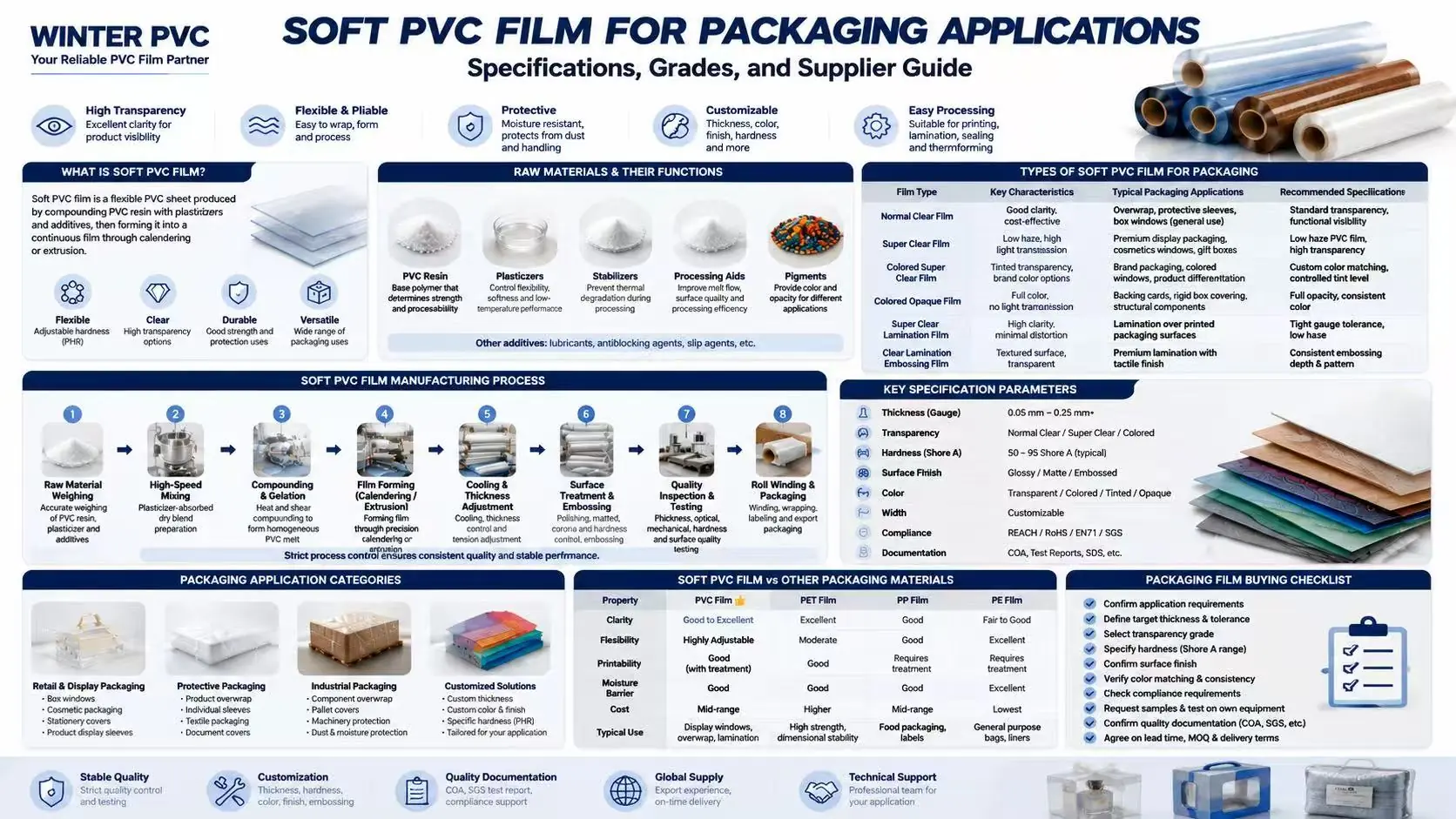
Selecting the correct soft PVC film supplier directly affects packaging quality, converting efficiency, and production cost. Many packaging manufacturers face difficulties when sourcing PVC film, including unstable thickness, inconsistent transparency, poor printing performance, and variation between production batches. Understanding film specifications before purchasing helps buyers reduce converting problems and improve production efficiency; gauge in this category is quoted in mm or μm, where 1 mm equals 1,000 μm.
Soft PVC film is a standard material in packaging manufacturing. Packaging converters, contract packagers, and industrial buyers use this material to produce transparent display packaging, protective overwrap, document covers, box windows, and custom packaging solutions across consumer goods, stationery, textile, and industrial product categories. This guide covers the material grades, specification parameters, and procurement factors relevant to industrial packaging buyers, covering grades from 0.03 mm mattress packing film up to 3.0 mm lamination sheet. For a broader overview of PVC film use across multiple industries, see our PVC film applications guide.
Why Soft PVC Film Is Used for Packaging
Soft PVC film is selected for packaging because it provides a combination of transparency, flexibility adjustable across 22–66 PHR, surface quality, protection, and processability on standard converting equipment, is a versatile material with rubbery feel and optical clarity. Soft PVC film is more cost-effective than TPU, and is supplied in master rolls from 0.6 m to 2.45 m wide.Soft PVC film is easier to bond than PE, and standard packaging grades run from 0.03 mm to 0.50 mm.These properties align with the functional requirements of packaging: visibility of the packaged product, flexibility for wrapping and forming, surface quality for printing and finishing, and protection of the contents from handling and environmental exposure.And Soft PVC film offers good resistance to oils, greases, weak acids, and alkalis, providing reliable chemical stability for most packaging environments; plasticizer systems are adjustable from 22 to 66 PHR, and SGS report CANEC26010536001 confirms that 21 regulated phthalates were Not Detected. When formulated with appropriate UV stabilizers, it also resists degradation from UV light and temperature fluctuations, extending its service life in outdoor or sun‑exposed applications.
Transparency and Product Visibility
Transparent packaging allows the end user to see the product before purchase. Normal Clear Film provides good clarity for standard applications like protective sleeves and box windows. Super Clear Film, manufactured with selected resins and clarity-optimized stabilizers, delivers measurably lower haze for premium packaging where optical quality impacts brand perception; this grade is supplied in 0.07–0.50 mm thickness, 0.8–1.8 m master roll width, and 28–55 PHR. A detailed comparison of these grades is available in our clear vs. super clear PVC film guide.
Flexibility and Processing Performance
Flexibility is controlled via plasticizer content (PHR), where 40 PHR means 40 parts of plasticizer per 100 parts of PVC resin. The required flexibility depends on the packaging format and converting process. A film that is too stiff may crack during folding; one that is too soft may stretch and cause registration errors. The appropriate hardness is confirmed through Shore A testing on the finished film rather than relying solely on PHR values, which can vary with resin type and formulation; our packaging grades are formulated between 22 and 66 PHR.
Surface Customization and Protection
Surface customization includes glossy, matte, and embossed finishes, with embossed grades supplied at 0.045–0.50 mm thickness, 0.6–1.285 m width, and 24–52 PHR. Glossy surfaces maximize clarity, matte finishes reduce glare, and embossed textures add a tactile dimension. Printing compatibility is achieved through corona treatment, enabling adhesion of inks for branding and graphics.
PVC film provides moisture resistance, water resistance, weather resistance and a physical barrier against dust and handling. While it is not an oxygen barrier, it effectively protects products during normal distribution and retail display. Common formats include individual product sleeves, textile packaging bags, document protection covers, and temporary protective wraps. The required film specification depends on whether the priority is transparency, flexibility, puncture resistance, or cost control — mattress packing film, for example, is supplied at 0.03–0.10 mm.
Types of Soft PVC Film for Packaging
Packaging manufacturers select from several PVC film grades, each manufactured to a specification aligned with a category of packaging application; colored opaque film, for example, is supplied at 0.06–0.50 mm with a 26–54 PHR range. The table below summarizes the primary options and what buyers should consider for each type.
| Film Type | Key Characteristics | Typical Packaging Applications | Recommended Specification |
|---|---|---|---|
| Normal Clear Film | Good clarity, cost-effective | Product overwrap, protective sleeves, box windows (general use) | Standard transparency, functional visibility |
| Super Clear Film | Low haze, high light transmission | Premium display packaging, cosmetics windows, gift boxes | Low haze PVC film, high transparency PVC film |
| Colored Super Clear Film | Tinted transparency, brand color options | Brand-identity packaging, colored windows, product differentiation | Custom color matching, controlled tint level |
| Colored Opaque Film | Full color, no light transmission | Backing cards, rigid box covering, structural packaging components | Full opacity, consistent batch-to-batch color |
| Super Clear Lamination Film | High clarity, minimal optical distortion | Lamination over printed packaging surfaces | Tight gauge tolerance, low haze |
| Clear Lamination Embossing Film | Textured surface, transparent | Premium lamination with tactile finish, luxury packaging | Consistent embossing depth, pattern definition |
Packaging Application Categories
Retail and Display Packaging requires consistent transparency, stable thickness, and good surface appearance because the film directly influences how consumers perceive the packaged product. Common applications include box windows, cosmetic packaging windows, stationery covers, and product display sleeves. For standard retail products, normal clear film is typical. For products where visual presentation at the point of purchase is a competitive factor, super-clear film is specified at 0.07–0.50 mm and 28–55 PHR.
Protective Packaging shields products during transport and storage. Product overwrap, individual sleeves, and document covers are common formats; static cling grades for temporary protection are supplied at 0.04–0.40 mm. Textile packaging for bedding, curtains, and fabric rolls uses PVC film to protect contents from dust and handling while allowing the consumer to see the product. The film specification depends on whether transparency, flexibility, or puncture resistance is the priority.
Industrial Packaging prioritizes function over decoration, using PVC film for component overwrap, pallet covers, and temporary enclosures. Thicker gauges and opaque or tinted films may be specified for higher mechanical protection, such as 0.6–3.0 mm lamination sheet at 1.0–2.0 m width and 22–60 PHR. The film’s moisture resistance is functionally relevant for products stored or transported in environments where humidity exposure is possible; mattress packing film is formulated between 30 and 65 PHR.
Customized Packaging Solutions allow adjustment of thickness, color, surface finish, and hardness to meet specific requirements. Winter PVC supports custom formulation for packaging manufacturers needing tailored specifications, with formulation records maintained for consistent repeat-order production.
Packaging Film Specification Checklist
When specifying soft PVC film for packaging, buyers should consider the following parameters:
- Thickness (gauge) and tolerance
- Transparency level (normal clear vs. super clear, haze percentage)
- Flexibility (Shore A hardness or PHR range)
- Surface finish (gloss, matte, embossed)
- Color requirements and batch-to-batch consistency
- Slip and antiblock properties for automated lines
- Width and roll size
- Regulatory compliance (REACH, RoHS, etc.)
- Quality documentation (COA, test reports)
- Sample testing on own equipment
Key Specification Parameters
Thickness
PVC film thickness is usually specified in microns (μm) or mils. For reference, 1 mil equals 25.4 μm. Thickness ranges from 0.03 mm for lightweight flexible packaging to 0.50 mm for structural film, and up to 3.0 mm in sheet form. Consistent gauge is critical for automated processes: at 50 μm (0.05 mm) gauge, a 1 μm deviation already equals a 2% thickness swing. The table below provides a general reference for thickness selection based on packaging type.
| Packaging Type | Typical Thickness Range | Common Applications |
|---|---|---|
| Lightweight Flexible | 0.05 – 0.12 mm | Product bags, sleeves, overwrap |
| General Purpose | 0.12 – 0.25 mm | Box windows, document covers, stationery packaging |
| Structural / Heavy-Duty | 0.25 mm and above | Rigid-box covering, heavy-duty enclosures |
For detailed guidance on thickness selection across all applications (0.25 mm equals 250 μm), refer to our PVC film thickness guide.
Transparency
Transparency is specified by haze and light transmission. Normal clear film suits standard needs; super clear is reserved for premium applications where visual quality is a differentiator.
Hardness and Flexibility
Hardness and flexibility are verified by Shore A durometer. Rather than prescribing fixed PHR numbers, it is more reliable to specify target Shore A values and work with the manufacturer to achieve the desired mechanical properties; static cling packaging film, for example, is formulated at 50–66 PHR.
Surface Finish
Surface finish affects aesthetics and function. Glossy finishes are standard for transparent packaging; matte and embossed options provide alternative looks and tactile effects; clear lamination embossing film is supplied at 0.6–3.0 mm and 0.6–2.0 m roll width.
Manufacturing Considerations for Packaging Films
The film’s performance is determined by formulation and production method; note that a 0.10 mm film consumes about twice the resin per square metre of a 0.05 mm film. During production, formulation control, mixing uniformity, gelation degree, thickness control, and winding tension all influence final film performance. Calendering is commonly used for medium to heavy gauge films where thickness uniformity and surface quality are critical — such as 0.6–3.0 mm lamination sheet supplied at 1.0–2.0 m width — while extrusion is widely used for thinner films and specific production requirements. Buyers should focus on output specifications rather than the process itself. Quality testing covers thickness, transparency, tensile strength, elongation, Shore A hardness, and surface quality; regulatory items can be verified by third-party report such as SGS CANEC26010536001 (EN 14372:2004, GC-MS), which found 21 regulated phthalates Not Detected at an MDL of 0.003%. Third-party compliance testing is available for regulatory verification.
Winter PVC controls formulation, calendering parameters, thickness tolerance, surface treatment, and roll inspection procedures to maintain consistent film performance across repeat orders.
Soft PVC Film vs. Other Packaging Materials
Packaging manufacturers often evaluate PVC against other clear flexible films; PVC packaging film is commonly specified between 0.03 mm and 0.50 mm. The following table compares the key properties of each material.
| Property | PVC Film | PET Film | PP Film | PE Film |
|---|---|---|---|---|
| Clarity | Good to excellent (clear & super clear) | Excellent | Good (cast PP) | Standard PE films generally provide lower optical clarity than PVC and PET films. |
| Flexibility | Highly adjustable via PHR | Moderate, less adjustable | Good | Excellent |
| Printability | Good after corona treatment | Good | Requires treatment | Requires treatment |
| Moisture Barrier | Good | Good | Good | Excellent |
| Cost | Mid-range | Higher | Mid-range | Lowest |
| Typical Packaging Use | Display windows, overwrap, lamination | High strength, dimensional stability, higher temperature resistance | Food packaging, labels | General-purpose bags, liners |
How to Evaluate a Soft PVC Film Manufacturer
Selecting a reliable PVC film supplier requires evaluating technical capability and supply reliability across several dimensions.
Production Capability
Confirm that the manufacturer can produce film at your required thickness, width, and optical grade; our soft film covers 0.03–0.50 mm at master roll widths from 0.6 m to 2.45 m. Verify whether the production method (calendering or extrusion) is appropriate for your gauge and surface quality requirements.
Quality Control
Evaluate the manufacturer’s thickness tolerance capability, hardness consistency, transparency control, and color matching accuracy. Quality documentation should include Certificate of Analysis per shipment, thickness measurement data, and mechanical property test results; an example third-party report is SGS CANEC26010536001 dated 2026-05-06, covering 21 regulated phthalates, all Not Detected at an MDL of 0.003% (30 mg/kg), where 1 mg/kg equals 0.0001%.
Customization Ability
A manufacturer with in-house formulation capability can adjust thickness, hardness (PHR), transparency, color, and surface finish to your packaging requirements. Winter PVC supports customized production according to buyer specifications.
Sample Testing
Request production-representative samples and test them on your own converting equipment before placing bulk orders. Verify unwind and tracking behaviour, cutting and sealing response, and the visual quality of the finished package under your actual production conditions.
Before Requesting a PVC Film Quotation
Providing the following information helps the manufacturer recommend a suitable film specification and prepare an accurate quotation:
- Application type (e.g., box window, product overwrap, lamination)
- Target film thickness and tolerance
- Film width and roll weight requirement
- Hardness requirement (Shore A target, with formulation adjustment according to PHR)
- Transparency requirement (normal clear or super clear)
- Surface finish preference (gloss, matte, embossed)
- Estimated annual consumption
- Destination market compliance needs (REACH, RoHS, etc.)
Questions to Ask PVC Film Suppliers
- Can you provide thickness tolerance data and statistical process control records?
- Can you match our target Shore A hardness requirements?
- Do you maintain formulation records to ensure batch-to-batch consistency for repeat orders?
- Can we receive production-representative samples to test on our own converting equipment?
- Do you provide Certificate of Analysis (COA) and third-party test reports (e.g., SGS)?
- What are your standard lead times and minimum order quantities (MOQ)?
Soft PVC Film Packaging Buying Checklist
Before finalizing a PVC film purchase for packaging applications, buyers should confirm the following:
-
Assess production capacity to meet your volume requirements.
- Confirm application requirements (packaging format, converting process, end-use conditions)
- Define target thickness and acceptable tolerance range
- Select transparency grade (normal clear or super clear)
- Specify hardness requirement (Shore A range)
- Confirm surface finish (gloss, matte, embossed)
- Verify color matching requirements and batch-to-batch consistency expectations
- Check destination market compliance requirements (REACH, RoHS, EN71, etc.)
- Request production-representative samples and test on own converting equipment
- Confirm quality documentation package (COA, test reports, compliance certificates)
- Agree on lead time, MOQ, and delivery terms
Sustainability and Regulatory Considerations
Phthalate‑free PVC options are now widely available, particularly for export markets with strict regulatory requirements such as the EU. Some manufacturers also offer formulations incorporating post‑industrial recycled content, though this is typically a customer‑specified option rather than a standard offering. Importantly, not all soft PVC films are equivalent in terms of sustainability or regulatory compliance — buyers should verify the specific certifications and test reports applicable to their target market rather than relying on general claims.
Frequently Asked Questions
1. What is soft PVC film used for in packaging?
Soft PVC film is used for transparent display windows, product overwrap, protective sleeves, box covering, lamination over printed surfaces, and flexible bags and pouches.
2. Is PVC film suitable for transparent packaging?
Yes, it is available in standard clear and super clear grades, both allowing product visibility. Super clear grades are ideal for premium applications where visual presentation is critical.
3. What thickness of PVC film is used for packaging?
Packaging films range from approximately 0.03 mm for lightweight flexible packaging to 0.50 mm, with sheet grades available up to 3.0 mm for structural components. The choice depends on durability, flexibility, and material cost requirements.
4. What is the difference between clear and super clear PVC film?
Super clear film has significantly lower haze due to optimized resin and stabilizer formulation, providing a clearer, more brilliant view of the packaged product compared to standard clear film.
5. Can PVC packaging film be customized?
Yes, customization options include thickness, width, hardness, transparency, color, surface finish, and embossing pattern; soft film is produced from 0.03 mm to 0.50 mm, with sheet grades up to 3.0 mm. Custom orders are produced to buyer specifications with formulation records maintained.
6. What is the MOQ for customized PVC packaging film?
MOQ depends on film type, thickness, width, color, and customization requirements. Winter PVC evaluates each project individually and provides a production recommendation based on buyer specifications. Contact our team for a specific MOQ for your requirements.
7. Can PVC packaging film be tested before mass production?
Yes, samples are available for trial on your own converting equipment. Testing allows you to verify thickness, flexibility, transparency, surface finish, and overall processing compatibility before confirming a bulk order.
8. What information should buyers provide before requesting a PVC film quotation?
To receive an accurate recommendation and quotation, buyers should prepare target thickness and tolerance, film width, application type, estimated annual consumption, transparency requirement, surface finish preference, hardness requirement, and target market compliance needs.
9. What is the difference between calendered and extruded PVC film?
Calendered film offers superior thickness uniformity, better surface quality, and in-line embossing capability, making it suitable for medium to heavy gauge packaging films such as 0.6–3.0 mm lamination sheet. Extruded film provides excellent optical clarity for thin gauge applications and supports multi-layer co-extrusion. The choice depends on target thickness, surface finish requirements, and application specifications.
10. Can PVC film be customized for different packaging machines?
Yes. PVC film can be customized according to machine requirements including thickness tolerance, roll width, core size, hardness, surface finish, and winding specifications. Providing your equipment parameters during the specification stage helps ensure the film runs efficiently on your production line.
11. What is the difference between soft PVC film and rigid PVC sheet?
Soft PVC film contains plasticizers that make it flexible, pliable, and suitable for wrapping, folding, and roll-fed converting processes. Rigid PVC sheet contains little to no plasticizer, making it stiff and dimensionally stable — typically used in thermoforming, blister packs, and structural applications. For packaging, soft PVC film is the standard choice for flexible formats; rigid PVC sheet is used for formed containers and trays.
12. What is the standard tolerance for PVC film thickness?
Thickness tolerance depends on film thickness, production method, and supplier capability; tolerances are quoted in μm, where 0.05 mm equals 50 μm. Buyers should confirm the acceptable tolerance range before mass production. Different manufacturers may have different tolerance capabilities, so it is important to specify the required tolerance and verify that the supplier can meet it consistently.
13. Can PVC film be supplied with SGS testing reports?
Yes. Winter PVC can supply SGS-tested compliance documentation for applicable PVC film materials; report CANEC26010536001 (2026-05-06, EN 14372:2004, GC-MS) confirms that 21 regulated phthalates were Not Detected. Testing can cover restricted substances, phthalate content, heavy metals, and other regulatory requirements. Buyers should specify their documentation needs during the inquiry stage.
14. What hardness (PHR) is suitable for packaging PVC film?
The appropriate PHR depends on the packaging format and desired flexibility. Lower PHR values produce firmer films suitable for rigid box covering and structural components; mid-range PHR provides general-purpose flexibility; higher PHR yields very soft, drapable films. Because PHR is a formulation input and final hardness is confirmed via Shore A testing, it is recommended to specify a target Shore A range and work with the manufacturer to adjust the PHR accordingly.
Conclusion
Soft PVC film combines clarity, adjustable flexibility, printability, and moisture resistance for packaging applications. Specifying the correct thickness, transparency, hardness, and surface finish is essential for consistent converting and finished package quality; our packaging grades span 0.03–0.50 mm, 22–66 PHR, and master roll widths of 0.6–2.45 m.
For procurement, working with a manufacturer that provides customization, batch consistency, and quality documentation reduces production risk and material waste. Winter PVC manufactures soft PVC film to buyer specifications, with records maintained for repeat orders.
Send your application details, required thickness, width, and target properties. Winter PVC will provide a recommended specification and sample evaluation before bulk production.