
Introduction
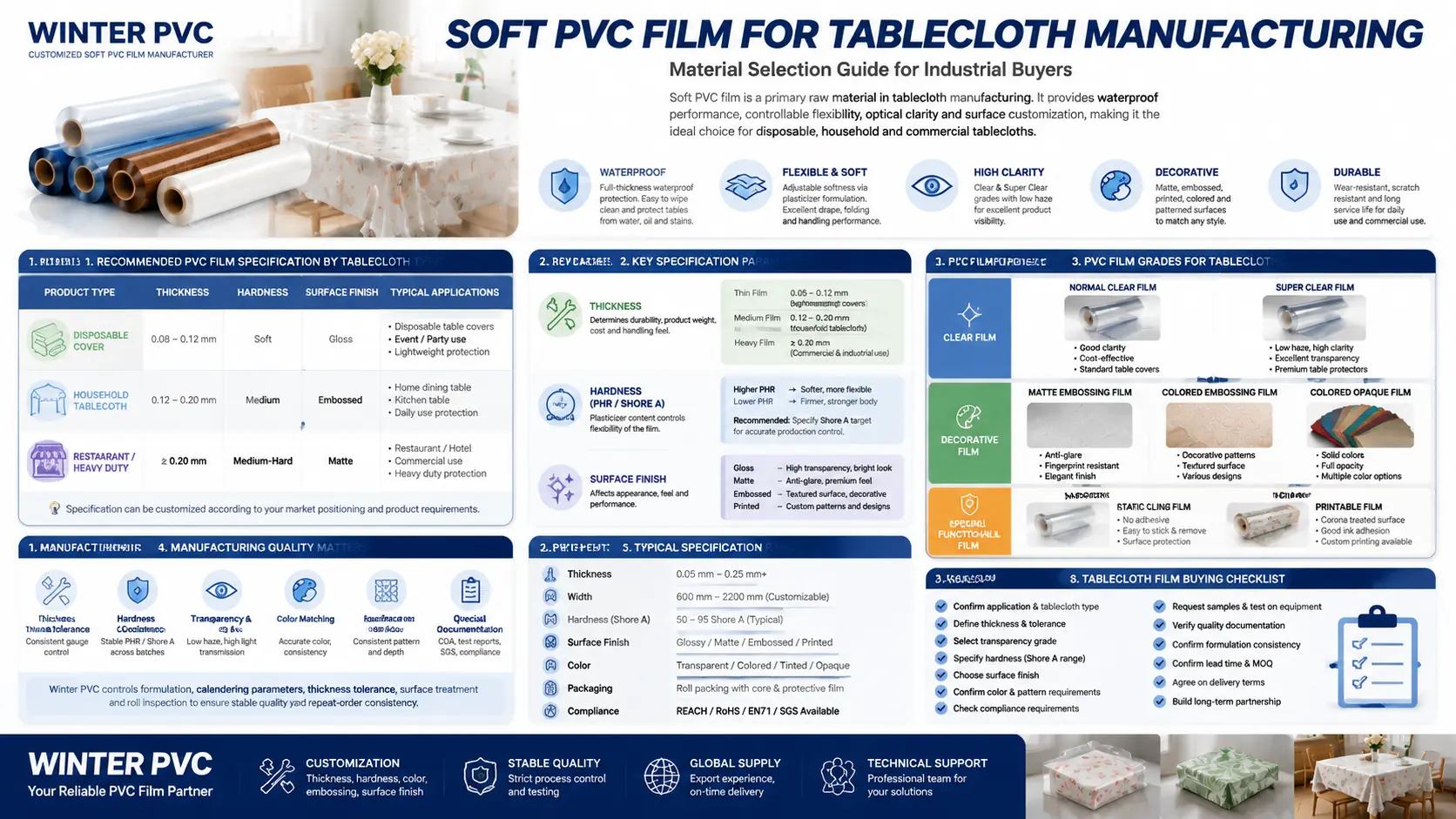
Soft PVC film is a primary raw material in tablecloth manufacturing. Tablecloth producers, PVC converters, and household product manufacturers select this material because it delivers waterproof performance, controllable flexibility, optical clarity when required, and surface customization options that other flexible sheet materials do not provide in a single product.
For industrial buyers — tablecloth manufacturers, importers, and distributors — the selection of PVC film directly determines the finished product’s appearance, handling characteristics, durability, and cost structure. A tablecloth made from a thin super-clear film with a glossy finish serves a different market segment than one made from a heavier embossed film with a matte surface. The difference is in the raw material specification, and that specification is set at the point of procurement.
Winter PVC manufactures soft PVC film for tablecloth production, with thickness, hardness (PHR), transparency, color, embossing pattern, and surface finish adjusted to the buyer’s product requirements. This guide explains the material properties, manufacturing considerations, and procurement factors that tablecloth manufacturers should evaluate when selecting PVC film.
Recommended PVC Film Specification by Tablecloth Type
The following table provides a quick reference for selecting PVC film specifications based on the intended tablecloth product category.
| Product Type | Thickness | Hardness | Surface Finish |
|---|---|---|---|
| Disposable cover | 0.08 – 0.12 mm | Soft | Gloss |
| Home tablecloth | 0.12 – 0.20 mm | Medium | Embossed |
| Restaurant cover | 0.20 mm and above | Medium-hard | Matte |
Why Soft PVC Film Is Used for Tablecloth Manufacturing
Soft PVC film is specified for tablecloth production because its combination of properties addresses the functional requirements of a table covering material. Each property is derived from the film’s formulation and manufacturing process.
Waterproof Performance
PVC film provides inherent resistance to water penetration. The polymer structure of PVC, combined with the plasticized, non-porous film surface, prevents water, beverages, and food liquids from passing through to the table surface beneath.
This waterproof characteristic is not a coating — it is a property of the material itself. Unlike fabric tablecloths that require a separate waterproof backing layer or surface treatment that can degrade with washing, PVC film is waterproof through its full thickness. A scratch or surface abrasion does not create a leak path through the material.
For end users, this translates to a wipe-clean surface. For tablecloth manufacturers, it means the material does not require additional waterproofing treatment during converting — the film arrives ready to cut, finish, and package.
Flexibility and Soft Touch
Soft PVC film drapes and conforms to table surfaces. This is a function of plasticizer content — the manufacturing variable that distinguishes soft PVC film from rigid PVC sheeting.
The flexibility of the film determines how the finished tablecloth behaves in use. A film with appropriate softness will drape over table edges without persistent curl, conform to slight surface irregularities, and fold for storage without cracking at the fold line. A film that is too firm will resist draping, lift at edges, and feel stiff to the end user.
Hardness — measured as PHR during formulation and verified as Shore A on the finished film — is adjusted to match the target product category. A lightweight disposable table cover uses a different hardness specification than a heavy-duty commercial tablecloth intended for repeated use.
Transparency and Decorative Appearance
Soft PVC film supports multiple decorative approaches within the tablecloth category:
Transparent table covers use clear or super-clear PVC film. The film is transparent enough that the underlying table surface — wood grain, tabletop color, or a placed decorative element — remains visible. The PVC layer protects without obscuring.
Printed tablecloths use PVC film as the substrate for surface printing. The film provides a smooth, receptive surface for gravure or screen printing. Print adhesion, color reproduction, and pattern registration depend on the film’s surface quality and dimensional stability during the printing process.
Colored and embossed tablecloths use film in which color is formulated into the compound during manufacturing, or surface embossing adds visual texture. These decorative effects are integral to the material and do not rely on surface printing alone.
Easy Processing
PVC film processes on standard converting equipment used in tablecloth manufacturing:
- Cutting: The film can be slit to width and cut to length on roll-fed cutting lines. Consistent gauge and flat lay-flat characteristics support accurate, repeatable cutting.
- Lamination: Where a multi-layer tablecloth construction is used, PVC film bonds with fabric backings and printed interlayers using standard adhesives and heat lamination processes.
- Embossing: Surface texture can be applied during film manufacturing or during the tablecloth converting process, depending on the production workflow and the pattern depth required.
- Printing compatibility: PVC film accepts gravure, screen, and digital printing with appropriate surface treatment. For high-adhesion printing, corona treatment or a print primer may be applied during film manufacturing.
Key Specifications of PVC Tablecloth Film
When procuring PVC film for tablecloth production, the specification determines both the manufacturing process and the finished product characteristics. Four parameters require particular attention.
Thickness Selection
Film thickness — measured in microns (μm) or mils — is the most direct determinant of the tablecloth’s durability, handling weight, and material cost per unit.
Thin films in the range of 0.08-0.12 mm produce lightweight table covers suitable for disposable or short-use applications. Medium-thickness films of 0.12-0.20 mm cover the majority of household tablecloth production, providing a balance of durability, drape quality, and cost. Heavier-gauge films of 0.20 mm and above are specified for commercial and heavy-duty tablecloths requiring greater puncture resistance and dimensional stability.
Thickness tolerance is as relevant as nominal thickness. A ±10% tolerance on a 0.15 mm film means the material can range from 0.135 to 0.165 mm. This variation affects the tablecloth’s feel, weight, and converting behaviour. For detailed guidance on thickness selection, refer to Winter PVC’s PVC film thickness guide.
Hardness (PHR) and Flexibility
The plasticizer content — measured as PHR (Parts per Hundred Resin) during formulation — is the manufacturing control that determines the film’s flexibility and softness. A higher PHR produces a softer, more flexible film; a lower PHR produces a firmer film with more body.
For tablecloth applications, the appropriate PHR range depends on the product type. Disposable and lightweight covers typically use moderate flexibility formulations. Standard household tablecloths require good drape and soft hand feel. Heavy-duty commercial tablecloths balance flexibility with dimensional stability.
Hardness is verified on the finished film as Shore A. For procurement, specifying a Shore A range is more reliable than specifying PHR alone, because Shore A integrates the effects of plasticizer type, resin grade, filler content, and processing conditions. The same PHR-versus-Shore A relationship is explained from the material-grade perspective in our rigid vs flexible PVC film comparison. For further detail, see Winter PVC’s PVC film properties guide, and for process detail see the soft PVC film manufacturing process guide.
Transparency Requirements
The optical specification depends on the tablecloth design:
- Normal Clear Film: Adequate transparency for general-purpose clear table covers at an economical price point.
- Super Clear Film: Low haze and high light transmission for premium transparent tablecloths where the table surface must be clearly visible.
- Colored Super Clear Film: Transparent with a subtle color tint for decorative table covers.
- Colored Opaque Film: Fully pigmented for solid-color tablecloths and printed tablecloth substrates.
For a technical comparison of optical grades, see Winter PVC’s guide to clear PVC film vs super clear PVC film.
Surface Finish Options
Glossy finish produces a reflective, bright surface common in event and hospitality applications. Matte finish reduces glare and shows fewer fingerprints. Embossed textures add visual depth and tactile quality. Winter PVC’s Matte Embossing Film and Colored Embossing Film provide textured surface options for tablecloth production.
Types of Soft PVC Film Used for Tablecloth Production
Different tablecloth products use different grades of soft PVC film. The grade is defined by its optical properties, surface finish, color, and formulation. The table below summarizes the primary film types and their tablecloth applications.
| Film Type | Key Characteristics | Typical Tablecloth Applications |
|---|---|---|
| Normal Clear Film | Good clarity, cost-effective | Standard transparent table covers, economy clear tablecloths |
| Super Clear Film | Low haze, high light transmission | Premium transparent tablecloths, invisible table protectors |
| Colored Super Clear Film | Tinted transparency, decorative color options | Decorative table covers with visible table surface, tinted protective films |
| Matte Embossing Film | Low-gloss, textured surface | Household tablecloths with embossed texture, anti-glare covers |
| Colored Embossing Film | Integral color, surface texture | Decorative embossed tablecloths, patterned table covers |
| Clear Lamination Embossing Film | Transparent, textured surface | Premium clear tablecloths with tactile finish, protective textured covers |
| Colored Opaque Film | Full color, no light transmission | Solid-color tablecloths, printed tablecloth substrates, full-coverage covers |
Soft PVC Film Manufacturing Considerations for Tablecloth Applications
Formulation Control
The formulation establishes the film’s baseline properties. PVC resin selection affects mechanical strength. Plasticizer type and loading affect flexibility and migration behaviour — an important consideration for tablecloth films where plasticizer migration could mark the table surface beneath. Calcium-zinc stabilizers are commonly used for consumer product compliance. Antiblocking and slip agents ensure smooth processing on automated converting lines.
Surface Treatment and Embossing
The film’s surface is established during manufacturing through roll surface selection and in-line embossing. Matte finishes use rolls with controlled micro-roughness. Embossed textures use heated embossing rolls that press the pattern while the film remains thermoformable. Winter PVC manufactures embossed films with pattern consistency verified against reference standards, and custom embossing roll development is available.
Quality Control
Film manufactured for tablecloth applications is tested for thickness tolerance, transparency and haze, tensile strength and elongation, Shore A hardness, and surface quality. Third-party compliance testing through SGS is available for REACH, RoHS, and phthalate content verification.
Applications of PVC Tablecloth Film
Household Table Covers
Household tablecloths represent the largest volume application. Products range from economical clear covers to decorated, embossed, and printed tablecloths. Material requirements include flexibility for drape, appropriate clarity, consistent surface finish, and color consistency.
Commercial Table Covering
Restaurants, hotels, and event venues use PVC tablecloths for waterproof protection and wipe-clean maintenance. Commercial products typically use thicker-gauge film (0.18 mm and above) with higher puncture resistance and lower plasticizer migration.
Industrial and Protective Cover Applications
PVC film is also used for industrial table and work-surface protection. These applications prioritize durability and waterproofing over decorative appearance.
Care, Cleaning and Storage of PVC Tablecloths
Tablecloth producers increasingly include care instructions with the finished product, both to meet retail labelling expectations and to reduce returns. The good news is that soft PVC film is one of the most forgiving covering materials available — provided a few simple rules are followed.
- Cleaning: wipe with a damp cloth and mild soap solution. Avoid abrasive pads, scouring powders and solvent-based cleaners, which dull the surface and can extract plasticizer from the film over time.
- Heat: PVC film softens at elevated temperature. Do not place hot cookware directly on the tablecloth, and avoid ironing or tumble drying.
- Folding and storage: store rolled rather than sharply creased where possible. Persistent creases are cosmetic rather than structural, but they are the most common customer complaint on thin-gauge covers.
- Prolonged contact: on lacquered, varnished or printed table surfaces, specify a film with a low-migration plasticizer system. Plasticizer migration is the mechanism behind the marks occasionally reported after months of direct contact.
- Shelf life: unopened rolls stored away from direct sunlight at moderate temperature retain their properties for well over a year; long outdoor exposure is what drives yellowing and embrittlement.
For procurement, these points translate into two specification decisions: a low-migration plasticizer system for tablecloths that will sit on finished wood surfaces, and a thickness adequate to the product tier — the thinner the film, the more visible creases and handling marks become.
Soft PVC Film for Tablecloth vs Other Flexible Materials
Woven fabric with PVC coating provides fabric-like drape but is heavier and more expensive. PEVA is chlorine-free but has lower strength. Non-woven fabric with PE lamination is lower cost but lower durability and limited clarity. Unsupported PVC film offers full-thickness waterproofing, adjustable flexibility, transparency options, printability, embossability, and color range at a competitive cost.
How to Choose a Soft PVC Film Supplier for Tablecloth Production
Thickness Consistency
Gauge variation affects cutting accuracy and finished product consistency. A supplier should state thickness tolerance capability and provide measurement data with shipments.
Custom Formulation Capability
A supplier with in-house formulation capability can adjust the film to your product requirements. Winter PVC supports customization in thickness, hardness (PHR), transparency, color, embossing pattern, and surface finish.
Color Matching
For colored tablecloth films, batch-to-batch color consistency is essential. A supplier should provide color matching to reference, approval samples, color difference data, and maintained records.
Sample Testing on Production Equipment
Test production-representative samples on your own converting equipment before committing to a production order. Evaluate cutting accuracy, printing adhesion, and the visual quality of the finished tablecloth.
Frequently Asked Questions
1. What type of PVC film is used for tablecloth manufacturing?
Soft PVC film — PVC resin compounded with plasticizers — is the standard material. It is available in transparent grades, embossed grades, and colored opaque grades depending on the product type.
2. What thickness of PVC film is suitable for tablecloth applications?
Thin films of 0.08-0.12 mm are used for lightweight covers. Medium films of 0.12-0.20 mm cover most household production. Films of 0.20 mm and above are for heavy-duty and commercial tablecloths.
3. Is soft PVC film waterproof?
Yes. PVC film is waterproof through its full thickness, not a surface coating. Water and liquids do not penetrate, and the surface can be wiped clean.
4. Can PVC tablecloth film be customized?
Yes. Winter PVC customizes thickness, hardness (PHR), transparency, color, embossing pattern, and surface finish according to the buyer’s specification.
5. What is the difference between clear PVC film and embossed PVC film?
Clear PVC film has a smooth surface and is transparent or semi-transparent. Embossed PVC film carries a three-dimensional surface texture. Embossed films may be transparent, colored, or matte.
6. What is the MOQ for customized tablecloth film?
MOQ depends on film type, thickness, width, color, and customization requirements. Winter PVC evaluates each project individually and provides a production recommendation based on buyer specifications.
7. How should PVC tablecloths be cleaned and stored?
Wipe with a damp cloth and mild soap; avoid solvents, abrasive pads and direct heat. Store rolled rather than tightly folded, keep away from direct sunlight, and specify a low-migration plasticizer system where the tablecloth will remain in prolonged contact with lacquered or varnished surfaces.
Conclusion
Soft PVC film is a versatile material for tablecloth manufacturing. Its waterproof performance, adjustable flexibility, transparency options, and surface finish versatility allow producers to manufacture products across market segments. Matching the film specification to the product requirement is key to consistent production.
Working with a manufacturer that can adjust parameters and provide documentation supports consistent converting and finished product quality. Winter PVC manufactures customized soft PVC film with controlled thickness, hardness (PHR), transparency, color, embossing pattern, and surface finish.
Send your tablecloth film requirements — product type, target thickness, hardness, and surface finish — to Winter PVC. Our team will recommend a suitable film specification and provide samples for evaluation before bulk production.
Need a Quotation or Technical Recommendation?
Send your specification to the Winter PVC export sales team — thickness, width, hardness (PHR), color, surface finish and estimated annual volume. Our engineers will confirm the suitable formulation, production route and documentation package, and arrange samples for evaluation on your own converting equipment.