
Static Cling Film Applications: Industrial Uses & Selection Guide
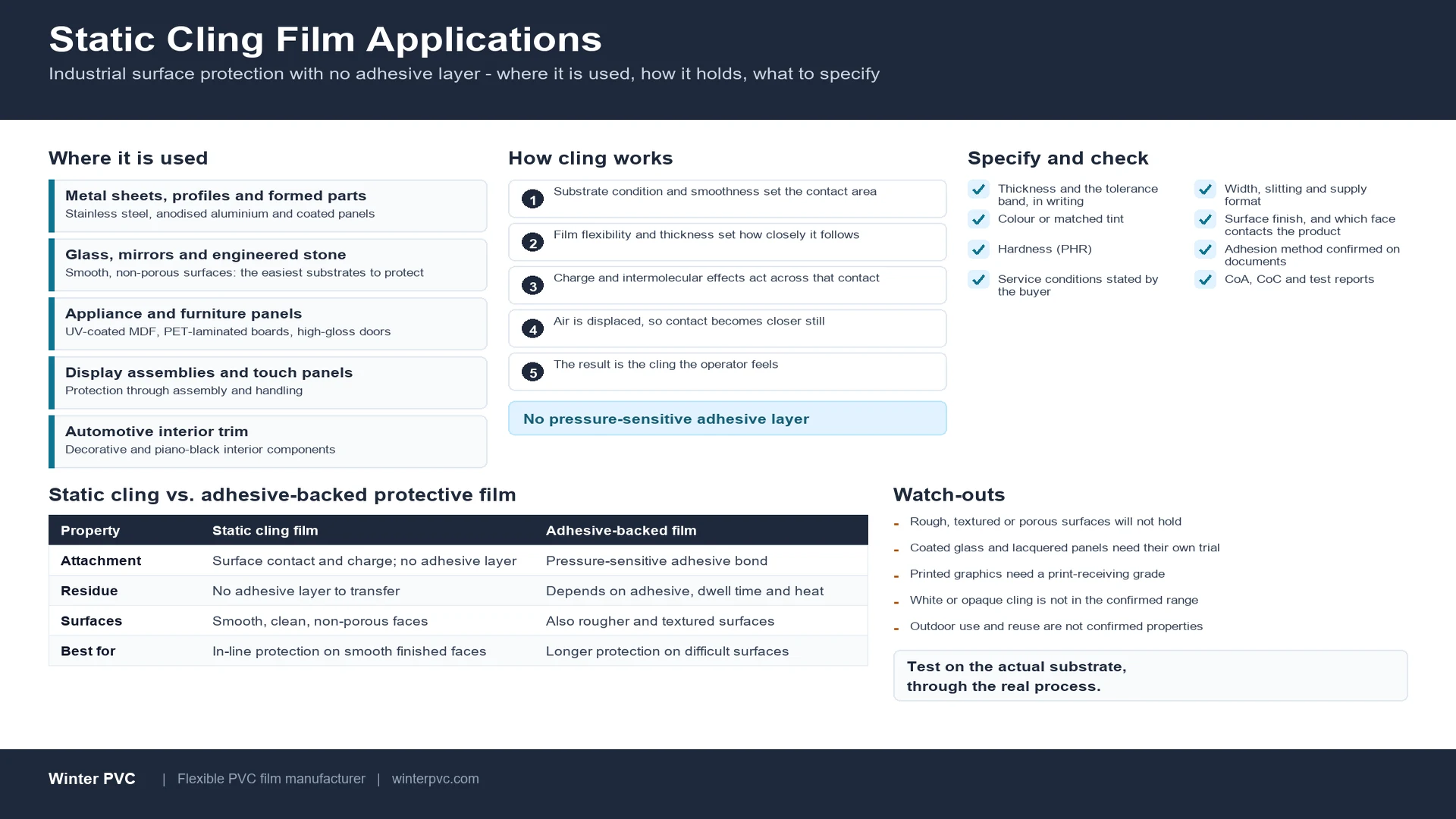
Static cling film is a plasticised PVC protective film supplied on rolls and applied to smooth surfaces to shield them from dust, handling marks and contamination while a product is manufactured, assembled, transported or installed. It carries no pressure-sensitive adhesive layer: it holds through surface contact, electrostatic charge and intermolecular attraction, and it is removed without an adhesive layer being introduced to the protected surface.
This guide is written for industrial buyers – importers, distributors, converters and manufacturers of metal, glass, appliance, furniture, display and automotive interior products – who need to decide whether a cling protective film suits their process and how to specify it. It covers where the film is used, what decides whether it holds, what to put on an enquiry, and how to qualify a sample.
Cling is not a fixed property, and it is not the same thing as tack or bond strength. It depends on the film formulation, how smooth and how clean the substrate is, how much contact the application method achieves, and the conditions the part meets while the film is in place. That is why a protective cling film should be specified against a substrate and a process rather than against a catalogue description, and why a sample trial is part of the purchase rather than an optional extra.
Scope. This article covers cling film used as a protective and handling film on smooth industrial surfaces. Printed promotional graphics need a print-receiving cling grade, which is a different product family; that difference is explained separately below.
How Does Static Cling Film Work?
Adhesion comes from three effects acting together. Smoothing the film onto a substrate displaces air and brings the two surfaces into close contact; where contact is genuinely close, weak intermolecular attraction acts across the contact area; and contact electrification leaves surface charge that adds further attraction. Formulation decides how flexible the film is and how its surface behaves, which in turn decides how much contact is achievable.
Electrostatic charge is part of the explanation, not the whole of it. A charged film will still slide off a dusty, oily, textured or porous surface, because charge cannot compensate for missing contact. The mechanism, including the difference between surface charge and practical adhesion, is set out in how static cling film works.
For specification purposes, cling follows a short chain:
- Substrate condition and smoothness set the real contact area available.
- Film thickness and flexibility set how closely the film follows the surface; see the PVC film thickness guide.
- Application method sets how much air is worked out and how much contact is achieved.
- Temperature and environment affect film stiffness, condensation at the interface and charge retention.
- Formulation ties the other four together, which is why two visually similar films can behave differently on the same panel. The property set behind formulation is summarised under PVC film properties.
Industrial Static Cling Film Applications by Substrate
The sections below are organised by the surface being protected, because that is the variable a buyer usually cannot change. They describe where this class of film is used in industry; they are not a per-substrate warranty, since suitability is confirmed against the specification and a sample trial.
Metal Sheets, Profiles and Formed Parts
Stainless steel sheets, anodised aluminium profiles and coated metal panels are common substrates. The film protects the finished face during shearing, forming, movement between process steps and storage, and is removed before assembly, packing or installation.
What to consider:
- Surface finish. Mirror and brushed finishes show any film-related marking more clearly than a satin finish.
- Surface cleanliness. Protective oils, mill residue and fingerprints reduce contact and therefore cling; agree the cleaning step that precedes application.
- Edge condition. Sharp sheared edges can tear film during handling, which argues for a heavier gauge or a different application method.
- Process heat. Where the panel passes through a downstream process, confirm the film specification suits that stage rather than assuming it does.
- Removal timing. Film left in place longer than planned, or removed after a heated process, may behave differently from the trial sample.
Glass Panels, Mirrors and Engineered Stone
Tempered glass, mirrors, glazed units and engineered stone are the most cling-friendly substrates because they are smooth, non-porous and dimensionally stable. The film keeps the finished face free of dust and handling marks through fabrication, transport and installation, and is stripped before handover.
What to consider:
- Coated or treated glass. The film meets the coating, not the glass, so a coated pane deserves its own trial.
- Cleanliness at application. Stacked or stored glass normally needs cleaning first; dust under the film is the most common cause of visible defects.
- Condensation. Cold glass brought into a warm space can form a moisture layer at the interface, which affects contact.
- Engineered stone. Surface texture and sealing vary more than on glass, so sample testing matters more, not less.
Appliance Panels, Furniture Boards and Laminated Surfaces
Appliance exterior panels, UV-coated MDF, PET-laminated boards, high-gloss cabinet doors and piano-black decorative parts are appearance-critical surfaces. The film has to survive handling and transport without leaving anything behind.
What to consider:
- Gloss level. High-gloss and piano-black finishes show any scratch, mark or residue, so application and removal technique matter as much as the film.
- Coating compatibility. Lacquered, UV-coated and laminated surfaces should be trialled with the intended film, because the film contacts the coating.
- Abrasion during transit. Where panels are stacked and moved, thickness and edge behaviour affect how well the surface stays protected.
- Removal before inspection. Define the removal point and inspect a trial panel that has been through the real route.
Electronic Display Assemblies and Touch Panels
Display assemblies, LCD and OLED touch panels and similar optical components are protected through assembly and handling, where contamination and handling marks are expensive to correct. The film shields the face during the process and comes off before final inspection or integration.
What to consider:
- Optical requirements. Where the surface is inspected or tested through the film, clarity and surface condition matter, not only cling.
- Contamination control. Cling film protects a surface inside a process; it is not a cleanroom classification and does not replace contamination controls. The application environment should be agreed.
- Removal without trace. The advantage of an adhesive-free film is that no adhesive layer is introduced. Removal still has to be confirmed on the actual component and process timing.
- Claims to avoid when sourcing. Do not assume anti-static, ESD-safe or cleanroom-grade performance unless a supplier has specifically qualified and documented it.
Automotive Interior Components and Trim
Interior trim, decorative panels and piano-black interior parts are protected during assembly, storage or shipment of the components themselves. These are interior applications, and the film is normally removed before the part is handed over.
What to consider:
- Component geometry. Flat panels are straightforward; curved or heavily contoured parts need a more conformable film and a validated application method.
- Plant conditions. Temperature, humidity and handling intensity vary by plant, so the trial should reflect the receiving line.
- Documentation. Automotive interior programmes often require material documentation, so establish which compliance and QC documents the supplier can actually issue before quotation rather than after.
Printable Static Cling Film: A Different Grade
Printable static cling film is not an ordinary cling film with ink added. It is a separate product family: the film has to be manufactured so its surface accepts and holds ink. Two independent properties are involved – printability, which depends on surface treatment, ink system, printer and curing route, and cling, which depends on formulation and contact behaviour. A film can be strong in one and weak in the other, so both are qualified on the same sample.
Before ordering printed cling film, confirm the following in writing:
- That the grade is a print-receiving grade, and what surface treatment or corona treatment it carries. An untreated protective cling grade should not be assumed to hold ink reliably.
- The ink system. Solvent, eco-solvent, UV-curable, latex and plastisol inks behave differently on plasticised PVC, and plasticiser movement in the film can affect ink adhesion over time.
- The process and curing settings. Curing route, web tension and how the film is supported through the press all affect the printed result.
- The service environment. A print that performs in a conditioned interior may behave differently on glazing exposed to sun and temperature cycling.
- The effect of printing on cling. Ink coverage, heavy ink deposits and additional surface treatments can reduce contact behaviour, so cling is tested on the printed film rather than on unprinted stock.
- Opacity requirements. A graphic needing an opaque background requires an opaque film grade, not a clear film printed heavily.
How this applies at Winter PVC: the confirmed static cling grade is a clear protective film, with translucent tints and solid colours matchable on request. A print-receiving cling grade is not part of the confirmed standard range. Our manufacturing documentation does describe corona treatment for films intended for printing, coating or lamination, and flexible PVC film is generally described as printable, but that is a general capability rather than a confirmation for this grade. Grade-specific printability is subject to specification review and sample testing on your own press, and where a requirement cannot be met it is stated before an order rather than discovered afterwards.
If printed graphics are your requirement, send the printing process, ink system, target substrate, graphic size and intended service duration. That information is what allows the printability question to be answered for a specification rather than in general terms.
Static Cling Film vs. Adhesive-Backed Protective Film
| Property | Static Cling Film | Adhesive-Backed Protective Film |
|---|---|---|
| Attachment mechanism | Surface contact, electrostatic charge and intermolecular attraction; no adhesive layer | Pressure-sensitive adhesive bond to the substrate |
| Adhesive layer | None | Coated adhesive present |
| Residue after removal | No adhesive layer is present, so adhesive residue is not expected on a clean surface; removal should still be confirmed on the actual substrate | Depends on adhesive type, dwell time, substrate and process heat |
| Removal and repositioning | Generally removable by hand, and repositionable while the surface stays clean | Repositioning is limited once the adhesive has wetted out |
| Surface requirements | Smooth, non-porous, reasonably clean surfaces: glass, finished metal, coated panels, laminates | Tolerates rougher, textured and more contaminated surfaces |
| Typical applications | In-line protection during fabrication, assembly and transport on smooth finished faces | Longer-duration protection, rough or textured surfaces, and where a stronger bond is needed |
| Printing and graphic use | Protective grade. Printed graphics require a print-receiving cling grade, evaluated separately | Printable protective films and tapes are widely available |
| Where the adhesive version wins | Not the best choice where the surface is rough, porous, heavily contaminated or strongly curved | The practical choice where the surface is difficult or protection must last longer |
Neither construction is universally better. Cling film is the lower-risk option where the protected face is smooth, the film is applied and removed inside a defined process window, and the surface must stay free of adhesive. Adhesive-backed protection is the practical choice where the surface is difficult, where the part is stored or shipped for a long period, or where the process cannot guarantee the cleanliness that cling depends on.
Buyer caution: the term “protective film” is used commercially for both constructions. State the adhesion method explicitly in the enquiry and on the purchase order.
Static Cling Film Specifications Buyers Should Evaluate
The table separates what to ask for from why it matters, and the notes below it distinguish general selection guidance from figures that apply to the Winter PVC static cling grade specifically.
| Specification | What to ask for | Why it matters |
|---|---|---|
| Thickness | Nominal gauge, and the tolerance band for that gauge in writing | Conformability, edge behaviour, protection level and cost |
| Width | Supplied width, master roll width, and slitting capability | Compatibility with the application line and material yield |
| Supply format | Master roll, slit roll, or sheeted and die-cut formats | Whether the film runs on the intended equipment |
| Colour and tint | Standard clear, or a matched tint or solid colour with a reference sample | Appearance where the film is visible during processing |
| Surface finish | Finish of the film face, and which face contacts the product | Contact behaviour and any risk of marking the protected surface |
| Hardness | PHR value or an agreed flexibility specification | How closely the film follows the surface |
| Adhesion method | Written confirmation of “electrostatic cling, no adhesive layer” | The core purchase decision when residue-free removal matters |
| Core size and roll build | Core diameter, roll length, outer diameter, winding direction | Feeding on the application equipment |
| Service conditions | The temperature and environment the film will meet, then a written recommendation for those conditions | Avoids specifying against an assumed temperature range |
| Winding and packaging | Winding tension, blocking behaviour, PE wrap, pallet or crate | Damage and waste between factory and line |
| Documentation | CoA, CoC, batch traceability, and which test reports apply to the grade | Incoming inspection and customer audit requirements |
Two rows carry the most commercial risk. Thickness tolerance should be agreed as a number, because “industry-standard tolerance” means different things to different suppliers and the figure decides whether protection is consistent. Service conditions should be described by the buyer and answered in writing by the supplier, because a protective film can behave differently after a heated or lengthy storage step.
The thickness range quoted for the Winter PVC static cling grade is approximately 0.04 mm to 0.40 mm, produced on calibrated gauges, with width from 0.6 m to 1.6 m master rolls. Other thickness bands published elsewhere on this site belong to different product families, so quote the grade when comparing suppliers. Current parameters are listed on the PVC static cling film product page.
Start an enquiry with three details. Send the application and substrate, the required thickness, and the required width or roll format. Those three are enough to begin a technical review; everything else can be settled afterwards by email. The product page is the fastest route for specification questions, and the contact page reaches the sales and technical team directly.
How to Evaluate a Sample Before Bulk Purchasing
A cling film sample should be tested as it will be used: on the actual substrate, with the production application method, under the conditions of the real process. A workable sequence:
- Identify the substrate precisely – material, finish, coating and current condition.
- Clean the surface using the production method and record what was used. Contamination is the most common cause of a failed trial.
- Apply a defined sample, standardising size, application pressure and squeegee or roller passes.
- Assess contact – how readily air is displaced, and whether bubbles or lifted edges remain.
- Observe cling over time – immediately, after several hours, and after the period the part will actually be protected.
- Test removal and record the effort, whether the film releases cleanly, and whether any cleaning or rework is needed.
- Repeat after each process step the part goes through while the film is in place, such as drying, heating, stacking or transport.
- Record results in a comparable format, so films from different suppliers are judged on the same basis.
Samples and production trial rolls are available on request, subject to batch inventory and project specification review; trial rolls are more informative than hand samples where the film will be applied by machine, because application method is one of the variables that decides whether cling works.
What Should Buyers Ask a Static Cling Film Supplier?
- Is the film an electrostatic cling film with no pressure-sensitive adhesive layer, and will that be confirmed on the purchase documents?
- What is the thickness tolerance for the requested gauge, stated as a number?
- What widths and roll formats are available, and can the film be slit to our converting width?
- What is the standard colour, and which tints or solid colours can be matched?
- What is the film hardness or flexibility specification, and how is it verified?
- Which substrates has this grade been tested on, and under what conditions?
- What service conditions should we declare so you can recommend a grade?
- Is the grade intended for printing, and if not, what would need to change?
- Can you supply a line-evaluation trial roll, and what does that involve?
- Which QC documents are issued with production orders?
- Which compliance documents apply to our destination market, and can they be issued for this grade?
- What are the MOQ and lead time for the specification we have described?
Winter PVC Static Cling Film Capabilities
Winter PVC manufactures flexible PVC film in China, and static cling film forms part of the Functional & Technical range for industrial surface protection programmes. The parameters below are taken from the current product specification:
- Adhesion method: electrostatic cling with no pressure-sensitive adhesive layer, intended for clean removal after use.
- Thickness: approximately 0.04 mm to 0.40 mm, on calibrated gauges.
- Width: master rolls from 0.6 m to 1.6 m, with precision slitting to the required customer width.
- Hardness: 50 to 66 PHR soft-flexible PVC.
- Surface and colour: clear transparent high-gloss smooth finish as standard; other surface profiles, translucent tints and solid colours are subject to evaluation.
- Supply format: master rolls and precision slit rolls; sheet cutting, die cutting and secondary converting are reviewed per project.
- Documentation: batch traceability through incoming material verification, in-line thickness monitoring and finished roll inspection, with CoA, CoC, SGS test reports and SGS non-phthalate test reports available on request.
- Compliance: formulations can be made to meet REACH, RoHS and EN-71 requirements for the destination market, with documentation issued on request.
- Commercial terms: MOQ depends on thickness, width and customisation; lead times depend on quantity and production schedule.
Printability is not a confirmed capability of the standard static cling grade. Print-receiving requirements are reviewed against the specification and validated by sample before an order is placed, and where a requirement cannot be met that is stated before the order.
Where a figure in this article differs from the product page or an issued datasheet, the product page and datasheet take precedence. How the film is produced, including the gauge control that supports consistent thickness, is covered in the PVC film manufacturing process.
Frequently Asked Questions
What is static cling film used for?
Industrial surface protection: shielding smooth finished faces during fabrication, assembly, transport and installation. Typical substrates are glass and mirrors, stainless steel and anodised aluminium, appliance panels, coated and laminated furniture boards, display assemblies, automotive interior trim and engineered stone.
Does static cling film use adhesive?
No. The grade described here has no pressure-sensitive adhesive layer. Because no adhesive is present, adhesive residue is not expected on a clean surface, though removal should still be confirmed on the actual substrate and process.
What surfaces does static cling film work on?
Smooth, non-porous, reasonably clean surfaces. Glass, finished metal and coated panels are the usual substrates. Rough, textured, porous or contaminated surfaces generally will not hold the film reliably.
Can static cling film be used on all glass?
No. Coated, treated or previously filmed glass presents a different surface from bare glass, so suitability should be confirmed on the actual pane rather than assumed.
Is white static cling film available?
The standard grade is clear transparent, with translucent tints and solid colours matchable on request. An opaque white cling grade is not part of the confirmed standard range and would need to be reviewed as a specification.
Can static cling film be printed?
Printed graphics require a print-receiving cling grade, which is a different product family. Printability is not a confirmed capability of the standard grade; general print-related capability is documented, but grade-specific printability needs specification review and a print trial.
Does printing affect cling performance?
It can. Ink coverage, heavy ink deposits and additional surface treatments can change contact behaviour, so cling should be tested on the printed film rather than on unprinted stock.
Can the film be reused?
Reuse is not a stated performance property of this grade. Whether a film can be reapplied depends on handling, storage and contamination, and it should be treated as a trial rather than assumed.
Does static cling film leave residue?
No adhesive layer is present, so adhesive residue is not expected on a clean surface. Material found after removal is more likely to come from contamination on the protected surface or from the process environment.
What thickness should I choose?
Thickness follows from the protection level, the substrate, the handling the part receives and the application method. Thicker is not automatically better: conformability, edge behaviour and cost all change with gauge. Start from the process and confirm on a trial.
Can the film be used outdoors?
Outdoor performance is not a confirmed property of this grade. Where exterior exposure is part of the process, the conditions should be stated and tested rather than assumed.
How do I test a cling film before a bulk order?
Apply a defined sample to a cleaned version of the actual substrate using the production method, observe contact and cling over the period the part is protected, then test removal after the process steps the part goes through. Trial rolls are more representative than hand samples for machine application.
Conclusion and Next Step
Static cling film earns its place where a smooth finished face must stay clean through a process and then be released without an adhesive layer. The selection variables are the substrate, the process conditions and the protection period – not the film alone.
Two points are worth carrying into a specification discussion. Cling depends on contact, so surface cleanliness and application method matter as much as the film. And printability and cling are separate properties: if printed graphics are the requirement, that changes the product family and needs its own evaluation.
To have a specification reviewed, send Winter PVC the following. Everything except the first items can be settled by email afterwards:
- Application and substrate material, with finish or coating;
- Required thickness, and required width or roll format;
- The process steps the film must survive, including temperature and duration;
- Indoor or outdoor use, and the expected protection period;
- Colour or tint requirement, if any;
- Printing requirements, if the application involves print;
- Estimated order quantity and destination market.
Specifications and current parameters are listed on the PVC static cling film product page, and the contact page reaches the sales and technical team. Buyers new to the material can start with what PVC film is, and where clarity matters for an inspection step, optical grade differences are explained in clear PVC film vs. super clear PVC film.