
Window Cling vs Static Cling: What’s the Difference and How Is Static Cling Film Used in Advertising?
Buyers meet both terms in the same week: a retail chain asks for “window clings”, a print supplier quotes “static cling film”, and a distributor forwards a spec sheet that uses neither phrase. The two are related, but they are not the same kind of term, which is where most of the confusion starts.
The short answer: static cling describes how a material attaches, while window cling describes what a product is for. A window cling can be a static cling product; a static cling film can be sold for something other than windows. Some suppliers use the terms interchangeably, and others use “window cling” for a low-tack adhesive vinyl, so the label alone does not tell you what you are buying.
This article explains the terminology, compares the options in a table a buyer can use in a quotation discussion, and sets out how static cling PVC film is specified for advertising work. It does not repeat the mechanism or the industrial selection guidance already published elsewhere on this site.
What Is Window Cling?
“Window cling” is a product description, not a material specification. It usually refers to a printed or plain sheet that is applied to glass – shop windows, glass doors, display cases, partitions – and removed later without tools. In retail and promotional use the phrase covers seasonal graphics, opening-hours signs, campaign artwork and decorative panels.
Two things make glass the natural surface for this product. It is smooth and non-porous, so a flexible film can achieve close contact across a large area, and it is usually cleanable, which matters because contamination is the most common reason a cling product fails to hold. Glass is also where promotional graphics are most visible, which is why the product category grew around it.
The catch is that “window cling” says nothing about the attachment method. Products sold under that name may be:
- a static cling film with no adhesive layer;
- a low-tack adhesive product designed for temporary glass graphics;
- a rigid or semi-rigid printed panel fixed mechanically.
If the attachment method is not stated, ask. It determines how the graphic is applied, how cleanly it comes off, and which surfaces will accept it.
What Is Static Cling Film?
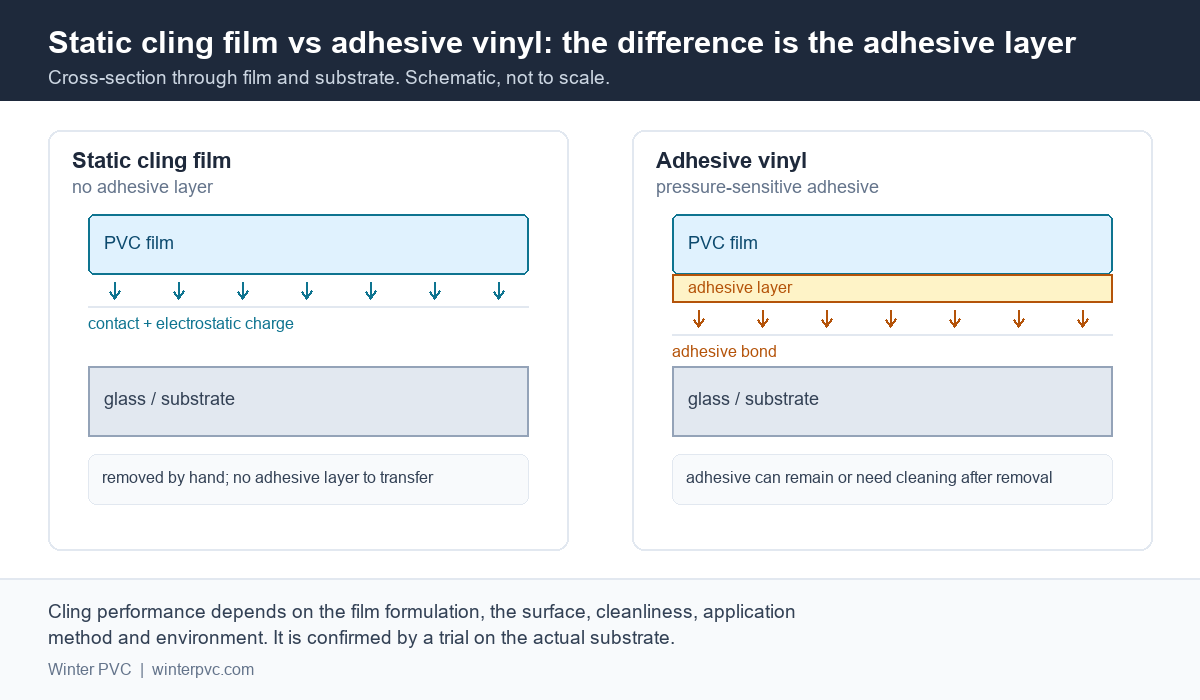
Static cling film is a plasticised PVC film supplied on rolls, with no pressure-sensitive adhesive coating and no liner. It holds to a suitable surface through close contact, electrostatic charge and weak intermolecular attraction across the contact area. The mechanism is explained in more detail in how static cling film works.
Three consequences matter for advertising work:
- Application is dry. No water, no adhesive, no squeegee technique borrowed from vinyl work. The film is positioned, air is worked out, and contact does the rest.
- Removal does not involve an adhesive layer. On a clean surface, adhesive residue is not expected, which is the main reason cling is chosen for short campaigns on expensive glazing.
- Performance depends on the surface. Smooth, non-porous and reasonably clean glass is the easy case. Coated, tinted, textured, dusty or greasy surfaces behave differently, and a trial on the actual pane is the only reliable answer.
It is worth separating static cling from adhesive vinyl at the procurement stage rather than the design stage: they tolerate different surfaces, different campaign lengths and different removal expectations. A comparison of the two constructions is set out in the static cling film applications guide, which approaches the same question from the industrial protection side.
Window Cling vs Static Cling: Key Differences
| Point of comparison | Window Cling | Static Cling |
|---|---|---|
| What the term describes | A product or application: a graphic for glass | A material behaviour: how the film attaches |
| Main emphasis | Where it is used and what it is for | How it holds without adhesive |
| Typical use | Retail and promotional graphics on windows, doors, cases and partitions | Any smooth surface: window graphics, but also protective and handling film |
| Attachment method | Not defined by the term – may be cling, low-tack adhesive or mechanical fixing | Contact, electrostatic charge and intermolecular attraction; no adhesive layer |
| Common surfaces | Glass and other smooth, non-porous surfaces | Glass, smooth acrylic, polished metal, coated panels and laminates |
| Removal and reuse | Depends on the product behind the term | Removable by hand; repositioning is practical while surfaces stay clean; reuse is conditional, not guaranteed |
| What to ask a supplier | Which attachment method, and which surface the product is designed for | Thickness, width, cling behaviour on your substrate, and whether the grade is print-receiving |
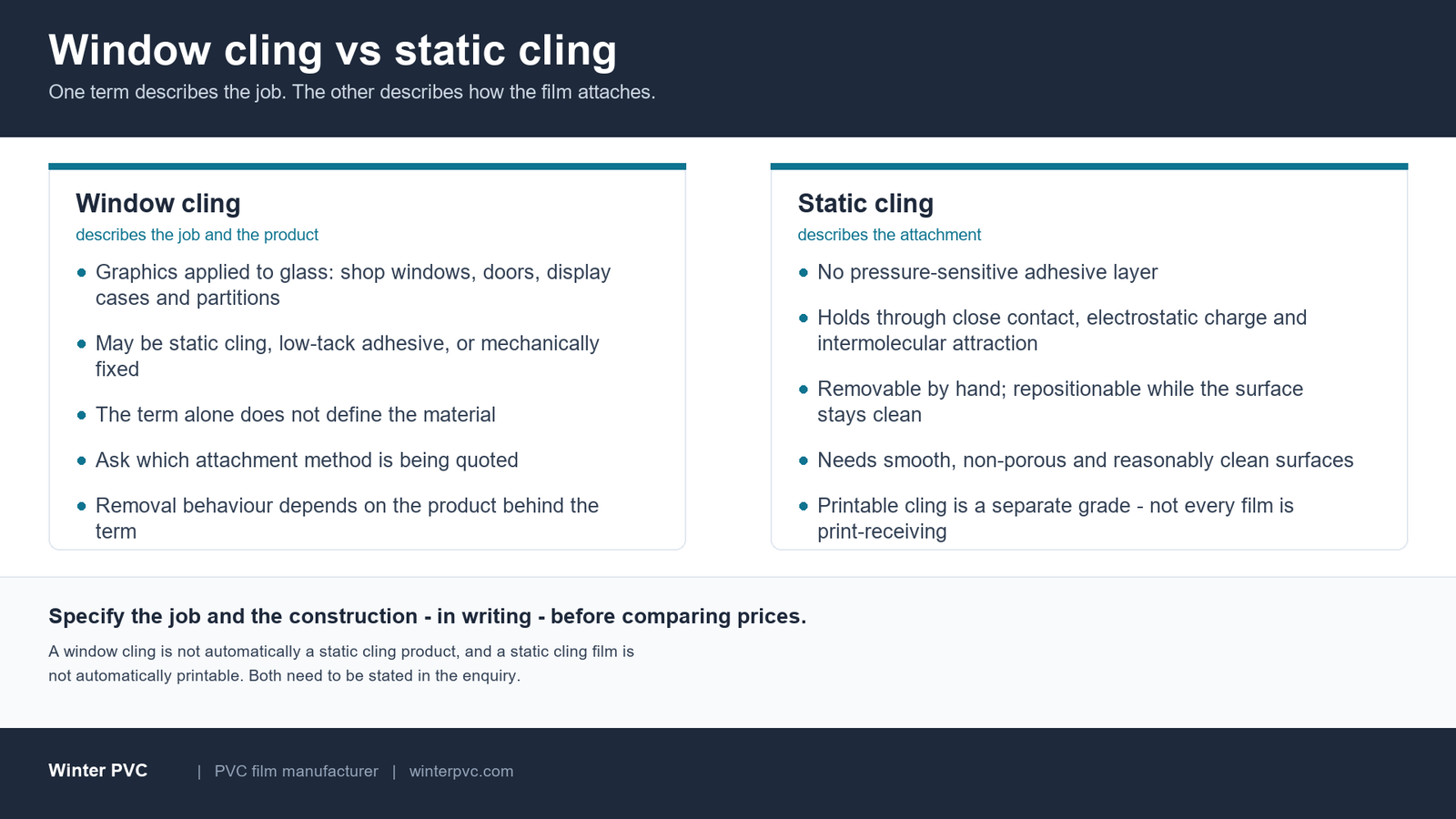
The practical conclusion for a buyer: use “window cling” to describe the job, and “static cling” to describe the attachment. When a supplier quotes, ask for both – the application and the construction – in writing.
Advertising Uses of Static Cling Film
The applications below share one requirement: a smooth, reasonably clean surface and a campaign that will end. Each entry lists what the buyer should verify before ordering, because the same film can behave differently across sites.
Retail Window Promotions
Where: shop windows and glazed entrances, usually the inner face.
Purpose: campaign artwork, price messaging, store branding and seasonal themes that change on a schedule.
Why cling suits: staff can apply and remove graphics without solvents or scrapers, and the glass returns to a clean state between campaigns.
Verify: glass cleanliness and any coating; the size of the largest panel that can be handled without creasing; and whether the printed side faces out or is reverse printed and viewed through the glass.
Storefront and Glass-Door Advertising
Where: entrance doors, lobby glazing and street-facing glass at ground level.
Purpose: opening hours, wayfinding, offers and brand messaging that must be readable at close range.
Why cling suits: the graphic can be replaced without leaving a removal job behind, which matters on doors that are in constant use.
Verify: how much handling the door glass receives, and whether the film edge will be disturbed by daily contact. High-traffic doors are a harder environment than a display window.
Seasonal Promotional Graphics
Where: any glazed frontage on a campaign cycle – holidays, sales, local events.
Purpose: short-life artwork that is installed and removed within weeks.
Why cling suits: installation and removal are part of store operations, not a contractor visit.
Verify: the removal date, and whether the same glass will carry a new graphic immediately afterwards. Residue and surface condition matter more when changeovers are frequent.
Point-of-Sale Displays
Where: display cases, glazed shelving, counter screens and fridge doors in retail environments.
Purpose: promotion graphics, product information and price messaging at the point of decision.
Why cling suits: small panels can be repositioned while a display is being merchandised.
Verify: the actual surface – many display cases are acrylic rather than glass, and acrylic scratches and attracts dust differently. Test on the material you will use.
Temporary Campaign Messaging
Where: event venues, pop-up retail, showroom glazing and short-term tenancies.
Purpose: branding for a defined period, with a known end date.
Why cling suits: no adhesive layer to remove from glass that belongs to someone else.
Verify: the terms of the tenancy or venue, and the condition the glass must be returned in. Also confirm whether the graphic will be applied by staff or by an installer.
Glass Partitions and Interior Display Graphics
Where: office partitions, meeting-room glazing, clinic and showroom dividers.
Purpose: information, wayfinding, decorative patterns and visual screening.
Verify: whether the intent is decoration or genuine screening. A clear film does not provide privacy; a translucent, frosted or opaque grade, or a print dense enough to obscure the view, is a different specification.
Where Static Cling Is Not the Right Choice
Cling is the wrong tool when the surface is rough, textured, porous or heavily contaminated, when the graphic must survive for a long period in a demanding environment, or when the substrate is curved or coated in a way that prevents contact. Adhesive vinyl tolerates more difficult surfaces and holds longer; it also brings residue and removal considerations. The decision is about the surface and the campaign, not about which product is better.
How to Choose Static Cling Film for Advertising
Substrate and surface condition. Establish the exact material – glass, acrylic, coated glass, polycarbonate – and its condition. A coating is the surface the film actually meets.
Thickness. The published range for the Winter PVC static cling grade is 0.04 mm to 0.40 mm. Thin film conforms more readily to surface texture and slight curvature; heavier film is easier to handle in large panels and more resistant to edge damage. The right gauge follows from panel size, handling and the surface, not from a default.
Transparency and colour. Clear transparent is the standard supply. Translucent tints and solid colours can be matched on request, generally against a physical sample or a Pantone or RAL reference. For graphics that must read against a busy interior, an opaque print or an opaque grade may be needed; a clear film printed heavily does not produce the same result.
Cling performance on the actual substrate. Test it. Contact area, cleanliness and temperature decide whether the film holds, and a demonstration on a supplier’s sample pane is not a substitute for a trial on the customer’s glass.
Indoor or outdoor exposure. Outdoor durability is not a confirmed property of this grade. Where exterior glazing is involved, state the conditions and test them rather than assuming indoor results carry over.
Application and removal frequency. A graphic changed weekly puts more stress on the film and the surface than one installed for a season. Frequent changeover raises the importance of clean removal and of storing the film properly between uses.
Printing compatibility. This is the item most often assumed and least often checked. Printing on plasticised PVC depends on the surface treatment of the film, the ink system, the press and the curing route, and on how the print behaves afterwards. Winter PVC does not currently list a print-receiving static cling grade, so printed work should not be assumed. Where print is essential, the process and ink system still need to be reviewed against the specification, and the practical test remains a print trial on the buyer’s press.
Roll width and processing. Master rolls run from 0.6 m to 1.6 m, with precision slitting to the required width. Confirm the roll format, core size and packing against the cutting or printing equipment that will handle the film.
What Should B2B Buyers Ask Their Supplier?
- Which attachment method does this product use – cling, adhesive, or something else?
- What thicknesses and roll widths are available, and can the film be slit to our converting width?
- Is the grade clear, tinted or coloured, and can a reference sample be matched?
- Which substrates has this grade been tested on, and under what conditions?
- Is the material intended for our printing process, and which ink system has been qualified?
- What documentation is available – CoA, CoC, test reports – for this grade and market?
- Can you supply a sample or trial roll for application and print testing?
- What is the expected behaviour on removal after the campaign length we plan?
Frequently Asked Questions
Is window cling the same as static cling?
Not exactly. “Window cling” describes a product used on glass; “static cling” describes how the film attaches. A window cling product may use static cling, a low-tack adhesive, or mechanical fixing, so the term alone does not define the material.
Does static cling film contain adhesive?
The grade described here has no pressure-sensitive adhesive layer. Because no adhesive is present, adhesive residue is not expected on a clean surface, though removal should still be confirmed on the actual substrate and process.
Can static cling film be used for retail window advertising?
It is used for that purpose where the glass is smooth and clean and the campaign is temporary. Suitability depends on the specific glass, the panel size and the handling the window receives.
Can static cling film be printed?
Only on a print-receiving grade, and only for the process and ink system it has been qualified with. The current Winter PVC static cling range does not list a print-receiving grade, so a printed project needs to be discussed before it is quoted, and a print trial is the only reliable test.
Can static cling film be reused?
Reuse is possible but not a defined property. It depends on how the film is removed, how it is stored and whether the surface and film stay free of contamination. Treat each reapplication as a trial rather than assuming a fixed number of cycles.
Does static cling work on all glass?
No. Coated, tinted, textured or poorly cleaned glass behaves differently from bare, clean glass. Suitability should be confirmed on the actual pane.
Is static cling film suitable for outdoor advertising?
Outdoor durability is not a confirmed property of this grade. Exterior glazing brings rain, condensation, temperature cycling and contamination, so the conditions should be stated and tested rather than assumed from indoor results.
Conclusion and Next Step
The terminology is easier once the two axes are separated: window cling describes the job, static cling describes the attachment. What decides whether a project works is the surface, the campaign length, the printed result and the removal expectation – not the label on the quote.
To have a specification reviewed, send Winter PVC the following. Only the first items are needed to start:
- Application and the surface the film will be applied to;
- Required thickness and roll width;
- Colour or transparency requirement;
- Printing process and ink system, if the graphic will be printed;
- Estimated quantity and destination market.
Samples are free of charge; freight is normally at the buyer’s cost. The published parameters are on the PVC static cling film product page, and the contact page reaches the sales and technical team. Buyers who need the wider product context can start from the PVC film product index.