
If you’re researching what is PVC film, you’re likely evaluating materials for a packaging, furniture, stationery, protective covering, or industrial manufacturing project.
PVC film is one of the world’s most widely used plastic film materials because it offers an unusual combination of flexibility, durability, processability, and cost efficiency. By adjusting its formulation, manufacturers can produce films ranging from semi-rigid sheets to highly flexible materials suitable for welding, sewing, laminating, and continuous industrial use.
In this guide, we’ll explain what PVC film is, how it is manufactured, where it is used, and how buyers can select the right specification for their applications.
In This Guide
- What Is PVC Film? Understanding the Basics
- Rigid vs Flexible PVC Film
- Internal Knowledge Hub (SEO Topic Cluster)
- How Is PVC Film Manufactured?
- Why Manufacturing Quality Matters
- PVC Film Applications (Industry Solutions)
- Key Advantages of Flexible PVC Film
- Compliance & International Standards (EN71, RoHS, REACH)
- How to Choose the Right PVC Film
- Common Mistakes When Sourcing
- Frequently Asked Questions
- PVC Film Regulatory Compliance and International Standards
- Conclusion
What Is PVC Film? Understanding the Basics
PVC film is a thin plastic sheet manufactured from Polyvinyl Chloride (PVC) resin combined with plasticizers, stabilizers, pigments, and other functional additives.Unlike many plastic films that offer a limited range of physical properties, PVC film can be engineered to achieve dramatically different levels of flexibility, transparency, softness, and durability.
Rigid vs Flexible PVC Film
Rigid PVC film contains little or no plasticizer and is used in blister packaging, cards, and structural applications.
Flexible PVC film contains plasticizers that improve elasticity and processing performance. It is widely used in welding, sewing, lamination, and continuous industrial production.
Internal Knowledge Hub
To fully understand PVC film from procurement and technical perspectives, the following guides provide deeper insights:
PVC Film Manufacturing Process: A Procurement Guide for Industrial Buyers
PVC Film Thickness Guide: How to Choose the Right Thickness for Industrial Applications
PVC Film Properties: Elevating Tensile Strength, PHR Hardness & Compliance
PVC Film Applications Guide | Industrial PVC Films for Packaging, Lamination & Surface Protection
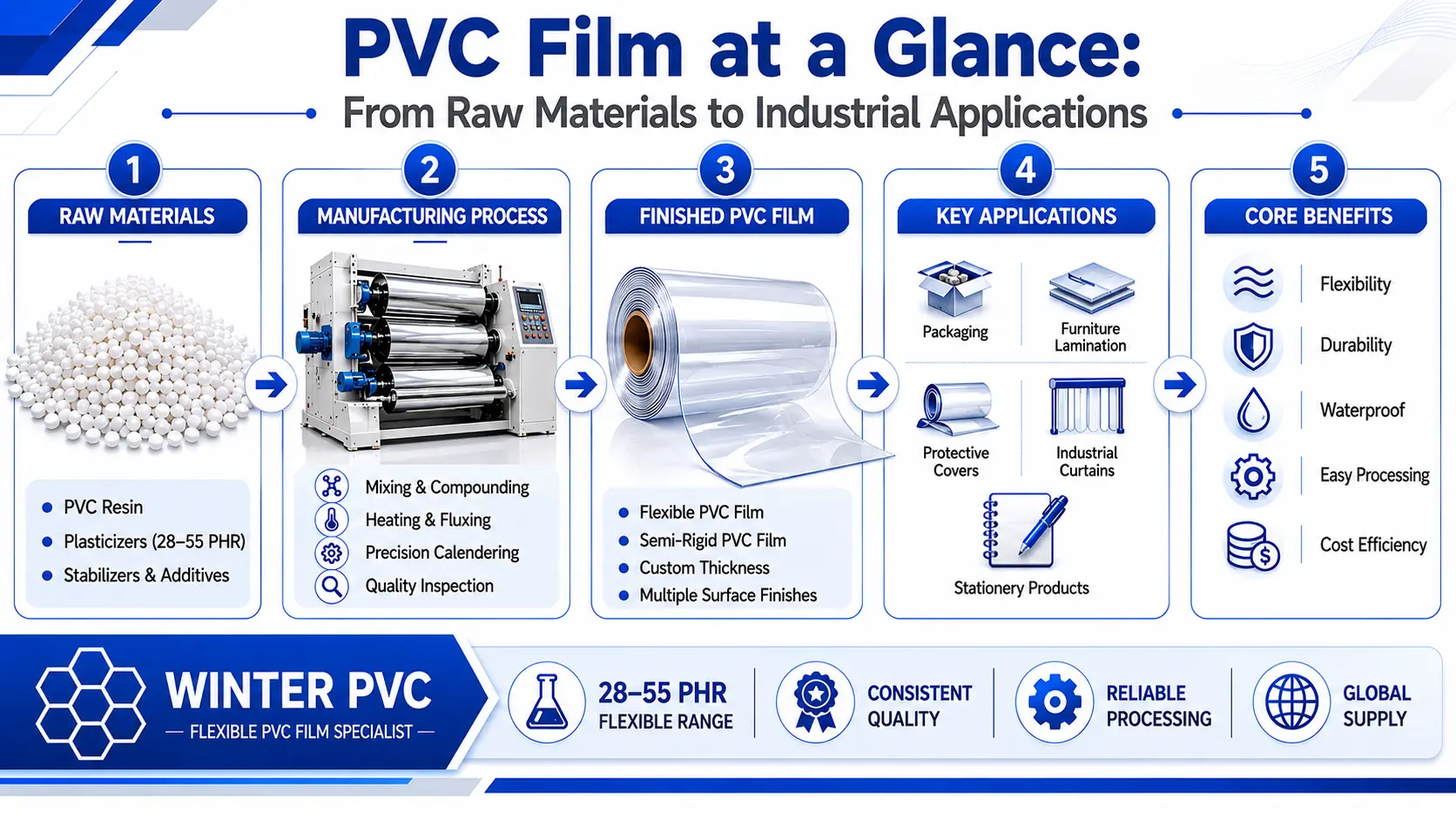
How Is PVC Film Manufactured?
Step 1: Raw Material Blending
PVC resin is mixed with plasticizers, stabilizers, and additives based on required specifications.
Step 2: Heating and Fluxing
The compound is heated and mixed into a uniform, molten material.
Step 3: Calendering / Extrusion
The material passes through precision heated rollers that determine exact thickness and surface quality.
Step 4: Cooling and Inspection
The film is cooled, undergoes strict tolerance testing, and is wound into rolls for industrial shipment.
Why Manufacturing Quality Matters
Even small variations in thickness or formulation can disrupt your production line and affect:
- Lamination stability and adhesion
- High-frequency welding performance
- Printing consistency and ink bonding
- Roll uniformity causing processing instability
- PVC Film Applications
Flexible PVC film is trusted across a wide range of industries because it combines exceptional flexibility, water resistance, and ease of processing. Instead of a one-size-fits-all material, it serves as a dedicated solution for three primary industrial sectors:
Industrial & Commercial Packaging: Optimized for heavy-duty shrink films, surface protective wrapping, and commercial packaging applications where product visibility and structural protection are equally critical.
Decorative Surfaces & Furniture Lamination: Specially formulated for seamless lamination onto MDF panels, cabinet doors, and decorative interior surfaces. It performs reliably across woodgrain, matte, glossy, and embossed finishes.
Protective Covers, Curtains & Stationery: The go-to industrial material for high-durability table covers, document holders, flexible strip curtains, and protective sleeves requiring long-term flexibility under repeated mechanical stress.
Key Advantages of Flexible PVC Film
High Fatigue & Crack Resistance: Our flexible PVC film is engineered to withstand continuous mechanical stress and repeated bending without cracking or whitening—ensuring long-term durability in heavy-duty environments.
Broad Processing Adaptability: Formulated for seamless secondary manufacturing, the material can be easily laminated, printed, high-frequency welded, sewn, or thermoformed on standard industrial equipment.
Industrial-Grade Barrier Protection: With excellent inherent resistance to moisture, oils, and common chemicals, it maintains its physical properties even in highly humid or exposed settings.
How to Choose the Right PVC Film
Hardness (PHR Range)
28–35 PHR: Best for furniture lamination, cabinet profiles, and book covers.
36–45 PHR: Ideal for packaging, general protective covers, and stationery.
46–55 PHR: Tailored for soft industrial products, strip curtains, and high-flexibility applications.
Thickness
Thickness directly impacts material cost and structural integrity. Thinner gauges are preferred for wrapping and print media, while thicker options support heavy industrial shields.
Surface Finish & Product Series
Transparent & Clear Series: Super Clear Film, Normal Clear Film, Colored Super Clear Film, Super Clear Lamination Film.
Decorative Surface Films: Matte Embossing Film, Colored Embossing Film, Clear Lamination Embossing Film, Colored Opaque Film.
Specialty & Protection Protection: Static Cling Film, Mattress Packing Film, Table Cloth andPlastic Table Cloth
Common Mistakes When Sourcing PVC Film
Choosing based on price only
Low-cost films often compromise batch-to-batch consistency and processing stability, leading to higher defect rates on your machinery.
Ignoring specific processing methods
Welding, lamination, and high-speed printing each require unique stabilizer and plasticizer formulations to prevent surface migration.
Skipping factory sample testing
Always request and test sample rolls on your actual production equipment before moving to bulk purchasing.
PVC Film Regulatory Compliance and International Standards
For industrial buyers requiring strict regulatory compliance, PVC film can be manufactured to meet major international safety and environmental standards.
EN71 Compliance: Suitable for applications involving toys, stationery, and consumer-facing products where safety of contact materials is required.
RoHS Compliance: Ensures that the material is free from restricted hazardous substances such as lead, cadmium, mercury, and other heavy metals commonly regulated in electronic and industrial supply chains.
REACH Compliance: Confirms that the material meets European Union chemical safety regulations regarding substances of very high concern (SVHC), supporting safe use in furniture, packaging, and export-oriented applications.
By selecting certified PVC film, buyers reduce regulatory risks in international trade and ensure smoother customs clearance across EU, US, and global markets.
Frequently Asked Questions
Is PVC film waterproof?
Yes, PVC film is naturally highly resistant to water, humidity, and moisture.
What is the difference between PVC and PET film?
PVC film is significantly more flexible, softer, and easier to weld or sew, while PET film offers higher heat resistance and structural rigidity.
Can PVC film be customized?
Yes. It can be fully customized in terms of thickness, color, PHR hardness level, surface embossing, and functional additives like UV stabilizers or anti-static agents.
How long does PVC film last?
Lifespan depends heavily on the application environment. For outdoor use, adding specialized UV stabilizers can significantly extend the material’s service life.
Conclusion
Understanding PVC film requires evaluating not just the material itself, but also its manufacturing consistency, thickness tolerance, chemical properties, and precise application scenarios.
For industrial buyers, aligning with a supplier capable of matching the exact technical specification can significantly improve production line efficiency and reduce overall manufacturing costs.
Need Help Selecting PVC Film?
We provide factory-direct, customized PVC film solutions tailored for packaging, furniture lamination, stationery, and heavy-duty industrial applications.
You can request technical guidance, free sample rolls, or custom specification matching for your production line.