
Introduction
Many of these purchasing criteria are directly influenced by core PVC film properties such as hardness, tensile strength, thickness consistency, transparency, and regulatory compliance.
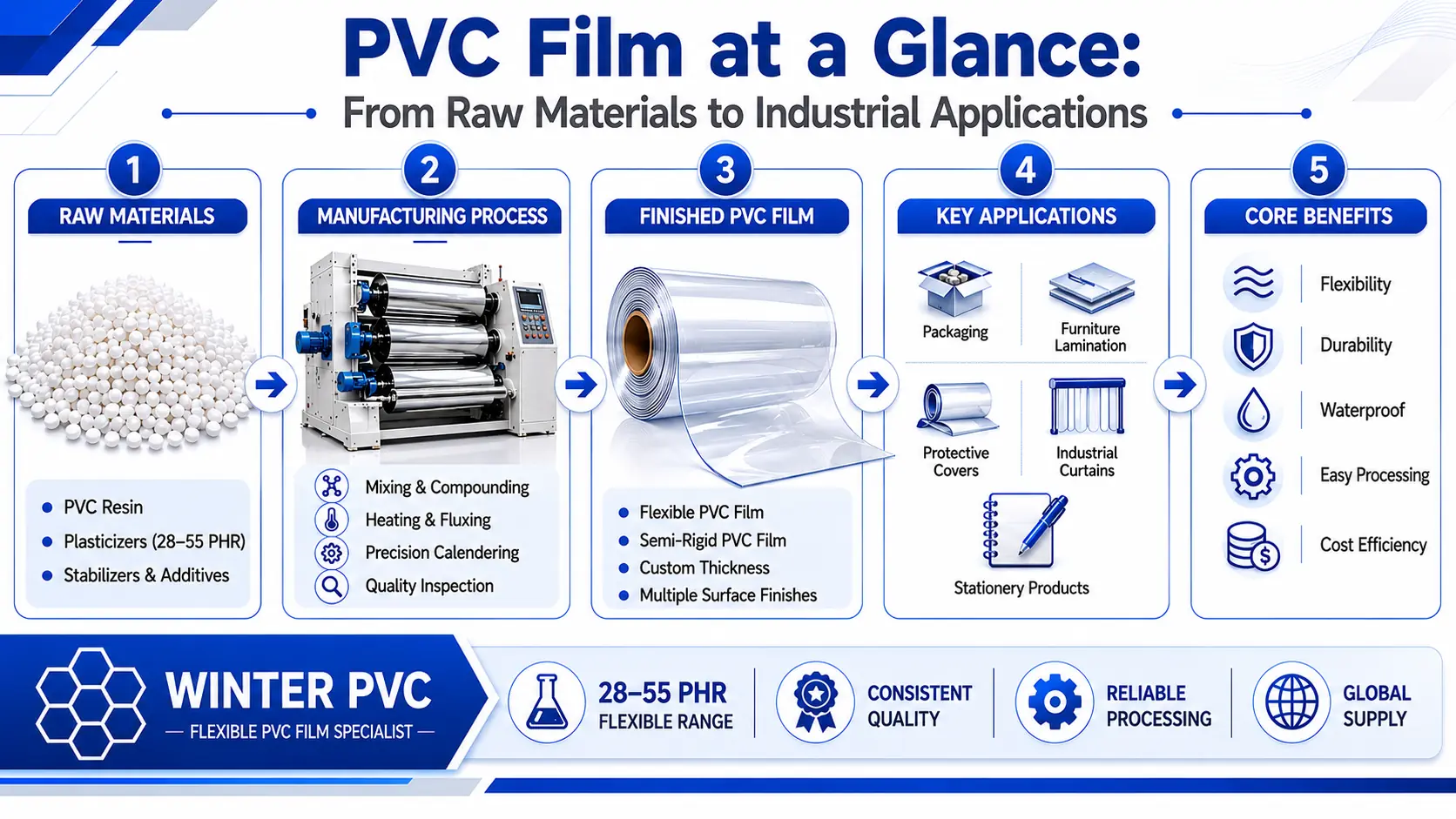
PVC (polyvinyl chloride) film is one of the most widely used thermoplastic films in industrial manufacturing. It is produced by calendering or extrusion of PVC resin compounded with plasticizers, stabilizers, and processing aids to achieve a targeted range of PVC film properties — from soft, elastic flexible grades to rigid, high-strength sheets.
If you are new to PVC materials, start with our complete PVC Films Guide to understand manufacturing methods, applications, and material selection principles before evaluating specific performance properties.
The industrial relevance of PVC film spans packaging, medical device manufacturing, construction, automotive interiors, stationery, graphic arts, and thermoformed consumer goods. In packaging alone, PVC film serves as shrink wrap, blister pack lidding, clamshell inserts, and pharmaceutical cold-form blister base webs. In medical applications, PVC film is used for IV bags, blood bags, and tubing because its PVC material properties can be tuned through plasticizer formulation — retaining clarity, weldability, and biocompatibility.
At Winter PVC, we manufacture PVC film in thicknesses ranging from 0.06 mm to 0.5 mm across flexible, semi-rigid formulations. Every batch is tested against REACH,RoHs, EN-71, and internal factory standards to ensure reproducible physical and chemical performance for downstream converting operations.
While understanding line behaviors is critical for converting, selecting the right formulation depends heavily on your specific end-use market. For a detailed breakdown of market-specific use cases, please refer to our dedicated overview of PVC film applications.
PHYSICAL PROPERTIES OF PVC FILM
The physical properties of PVC film directly influence how it performs throughout a customer’s production process — from unwind stability and die-cutting precision to heat-sealing efficiency and final product appearance. The table below presents typical physical properties for our standard flexible PVC film formulations (approximately 35–45 PHR). These values are provided as representative reference data based on Winter PVC’s regular calendered production. Depending on specific application requirements, selected properties and formulations can be customized and optimized to support different processing conditions, equipment configurations, and end-use performance objectives.
| Property | Test Standard | Typical Value | Unit |
|---|---|---|---|
| Tensile Strength (MD/TD) | ASTM D882 | 15–28 | MPa |
| Elongation at Break (MD/TD) | ASTM D882 | 200–380 | % |
| 100% Modulus | ASTM D882 | 4–10 | MPa |
| Hardness | Shore A (15 s) | 65–95 | — |
| Density | ASTM D792 | 1.23–1.38 | g/cm³ |
| Transparency (Haze) | ASTM D1003 | 2.0–8.0 | % |
| Gloss (60°) | ASTM D2457 | 80–110 | GU |
| Continuous Service Temperature | Internal | -25 to +65 | °C |
| Vicat Softening Point | ASTM D1525 | 50–85 | °C |
| Water Absorption (24 h) | ASTM D570 | 0.1–0.5 | % |
Disclaimer: The technical data contained herein are typical properties of the material based on laboratory reference standards and are intended solely for guidance and evaluation purposes. They do not constitute a formal contract, legal warranty, or binding product specification for any specific batch. Because actual processing conditions and end-use applications vary, customers are highly recommended to perform their own testing or request a batch-specific Certificate of Analysis (COA) prior to large-scale production.
These PVC film properties are not fixed constants — they shift predictably with plasticizer content, filler loading, resin molecular weight (K-value), and processing temperature. Winter PVC controls these variables within tight process windows, delivering lot-to-lot consistency that converters depend on for repeatable machine settings. For example, a Shore A hardness drift of just 3 points can alter unwind behavior and heat-seal peel force on high-speed packaging lines.
MECHANICAL PROPERTIES
Mechanical performance is the primary selection criterion for converters evaluating PVC film across industrial applications. Unlike datasheet values that describe a static material, mechanical properties on a production floor describe how the film interacts with web guides, dancer rollers, pneumatic clamps, cutting dies, and heat-seal jaws.
Tensile Strength
Tensile strength, measured per ASTM D882, defines the maximum stress the film can withstand before yielding or breaking. In flexible PVC film formulations at 28–55 PHR plasticizer, machine-direction (MD) tensile strength typically falls between 15 and 28 MPa. Rigid PVC film, with little to no plasticizer, reaches 40–55 MPa.
This matters for high-speed form-fill-seal (FFS) lines where the film is drawn through the machine under constant tension. A film with tensile strength below the specified range elongates excessively, causing registration drift and seal misalignment. A film with tensile strength too far above range resists stretching, leading to web breaks at acceleration.
Flexibility and Elastic Modulus
The flexibility of PVC film is governed primarily by plasticizer ratio, expressed as parts per hundred resin (PHR). A 25 PHR formulation yields a semi-rigid film with a 100% modulus of 8–12 MPa; a 50 PHR formulation reduces the 100% modulus to 2–4 MPa, producing a soft, drapable film suitable for medical bag fabrication.
Elongation at break ranges from 200% to over 380% in flexible grades, enabling deep-draw thermoforming and high-stretch overwrap without fracture. Converters select within this range based on the draw ratio their tooling requires.
Tear Resistance
Tear resistance (Elmendorf, ASTM D1922) determines how the film survives die-cutting, perforation, and in-service abuse. Flexible PVC film exhibits tear strengths of 20–60 N/mm depending on formulation. In packaging applications such as blister packs where the consumer pushes a tablet through a lidding foil, the underlying PVC layer must resist propagation of a tear initiated at the puncture point.
Impact Resistance
PVC film absorbs impact energy through viscoelastic deformation. In rigid formulations, notched Izod impact values (ASTM D256) of 20–80 J/m are typical. This property is critical in thermoformed trays, where the formed corner must survive drop testing without cracking.
How Properties Affect Production Line Performance
PVC film properties play an important role in production line performance. Variations in modulus across the roll width can contribute to uneven tension distribution, potentially leading to web wrinkling, wandering, or telescoping during winding. Likewise, insufficient tear resistance may increase the likelihood of edge debris during slitting, which can affect downstream converting operations.
At Winter PVC, our manufacturing process and quality control procedures are designed to support consistent MD/TD tensile balance, elongation uniformity, and reduced residual stress. We believe that material data is most valuable when it translates into stable and reliable performance under real production conditions.
CHEMICAL PROPERTIES
The chemical properties of PVC film determine its compatibility with packaged contents, resistance to environmental degradation, and compliance with regulatory frameworks across target markets.
Chemical Resistance
PVC film generally exhibits good resistance to many acids, alkalis, alcohols, and aqueous salt solutions under normal service conditions. This characteristic contributes to its use in applications such as industrial labels, protective packaging, and other environments where moderate chemical exposure may occur.However, PVC film may be affected by certain organic solvents, including ketones (such as MEK and acetone), chlorinated solvents, and aromatic hydrocarbons, which can cause swelling, softening, or degradation depending on exposure conditions.For applications involving chemical contact, material selection and formulation should be evaluated based on the specific chemicals, concentrations, temperatures, and exposure durations involved. Winter PVC can provide customized formulations using different resin grades and processing parameters to help meet application-specific requirements.
UV Resistance and Weathering
Unstabilized PVC film degrades under UV exposure through dehydrochlorination — the progressive loss of HCl from the polymer backbone, which causes yellowing, embrittlement, and loss of transparency. UV-stabilized formulations incorporating TiO₂ (for opaque grades) or benzotriazole / HALS (for clear grades) extend outdoor service life significantly.
In accelerated QUV weathering (ASTM G154, UVA-340, 500 h), a well-stabilized flexible PVC film retains ≥85% of its original tensile strength and shows ΔE color shift below 3.0. Without stabilization, the same film loses over 40% tensile strength in under 200 hours. This PVC material property — stabilizer-dependent durability — means that the end-use environment must be specified at the quoting stage so the correct stabilizer package is selected.
Plasticizer Influence on Chemical Behavior
Plasticizers do more than soften the film — they affect migration resistance, extraction behavior, and thermal stability. Phthalate plasticizers (DOP, DINP) remain the industry workhorse due to cost-performance balance. However, for medical, food-contact, and toy applications, Winter PVC offers non-phthalate plasticizers (DOTP, ATBC, citrate esters) and phthalate-free formulations compliant with EU 10/2011, FDA 21 CFR, and EN 71-3.
Plasticizer migration — the slow exudation of plasticizer to the film surface — must be controlled because it alters surface tack, heat-seal behavior, and print adhesion over time. Migration rate depends on plasticizer molecular weight, compatibility with PVC resin, and storage temperature. Higher molecular weight plasticizers (e.g., polymeric types) migrate more slowly but are less efficient softeners, requiring higher loading for a given hardness target.
Aging Behavior
PVC film may undergo changes over time due to factors such as plasticizer migration, heat exposure, ultraviolet (UV) radiation, and environmental conditions. The rate and extent of aging depend on the formulation, processing conditions, storage environment, and end-use application.
Under typical indoor service conditions, PVC film is commonly used in applications that require long-term flexibility and durability. However, prolonged exposure to elevated temperatures, direct sunlight, or harsh environmental conditions may accelerate changes in physical properties over time.For applications involving higher temperatures or extended service life requirements, formulation selection should be evaluated according to the specific operating environment. Winter PVC can provide customized formulations designed for different performance and durability requirements.
Regulatory Compliance Considerations
Many PVC film applications require compliance with regional regulatory frameworks and customer-specific requirements. Common standards requested by industrial buyers may include:
Compliance requirements vary depending on the end-use application, formulation, and destination market. Buyers should confirm specific regulatory requirements during the sourcing and qualification process.
Documentation and testing requirements can be reviewed on a project-specific basis prior to production and shipment.
PVC FILM TYPES AND PROPERTY DIFFERENCES
Not all PVC film is the same. The PVC film properties vary dramatically depending on the plasticizer ratio, resin K-value, and additive package. The table below summarizes the four primary product categories manufactured by Winter PVC.
| Type | Plasticizer (PHR) | Key Properties | Typical Applications |
|---|---|---|---|
| Flexible PVC Film | 30–55 | Soft and flexible, good elongation, excellent drapability, suitable for HF/RF welding and converting applications |
Flexible packaging, tablecloth film, stationery products, protective covers, promotional materials, static cling applications, general industrial converting |
| Clear PVC Film | 20–45 | High transparency, smooth surface finish, good printability, excellent visual appearance, suitable for lamination and packaging applications |
Lamination films, printed graphic protection, packaging windows, label overlays, display and presentation materials |
| Opaque / Colored PVC Film | 25–50 | Customizable colors, good opacity, consistent surface appearance, available in a variety of decorative finishes |
Decorative laminations, furniture surfaces, stationery products, display materials, promotional graphics, general industrial applications |
The transition between flexible and rigid PVC film is not always absolute. Semi-rigid formulations occupy a middle ground, offering greater shape retention than flexible grades while maintaining a degree of flexibility during converting and handling. Depending on formulation and end-use requirements, semi-rigid PVC films are often selected for applications such as folding box windows, printable sheet products, card-related materials, and other applications requiring a balance between stiffness and flexibility.
To better understand how these mechanical characteristics are established at the factory level, you can review our comprehensive breakdown of the PVC film manufacturing process.
HOW PVC PROPERTIES AFFECT INDUSTRIAL APPLICATIONS
The utility of PVC film in industrial converting is not a single property but a combination of them working together in a specific process window. Below we examine four key application areas and how PVC film properties determine performance.
Packaging Performance
In blister packaging applications, rigid PVC film is typically thermoformed under controlled heating conditions to create consistent cavity shapes while maintaining adequate material distribution throughout the formed structure. Successful thermoforming performance depends on factors such as formulation, sheet thickness, tooling design, and process parameters. Material consistency, formulation control, and stable manufacturing conditions all contribute to reliable forming performance.
For flexible overwrap and packaging applications, PVC film is often selected for its ability to maintain dimensional stability during processing while providing dependable sealing performance. Actual shrinkage behavior and seal characteristics vary depending on film formulation, converting conditions, sealing equipment, and end-use requirements. Consistent film quality, controlled surface characteristics, and appropriate formulation design help support stable processing across a wide range of packaging applications.
Lamination Performance
PVC film is widely laminated to paper, paperboard, textiles, and other polymer substrates for both decorative and functional applications. Successful lamination performance depends on factors such as surface treatment, adhesive compatibility, surface characteristics, and dimensional stability throughout the converting process.
For lamination applications, surface preparation and proper material selection play an important role in achieving reliable adhesion and finished product appearance. Depending on customer requirements and processing methods, surface-treated PVC films may be available to support a variety of lamination and converting applications.
Static Cling Behavior
Static cling PVC film — used for window graphics, POS displays, and protective masking — relies on inherent surface resistivity and charge retention to adhere to smooth surfaces without adhesive. This requires a formulation with high surface resistivity (typically 10^12–10^14 Ω/sq) and a plasticizer system that does not exude and reduce cling over time.
The property is process-sensitive: film calendered at lower temperatures retains higher surface resistivity; post-calendering corona treatment for printability trades off against static cling strength. Winter PVC can supply dual-surface film — one side corona-treated for printing, the other side untreated for cling — from a single calendering pass.
HF/RF Welding Performance
High-frequency (HF) welding, also known as radio-frequency (RF) welding or dielectric sealing, is a widely used joining method for flexible PVC products such as packaging materials, stationery products, inflatable items, and protective covers.
PVC film is commonly selected for HF welding applications because it responds efficiently to radio-frequency energy, allowing rapid and reliable sealing when appropriate welding parameters are applied.
Weld quality can be influenced by multiple factors, including film formulation, plasticizer system, film thickness, equipment settings, electrode design, and production conditions. As a result, welding performance may vary depending on the specific application and processing environment.
For projects requiring HF welding compatibility, Winter PVC can provide customized formulations and technical recommendations to help customers optimize processing efficiency and achieve stable production results.
MANUFACTURING IMPACT ON PROPERTIES
The final PVC film properties are not determined by raw material selection alone — the manufacturing process exerts equal, and in some cases greater, influence.
Plasticizer Ratio (PHR) Control
The plasticizer-to-resin ratio is the single most influential formulation variable for PVC material properties. PHR is controlled gravimetrically in the compounding stage with precision of ±0.5 PHR of target. A deviation of 2 PHR shifts Shore A hardness by approximately 3–4 points — enough to change the film’s unwind behavior and heat-seal response on a high-speed packaging line.
Temperature Control
The physical properties of PVC film are influenced not only by formulation design but also by manufacturing consistency throughout the production process.
Variations in processing conditions can affect film thickness, surface appearance, transparency, and mechanical performance. Consistent production control helps maintain uniform film quality and supports reliable downstream converting operations.
For industrial buyers, factors such as thickness consistency, optical clarity, surface finish, and roll-to-roll uniformity are often more important than individual process parameters. These characteristics can directly influence printing, lamination, welding, and other converting processes.
When evaluating suppliers, it is advisable to review product specifications, request production samples, and verify whether the film performs consistently under actual processing conditions.
Thickness Control and Tolerance
Thickness is one of the most important PVC film properties because it directly influences converting efficiency, material utilization, and finished product quality.
In industrial applications, inconsistent film thickness may affect printing, lamination, thermoforming, welding, and slitting performance. Variations across the roll can lead to uneven heating, inconsistent forming behavior, unstable tension control, and increased material waste during processing.
For buyers evaluating PVC film suppliers, thickness consistency is often as important as the nominal thickness itself. Reviewing technical specifications, production samples, and quality control procedures can help ensure the selected film meets the requirements of the intended application.
The acceptable thickness tolerance may vary depending on film thickness, processing method, and end-use requirements. Buyers should discuss specific tolerance expectations with their supplier before production.
CONCLUSION
If you are still evaluating material specifications, our PVC Films Guide explains manufacturing methods, film types, hardness ranges, and key selection principles that influence different PVC film applications.
The diversity of PVC film properties — from soft, elastic flexible grades to rigid, high-strength sheets — makes PVC one of the most versatile materials in industrial converting. No other polymer film offers the same combination of formulation flexibility, processability on standard converting equipment, HF weldability, clarity, and cost-efficiency in a single material platform.
While understanding individual PVC film properties is essential, successful material selection also requires evaluating manufacturing methods, application requirements, and processing conditions. If you are comparing different PVC films for industrial use, we recommend starting with our complete PVC Films Guide for a broader overview of material types, applications, and selection principles.
Key takeaways from this technical overview:
• Physical properties (tensile strength, elongation, hardness, haze, density) are formulation-dependent and must be specified per application — there is no “standard” PVC film.
• Mechanical properties directly affect production line behavior: consistent modulus, balanced MD/TD properties, and controlled residual stress are as important as the numbers on the data sheet.
• Chemical properties — particularly plasticizer type, stabilizer package, and regulatory compliance — must be matched to the end-use environment and market requirements.
• Manufacturing process control at the calender (PHR accuracy, temperature uniformity, thickness tolerance) determines whether the film performs consistently on the customer’s converting equipment.
At Winter PVC, we deliver PVC film solutions tailored to your technical specifications, rather than a rigid catalog. Through standardized calendering processes, strict quality control monitoring, and a commitment to batch-to-batch consistency, we strive to ensure that the materials delivered align closely with your production requirements.
For technical consultation, custom formulation development, or a sample request against your target specification, contact the Winter PVC team today.